- What is an antiparasitic treatment
- Antiparasitic treatments for dogs: the types
- Parasites that infest the dog
- Antiparasitic treatment or repellent: what is the difference?
- When should antiparasitic treatments and repellents be used?
- What to do after putting the antiparasitic treatment on the dog
- Can I pet the dog after putting on the antiparasitic treatment?
- What happens if I touch the antiparasitic treatment
- How long does it take for the antiparasitic treatment to take effect

Are you wondering whether you can pet the dog after the antiparasitic treatment? This is a very common and important question, both for the health of the furry ones and for that of the pet-mate.
In fact, there are some precautions to be respected after having applied the antiparasitic treatment which, we remind, is a product that has the purpose of protecting dogs from annoying and/or dangerous insects that can generate infections and pathologies.
As happens with almost all topical products (which are applied on the skin), or ingestible ones, it is important to follow some instructions, to make sure that the health of everyone is safeguarded and that the antiparasitic treatment does its ‘job’ in the best way.
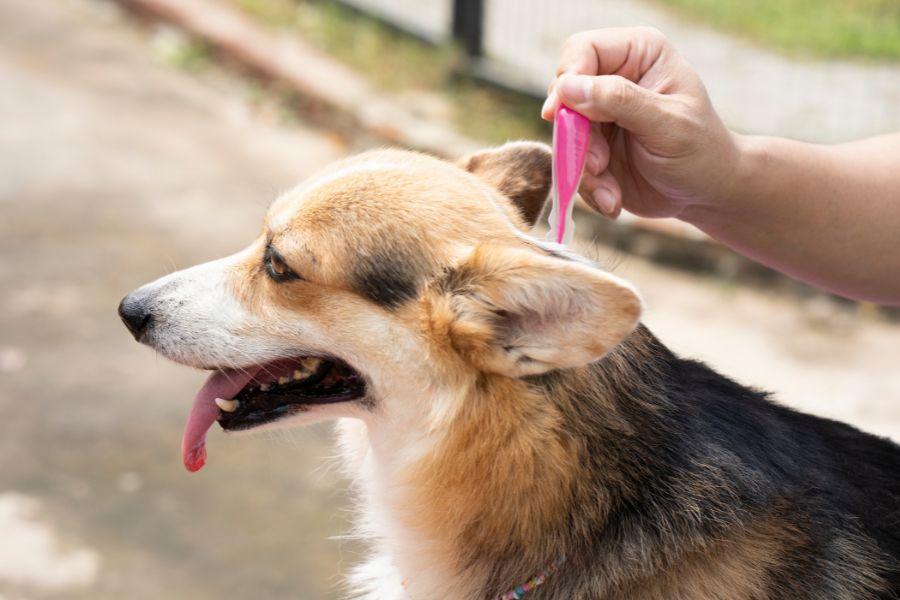
The spot-on antiparasitic treatment (or in pipettes) must be applied in an area of the body where the little darling cannot lick or scratch himself, such as the space between the shoulder blades.
What is an antiparasitic treatment
Antiparasitic treatments are chemical formulations that have the purpose of eliminating the parasites that may have attached themselves to our little four-legged darlings.
It is good to make a clarification, because with the term “antiparasitic treatments for dogs” we often also mean products that have only a repellent action, that is, they keep parasites away from dogs.
Well then, there are antiparasitic treatments that eliminate insects, others that carry out only a repellent function (and it would therefore be correct to call them insect repellents) and still others that carry out both of these actions.
Antiparasitic treatments for dogs: the types
On the market there are different options of antiparasitic treatments for dogs and the most common ones are available in collar, pipettes (spot-on) and tablets format.
Antiparasitic collars
The antiparasitic collar for the dog is a real collar that contains specific substances with gradual release through which it eliminates parasites and keeps them away, thanks to the repellent action. It is objectively simple to use, it is resistant to occasional contact with water and it has a variable duration, usually around three months, depending on the model.
Spot-on (pipettes)
Pipettes are antiparasitic treatments in liquid form of drops for external use, generally usable starting from the age of 7 weeks that are applied directly on the dog’s skin, in the area between the shoulder blades, because it is a safe area, in which the little darling cannot manage to lick or scratch himself.
The active ingredient is absorbed by the skin and re-emitted through the sebaceous glands, so that insects are eliminated. In addition, pipettes often ensure a global protection from the different types of parasites. In most cases, how many antiparasitic treatments for dogs carry out an insecticidal, acaricidal and repellent action.
Antiparasitic treatments in tablets or pills
Antiparasitic pills for dogs are administered orally and, like the other products, have the objective of eliminating insects already present and protecting the little darlings from their attacks.
In this case the action starts from the inside, that is, the active ingredient spreads in the blood and kills the parasites, often before they can lay the eggs. In addition, oral antiparasitic treatments guarantee protection from insects that varies depending on the product.
This is a convenient choice, suitable for dogs that do not tolerate other types of application and often easy to administer, because the antiparasitic treatment for dogs in pills is formulated with tastes and smells that are pleasing to dogs.
Antiparasitic sprays
The antiparasitic treatment for dogs spray is applied directly on the dog’s coat and is ideal for an extended or localized treatment.
The formulation can be different, some sprays eliminate parasites and protect the dog over time thanks to the repellent action, while others carry out only a repellent action.
The convenience of these antiparasitic treatments is in the spray format, which allows you to spray the product over the whole body and to reach, when necessary, specific areas.
And the injectable antiparasitic treatment? In this case we are talking about long-lasting antiparasitic treatments for dogs (up to 12 months) that are injected into the little furry one by the veterinarian.
This is an interesting choice if the little darlings do not love tablets, spray or pipettes, because with the injection long protection is guaranteed. In addition, with this type of device there is no need to remember to apply the product monthly, as happens with other types of antiparasitic treatment for dogs and cats.
Antiparasitic shampoos
On the market there are shampoos that carry out an insecticidal action and are used when needed if the dog has been attacked by insects. You can ask your trusted veterinarian for advice to understand which shampoo is most suitable, based on the type of insects present on the coat and also on the characteristics of the little furry one.
Natural antiparasitic treatments with only repellent action
The “classic” antiparasitic treatments for dogs are based on chemical substances that have a lethal effect on parasites while, at the same time, protecting the dog from their attacks.
Then there are products that are defined as natural antiparasitic treatments for dogs, but it is good to consider that these products do not eliminate insects already present, but rather carry out only the repellent function.
These are ideal products for those who look for more ecological alternatives, which contain substances that are naturally unwelcome to insects such as, for example, Geranium essential oil, Cajeput essential oil (White Tea Tree) and Neem vegetable oil.
Is Neem oil an antiparasitic treatment for dogs? And Tea Tree? The answer, therefore, is no: these oils and natural extracts do not carry out an insecticidal action, but only a repellent one.
They are still very useful and beneficial products, because they can be used to support in a natural way insect prophylaxis.
Is it possible to use only natural antiparasitic treatments for dogs (in the sense of repellents)? This is a personal option, for this reason it is good to ask your trusted veterinarian for advice to make a choice that protects the little furry one and always ensures his well-being.
Does repellent shampoo exist? Of course! This product contains natural extracts with a smell that is very unwelcome to insects – not to all of them but to some yes, such as for example fleas – which, during the bath, fall stunned, therefore it can be used successfully to support the prophylaxis indicated by the veterinarian.
Let’s remember that it is a different product from the insecticidal antiparasitic shampoo that is recommended by the veterinarian as a therapy when insects are already present on the coat.
Which antiparasitic treatment to choose if there are multiple dogs in the family?
The choice of the antiparasitic treatment can also be made based on how many little furry ones there are in the family.
If, for example, at home there are two or more dogs used to playing and nibbling each other, it can be useful to choose the antiparasitic collar rather than the pipettes, to avoid that one of the dogs accidentally comes into contact with the product.
It is also important to consider everyone’s habits. If, for example, the dogs are used to taking baths in the sea, at the lake or on the riverbank during the summer period, then the collar might not be the most suitable choice and it is preferable to opt for the antiparasitic treatment in pipettes or in tablets.
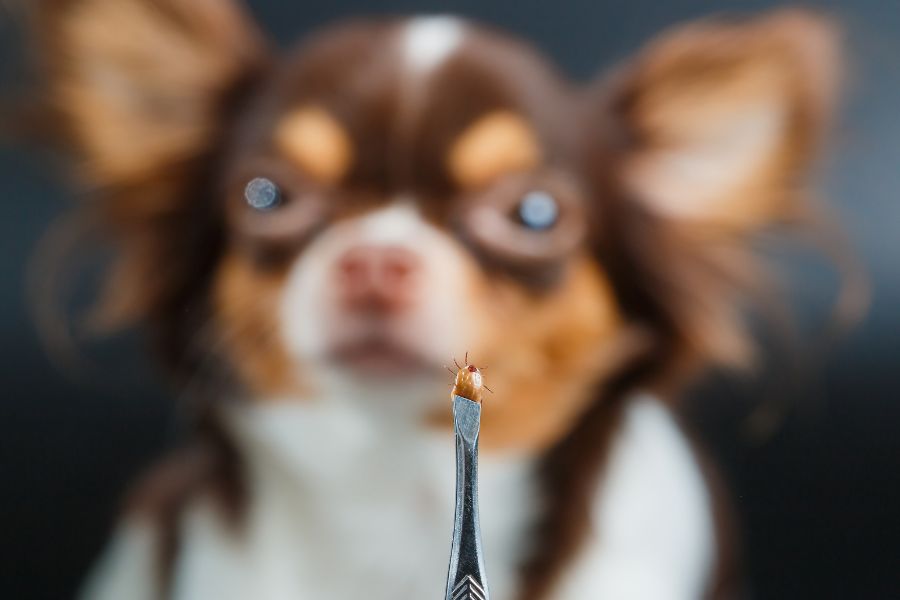
Here is the tick, the most bitter enemy of the health of our dogs!
Parasites that infest the dog
Aaargh, parasites! Nature is wonderful, but some insects are really dangerous for our little four-legged hearts (as well as for us humans!). Let’s see which are the most common dog parasites.
Fleas
Fleas are very small, jumpy insects that live on the dog’s coat and reproduce by sucking his blood. Yes, it’s a horror-movie image and, unfortunately, besides being annoying these parasites are also dangerous, because their bite can generate more extensive problems such as: anemia, weight loss, tiredness, flea allergic dermatitis.
Ticks
Ticks are at the top of the ranking of dog parasites. They are arachnids like spiders and scorpions, but above all they are “opportunistic” parasites, because they realize that nearby there is a little warm-blooded being and they attach to him, to live at his expense. These insects, in fact, bite and suck blood, settling in the host’s body even for weeks. We know how dangerous ticks are, but it is always good to repeat it: they create annoyance and pain for the dog as well as being a vehicle of risky diseases, such as Ehrlichiosis and Lyme Disease.
In addition, it is essential to be aware of the methods and techniques to correctly remove a tick from our dog to avoid infections.
Mosquitoes
Irritation, swelling, itching: the mosquito bite does not spare even our four-legged friends and these flying insects are quite dangerous, because they are a vehicle of diseases. Above all stand out Heartworm Disease and Subcutaneous Filariasis, pathologies that lead to cough, tiredness, loss of appetite and, if it is not recognized and promptly treated, to very serious heart and lung problems.
Phlebotomines or Sandflies
We can call them whatever we want, Phlebotomines or Sandflies, but the substance does not change: these parasitic insects of yellow or sand color are a threat because they transmit Leishmaniasis, one of the most dangerous diseases for our little four-legged hearts.
Mites
Mites are tiny voracious insects that can attack dogs and create intense itching. These parasites can live on the little furry one’s skin even if, often, they attack the ear and settle in the auricle creating a very annoying itching. This condition leads the dog to scratch continuously, which can generate abrasions, wounds and also self-trauma.
Fly larvae
We also include among dog parasites some types of flies that can lay eggs on the skin (often on the wounds) of the little furry ones. This can generate a pathology that is called Myiasis, that is, an attack by larvae that feed on the dogs’ skin and make the wounds deeper. Myiasis is a parasitic condition absolutely to be stopped before it migrates toward other areas of the dog’s body, especially toward the internal organs.
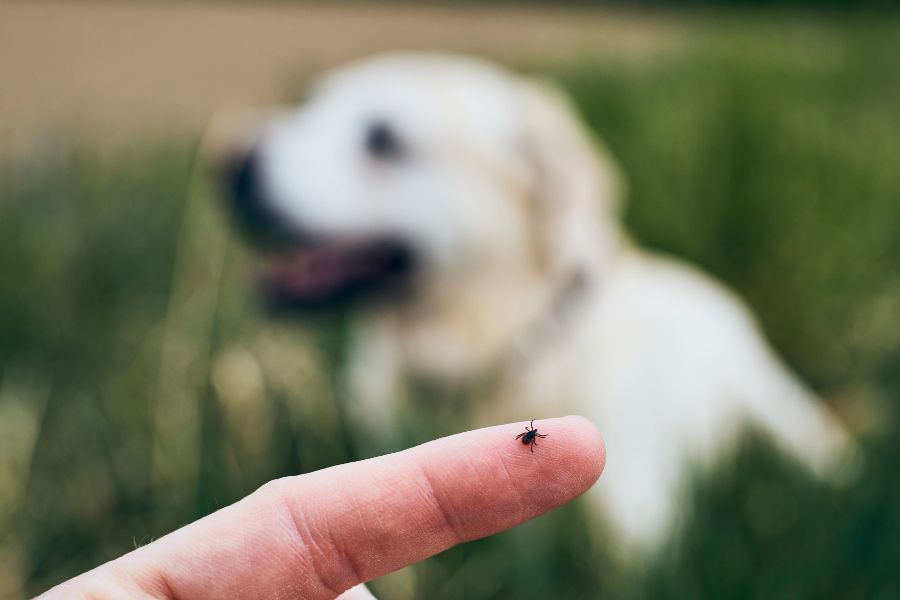
She is a flea and she was about to bite this little four-legged heart: to protect him we always use the most suitable antiparasitic treatment!
Antiparasitic treatment or repellent: what is the difference?
The difference between antiparasitic treatment and repellent lies mainly in the action but, as we wrote a few lines above, there are products on the market that carry out both functions.
Antiparasitic treatments for dogs are products with the function of eliminating insects that may already have attached to the little furry ones.
Pharmacological antiparasitic treatments for dogs contain substances called ectoparasiticides, that is, able to eliminate insects already present on the dog.
Among the best-known active ingredients we find synthetic Pyrethroids (such as Permethrin and Deltamethrin), which can also carry out a repellent action. Other compounds used include Fipronil, Flumethrin, Selamectin and many others. These are however products of a pharmacological nature, whose use must always be assessed with the trusted veterinary doctor.
Some of the ectoparasiticidal active ingredients, such as synthetic Pyrethroids, also exert a repellent action against insects.
In the case of intestinal parasites of the dog, instead, other active ingredients are needed and it is always good to ask your trusted veterinarian for advice on the products to use.
There are therefore natural repellent products that contain substances of vegetable origin whose smell is unwelcome to insects: Neem oil, Cajeput essential oil (White Tea Tree) and Geranium essential oil.
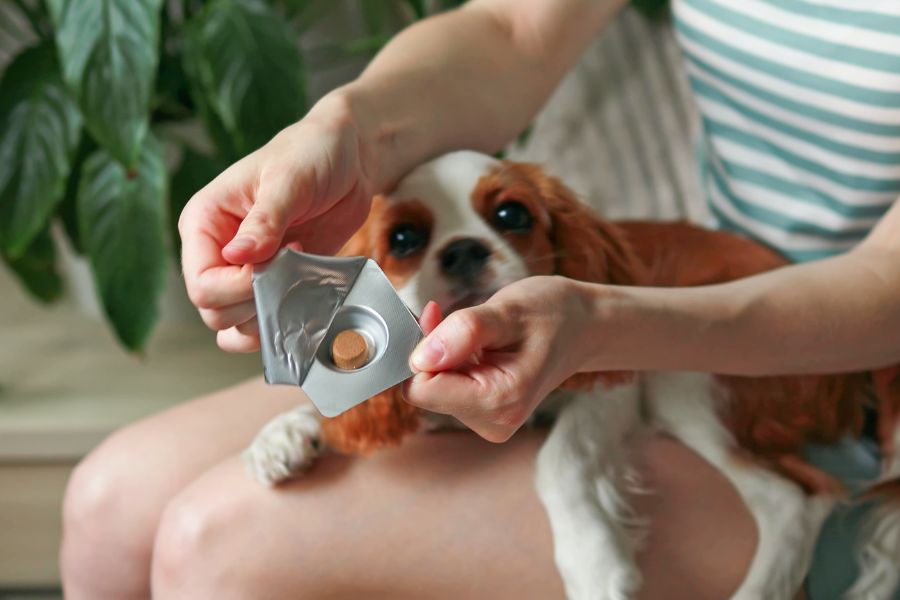
The antiparasitic treatment in tablets is the suitable solution for dogs that do not like collars, antiparasitic sprays or spot-on (pipettes).
When should antiparasitic treatments and repellents be used?
The main advice is to ask your trusted veterinarian for advice, because they can calibrate the appropriate antiparasitic treatment and repellent based on the dog’s breed, his weight, his clinical conditions and also his lifestyle habits.
Important: the antiparasitic treatment for dog puppies must be chosen with great care and by asking the veterinarian for advice, because the little ones are more delicate and therefore a specific product suitable for their age is needed.
That said, the antiparasitic treatment, intended as an insecticide, is a product that is used when there is the suspicion, or the certainty, that the little darling has been attacked by parasitic insects.
For example, as we have seen, the antiparasitic shampoo with insecticidal action is used when needed to eliminate the parasites present on the coat, according to the therapeutic advice of the veterinarian.
Repellent products are just as important and must be used to protect dogs from parasite attacks, because they carry out an important preventive activity.
The question is: when to use these products during the year?
In spring nature awakens, that’s why it is essential to think about using these products already starting from the end of February and throughout the summer season.
A lot depends on temperatures, because if the month of March is mild insects can already begin to attack and it is therefore useful to act with prevention. The same applies if in autumn there are still warm temperatures, therefore it is good to protect dogs also in this period.
When to put the antiparasitic treatment on after the bath?
The antiparasitic device must be put on at a distance from the bath, not when he has just been washed, at least a week (but even two) must pass from the bath.
It is not recommended to bathe the dog immediately before applying the spot-on antiparasitic pipette.
The reason is linked to the functioning of the product itself: spot-on pipettes must be applied on dry and intact skin, and when you bathe the dog, even using delicate shampoos, the skin can be temporarily more sensitive, and the natural lipid film that coats and protects the epidermis can be slightly altered.
This layer is fundamental for the correct diffusion of the active ingredient present in the pipette, which precisely uses the sebaceous secretion to distribute itself over the entire skin surface and act effectively.
In practice, if the skin is “too clean” (or still damp), the product risks:
- not adhering well
- not distributing correctly
- or, in the worst case, being less effective or not being effective at all
What to do after putting the antiparasitic treatment on the dog
The first rule is to scrupulously follow the instructions written on the package, because every antiparasitic product has its own rules. Normally, once the antiparasitic treatment has been applied it is good to:
- Wash your hands immediately
- Not wash the dog for 24-48 hours
- Avoid outdoor baths (in rivers, streams, sea…) for at least 5 days
- Carefully monitor the dog following the applications, to check that skin eruptions or other issues do not occur
- Avoid petting the dog for at least 48 hours
- Avoid being in contact and sleeping together with the dog for at least 48 hours from the application
And if the dog scratches after the application?
Is the dog agitated after the antiparasitic treatment? Does he scratch insistently? If the dog scratches and is very agitated after having applied the product it is good to contact your trusted veterinarian, because it could be an allergic reaction.
If instead he scratches a little and the agitation disappears after a few minutes, it could be a side effect of the application, which perhaps was not very appreciated by the little darling…

Can you pet the dog after the antiparasitic treatment? The answer is only in the 48 hours following the application.
Can I pet the dog after putting on the antiparasitic treatment?
This is a common question and, in the 48 hours following the application, the answer is: nowhere.
You need to “hold back” from waves of affection for his own good, because after having put the antiparasitic treatment on the dog it is good practice to wait at least 24-48 hours before petting him.
If the chosen antiparasitic treatment is in spot-on format, therefore the pipettes, you must absolutely avoid touching the treated area, both to not come into contact with the chemical substances and to allow the product to fully carry out its function.
In any case, it is important to scrupulously follow the instructions shown on the package and adhere to them. The question then becomes: how to pet a dog once this time has passed? The advice is to avoid the areas where the application was done (back of the neck, neck… ) and pet him in other areas of the body such as the head, the little paws, the lower back and the tummy.
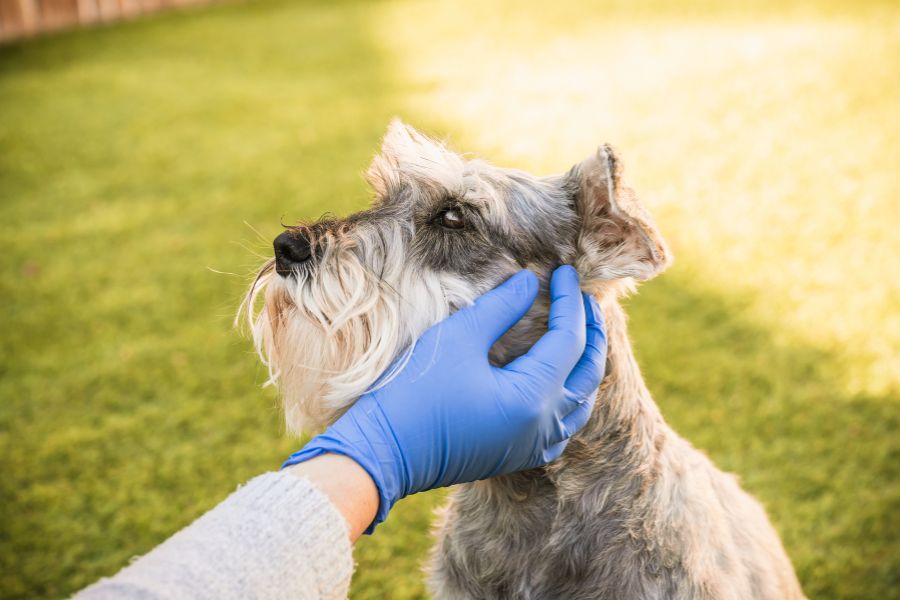
A woman applies the antiparasitic spray with gloves: an excellent choice, because you should never touch the product with bare hands!
What happens if I touch the antiparasitic treatment
What happens if the antiparasitic treatment is touched inadvertently? First of all, it is important to use protective gloves when applying it, so as to avoid direct contact with the product.
In the case of antiparasitic sprays for dogs it is also recommended to use protective glasses and always keep the recommended spraying distance.
In case of contact with the product it is good to rinse immediately with water, wash the hands and the affected areas and, if eruptions occur or the skin turns red, it is better to get in touch immediately with your trusted doctor.
And if it happens to the dog?
If the dog inadvertently licks the antiparasitic medicine it is good to contact your trusted veterinarian, who will know how to give the right indications based on the applied product.
It is not good to be alarmed nor absolutely induce the dog to vomit: better to call the veterinarian and ask how to behave, trusting their advice.
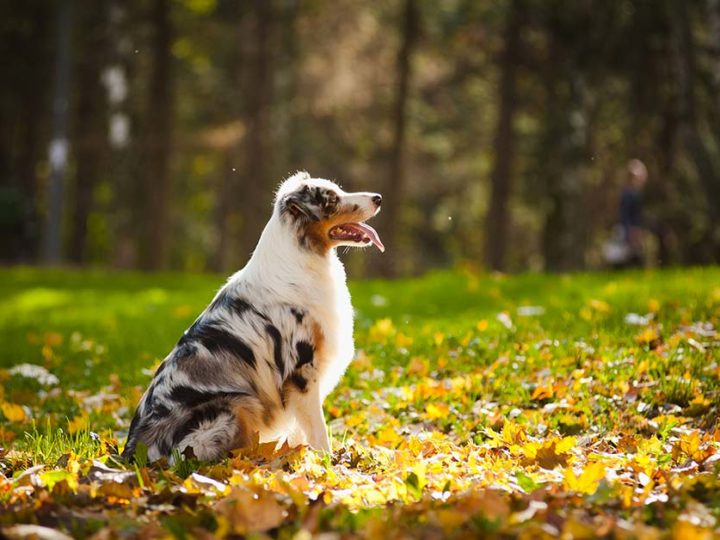
A dog free and protected from parasites enjoys nature.
How long does it take for the antiparasitic treatment to take effect
How long does it take for the antiparasitic treatment to take effect in the dog?
In this case too, a lot depends on the type of product chosen. Basically, antiparasitic treatments require a time from 24 to 48 hours to act with an insecticidal action, especially if aimed at insect larvae.
For this reason it is good to let the product run its course, avoiding touching the dog and trying that in the 48 hours following the application he is not subjected to “lively” activities, such as for example long walks or runs.
Today we have seen whether you can pet the dog after the antiparasitic treatment, what these products are and what actions they carry out, as well as the difference between antiparasitic treatments and insect repellents.
Now we invite you to also discover what antiparasitic treatments for cats are and how to choose the products to use to prevent and treat possible infestations!