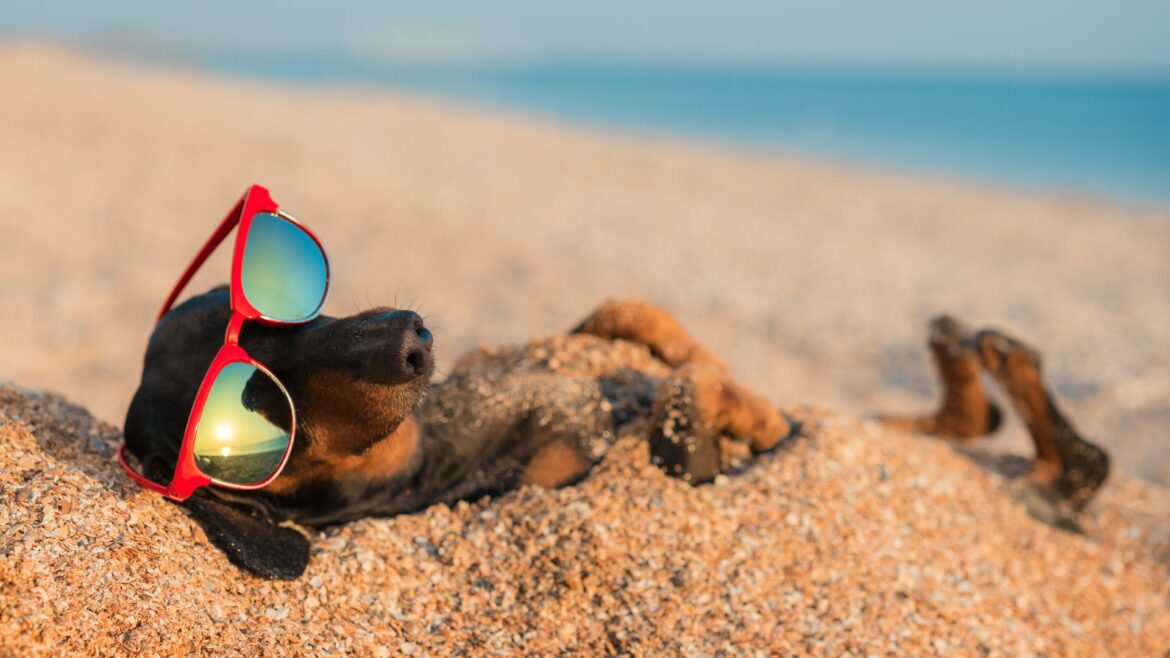
Summer, sun and relaxation: it’s not only us humans who enjoy the beautiful season, because our four-legged friends also love to bask under the warm rays of the sun! But do dogs get a tan? And, above all, can they get sunburned like can happen to us if we do not protect ourselves adequately?
In this article we answer these two very important questions and we see how to protect our little furry ones from the sun, with practical advice that helps us avoid sunburns, the very dangerous heat strokes and, in general, the discomforts that can arise when the sun shines high and strong in the sky.
So we can guarantee our little darlings a fun, relaxing and always safe summer.
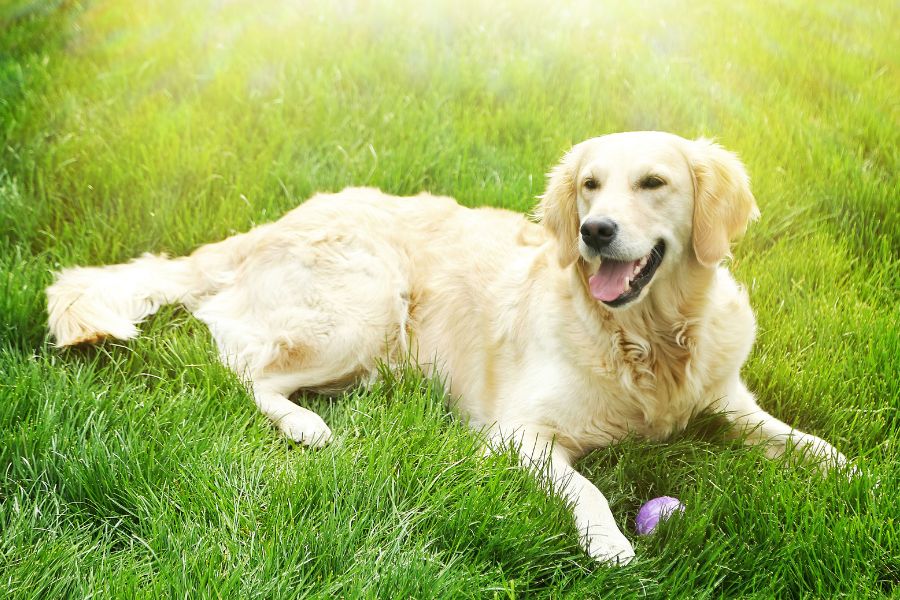
This adorable Labrador is enjoying the sun in the garden but attention! Dogs have delicate skin and they too can get sunburned.
Do dogs get a tan?
The answer is yes: dogs get a tan, but not like it happens to us humans.
Tanning, for people, is actually a natural defense mechanism. In the skin there are cells called melanocytes that, when they are exposed to sunlight, activate the production of melanin, the pigment responsible for the darker complexion of the skin and that takes care of protecting it from the damage caused by ultraviolet rays.
Dogs do not develop a real tan, above all because they have a coat that, among other things, has the purpose of protecting them from weather agents, sun included.
But, there is a but: the coat is not always an effective barrier against UV rays, the ultraviolet rays that cause damage to the skin. There are in fact areas of exposed skin, such as the ears, the nose and the tummy, that can get sunburned.
Naturally, hairless dogs are more vulnerable, as are breeds with short hair and light or pinkish skin, such as for example the Maltese, the Bull Terrier, the Shih Tzu and the Poodle when he has light hair.
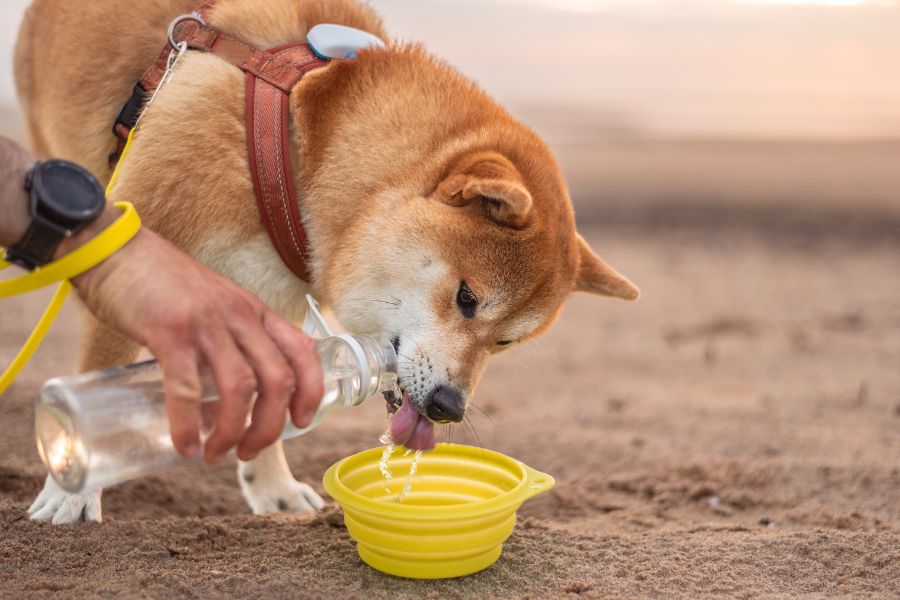
At the beach let’s always remember to bring fresh water for our little furry darling!
Protecting the dog from the sun: methods and tips
Now that we have seen that dogs get a tan, albeit in their own way because protected by the coat, let’s see some very important rules to protect them from the damage of the sun’s rays.
- Let’s prevent them from exposing themselves to the sun during the hottest hours: from 11:00 to 16:00 UV rays are more intense, therefore it is necessary to avoid exposing dogs during these hours and monitor that they do not do it on their own, perhaps at home if we have a terrace or a green space.
- Let’s always offer shaded areas: shade is more necessary than ever for dogs, especially on the hottest days, because in these areas the sun’s rays are weaker and the temperature is lower. If we are at the sea, in the mountains or at the lake, let’s always get a shelter such as an umbrella, a gazebo, or stop in wooded areas where the dog can take shelter.
- Let’s make sure that the little darling always has fresh and clean water available: the risk of dehydration is just around the corner, because the dog’s ability to dissipate heat through breathing and saliva is limited. It is therefore vital to have with us fresh (never cold!) and clean water not only to offer to our little darlings. Before going for a walk or into hot areas (but also after exposure to the sun), it is good to wet the tummy, little legs and little paws to refresh these areas and help the little furry one return to temperature.
- Let’s use sunscreen protection for dogs: this point is very important, because we might think that sunscreen protection for humans is also fine for dogs. No, it is not like that: little furry ones need an adequate product, formulated based on their coat and their skin. There are specific solutions, such as the sunscreen protection spray, designed for their skin, and it is important to use it in summer to protect the skin from sunburns!
- Let’s bring with us useful accessories to cool and protect dogs in summer: cooling bandanas, light anti-UV little shirts or cooling mats are very useful accessories, because they help lower the little furry ones’ body temperature. Let’s remember that the dog’s temperature is between 37.5° and 39°, but if the mercury column flies up even to (and over) 40°, imbalances can occur that generate the very dangerous heat stroke (which we will explore in a few lines). Cooling objects therefore help lower the dog’s body temperature and bring it back to normal.
- Let’s pay attention to the paw pads: paw pads are among the most delicate areas of the dog’s body, yet they are the ones that come into direct contact with surfaces that the sun may have overheated: from sand at the sea and at the lake, up to stones in the mountains and asphalt in the city. Let’s therefore pay attention to the surfaces where we walk; let’s touch them and feel if they are overheated and, if the answer is yes, let’s prevent the little furry one from walking on them.
For complete protection, also read our in-depth article on how to protect the dog’s paws. In addition, to rehydrate the little paws, there are products that carry out a targeted action, such as the protective paw pad balm which, besides hydrating and softening, creates a natural barrier between the paws and the surfaces.
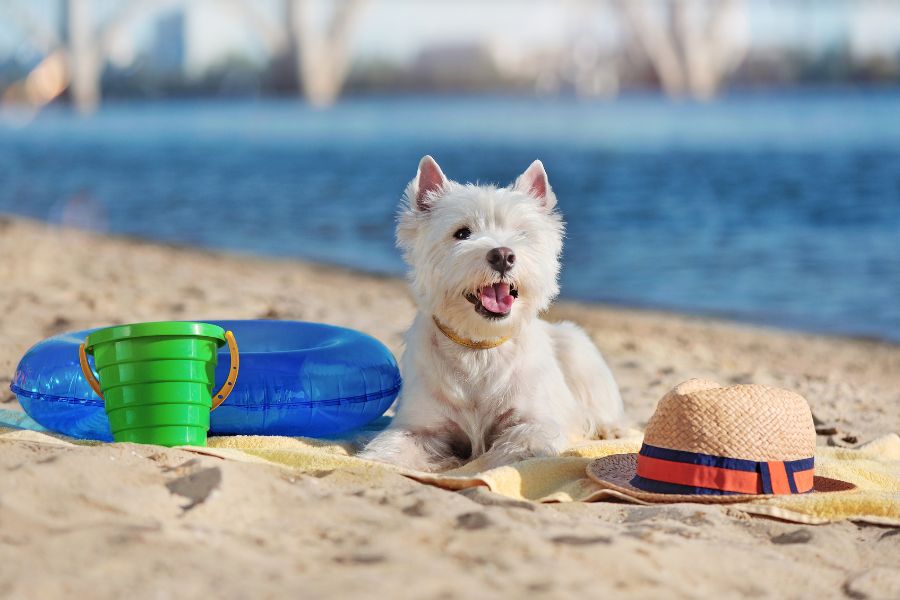
When the sun reflects on the sand and in the sea water it increases in intensity: let’s always remember it in our trips to the beach with the little furry ones!
Can dogs be taken to the beach?
Yes, dogs can be taken to the beach, but you have to pay attention to some aspects.
First of all, not all beaches allow access to little furry ones, so you have to get informed.
If we want to go to an italian private beach club, it is enough to ask the managers, while if we take dogs to a free beach we can look for information on the italian municipality’s website or, in any case, read the signs that are usually present on site.
If it is a free dog beach, no problem, but there can be beaches that provide rules, such as for example keeping dogs on a leash or that forbid bathing in the sea (often for safety reasons).
Let’s remember, therefore, that the beach is a magical place, but that in summer it can become scorching and put the health of our four-legged friend at risk for two main reasons:
- When the sun’s UV rays reflect on the sand and on the sea water (but also of the lake and rivers), they increase in power and this increases the risk of sunburns;
- Usually beaches are exposed places, so the temperature is high, and this can cause the dreaded heat stroke.
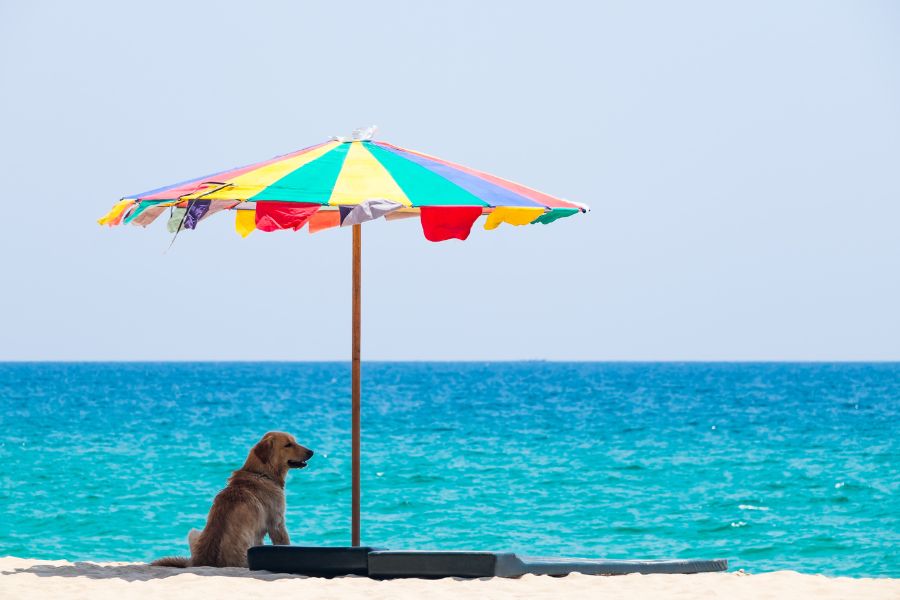
If we go to a free beach with the dog, let’s always bring the umbrella with us to create a shaded area where he can shelter from the sun’s rays.
Tips to keep the dog safe at the beach
The dog’s safety at the beach is a priority! Here is an essential list of actions to do to protect his health:
- Choose or create areas with constant shade: even if the sun is not strong, let’s remember that the dog has delicate skin and can get sunburned. Therefore, let’s always equip ourselves with umbrellas, towels, beach tents, to create shaded areas;
- Apply sunscreen spray for dogs: before and during exposure, just like we humans do when we expose ourselves to the sun;
- Always have fresh water within paw’s reach;
- Pay attention to hot sand, which can create irritations to the little paws and the dog’s nose or, in the worst case, burns. And after exposure, the walk or the day at the sea, it is good to apply specific products to hydrate these very delicate areas;
- Always rinse the dog with fresh water after bathing in the sea, to remove salt and sand, which have a dehydrating and irritating effect on the coat and skin of little furry ones.
Why do dogs lie in the sun even in summer?
Dogs love warmth and look for the sun. It is an ancestral behavior, probably inherited from wolves, which creates sensory stimuli of pleasure and well-being thanks to the release of oxytocin.
In addition, instinct leads dogs to sunbathe because in this way they produce vitamin D (just like happens to us humans), which is essential for the absorption of calcium and, therefore, for good bone health.
It can be said, therefore, that when little furry ones seek the sun they combine the useful with the pleasurable, but you have to pay attention because dogs do not always perceive when the heat is too intense.
That is why it is our task to monitor their behavior and act to protect them, especially in summer, when the sun is strong.
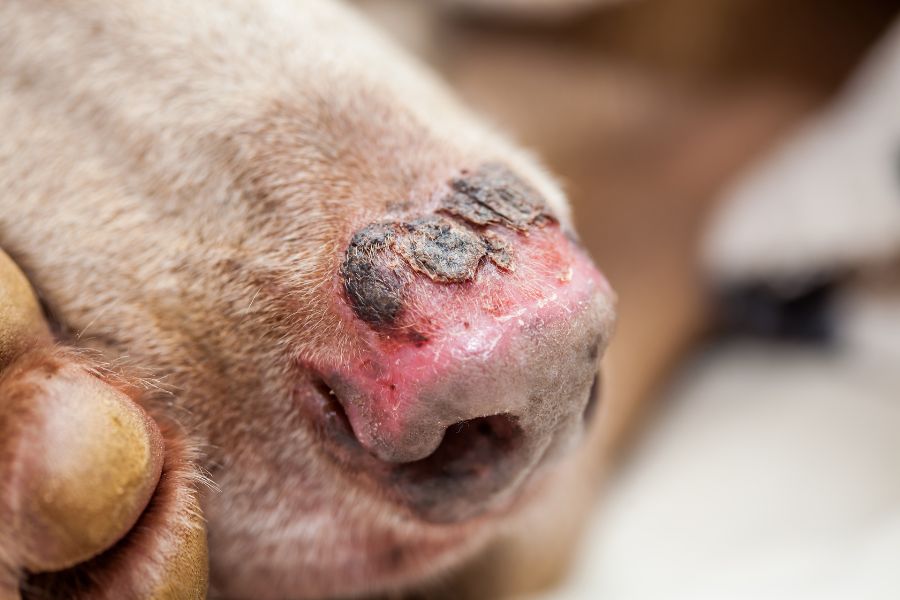
The dog can get sunburned if he stays under the sun for a long time.
Risks to avoid: sunburns and heat strokes
The risks to prevent are mainly two: sunburns and heat stroke.
Sunburns in dogs
Sunburns in dogs occur especially in areas of the body without hair or where the coat is sparse:
- Nose: attention to sunburn of the dog’s nose, because it is the most frequent. This happens because, since the dog’s nose is often black or dark, we may think it is immune from the effects of the sun. Instead, it is not at all like that. This area must be protected with a specific sunscreen product for dogs, because it is among the most delicate ones.
- Inner ears and belly: these are exposed and hairless areas, which can therefore get sunburned. Also in this case, let’s apply the sunscreen protection for dogs uniformly.
- Paws: sunburn of the dog’s paw pads is, unfortunately, very widespread. As seen, it is the part of the body that immediately comes into contact with surfaces that, in summer, can be scorching. So you have to pay super attention to this aspect, applying sunscreen protection for dogs on the upper part and a good paw pad balm on the lower one.
How to understand if the dog has gotten sunburned?
The skin, in this case, can appear reddened and very hot. In these cases let’s immediately stop the exposure and apply an after-sun product for dogs with a calming and soothing effect.
Heat stroke
Heat stroke in the dog is among the most serious risks to avoid. It is, in fact, a condition that, if not treated immediately, can lead to neurological damage. Among the consequences of heat stroke in the dog there is, unfortunately, also death and the symptoms to recognize promptly are:
- Panting
- Trembling and weakness
- Tongue that becomes very red or purplish
- Immediate diarrhea or vomiting
If we realize that the dog has these symptoms, let’s immediately move away from hot areas, seek shelter in the shade and contact the veterinarian right away.
Naturally, let’s always try to prevent and, therefore, to avoid a possible heat stroke in the dog by following the advice that we have written to you up to now, that is: let’s always offer him shade, fresh water and let’s avoid going to the beach during the hottest hours of the day, from 11:00 in the morning to 16:00 in the afternoon.
Today we have seen that protecting the dog from the sun is essential to guarantee his well-being during the warm season. With simple precautions, such as the use of specific sunscreens, the creation of shaded areas and the right hydration, we can prevent our four-legged friend from suffering sunburns or heat strokes. And if you also want to know how to cool the dog in summer, read our article!
Discover all the specific products for the protection of your dog from the sun on Yuup! and make your furry friend’s summer safe and fun!