Someone said that there are journeys you take with a single piece of luggage: the heart.
The journey we are telling you about today is one of these, because it touches one of the most beautiful and unfortunately most afflicted destinations in our country: the Terre Mutate.
The “Cammino delle Terre Mutate” is a route that winds through the Apennines and retraces the areas hit, in several places and over several years, by the earthquakes that wounded central Italy, such as the L’Aquila one in 2009 and the Amatrice one in 2016.
Because of the earthquakes, the territories, villages and communities of these lands have “changed” their face, and the trail, which runs from Fabriano to L’Aquila crossing as many as four regions, is a red thread that retraces these wounds with the aim of raising awareness and spreading help to the people who chose to stay and rebuild their life and community.
Alberto, Yuup!’s Project Manager, walked some of the many stages with his partner Giulia, discovering the immense humanity of those who live in those places and meeting the people who provided help in the most dramatic moments and beyond…
During the route, Alberto and Giulia also met the four-legged heroes of the Terre Mutate: the rescue dogs who served during the tragedies caused by the earthquakes and helped save many lives with their courage.
This experience reflects Yuup!’s desire to discover every aspect of the world of our four-legged friends in its fullness.
Our purpose has always been not only to take care of their hygiene and well-being, but also to explore the life of furry hearts, both in ordinary life and in very extreme situations.
This was an excellent opportunity to give a voice to the four-legged heroes who, every day, are alongside human heroes ready to risk their own life to save that of others.
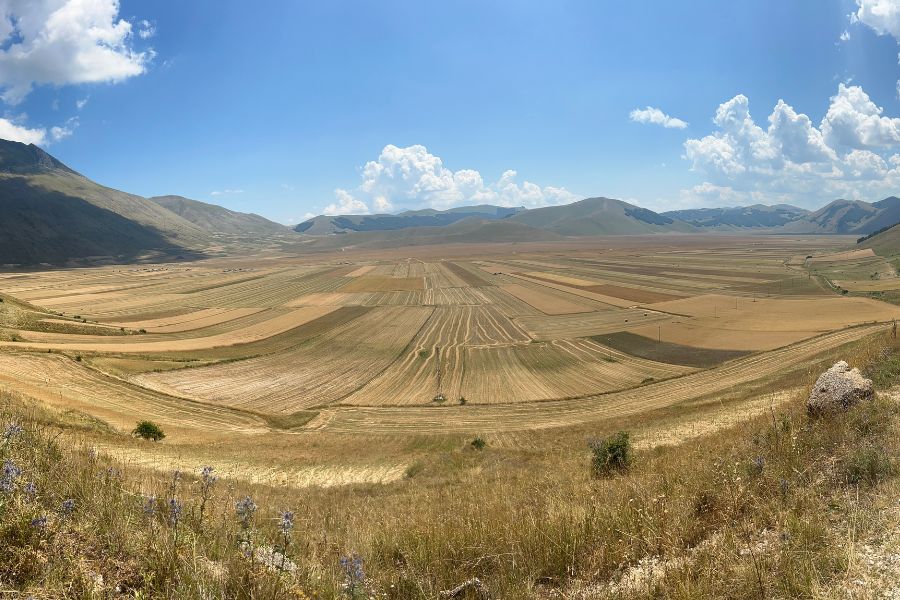
In this photo, all the natural wonder of the Terre Mutate: the Piani di Castelluccio
The journey through the Terre Mutate
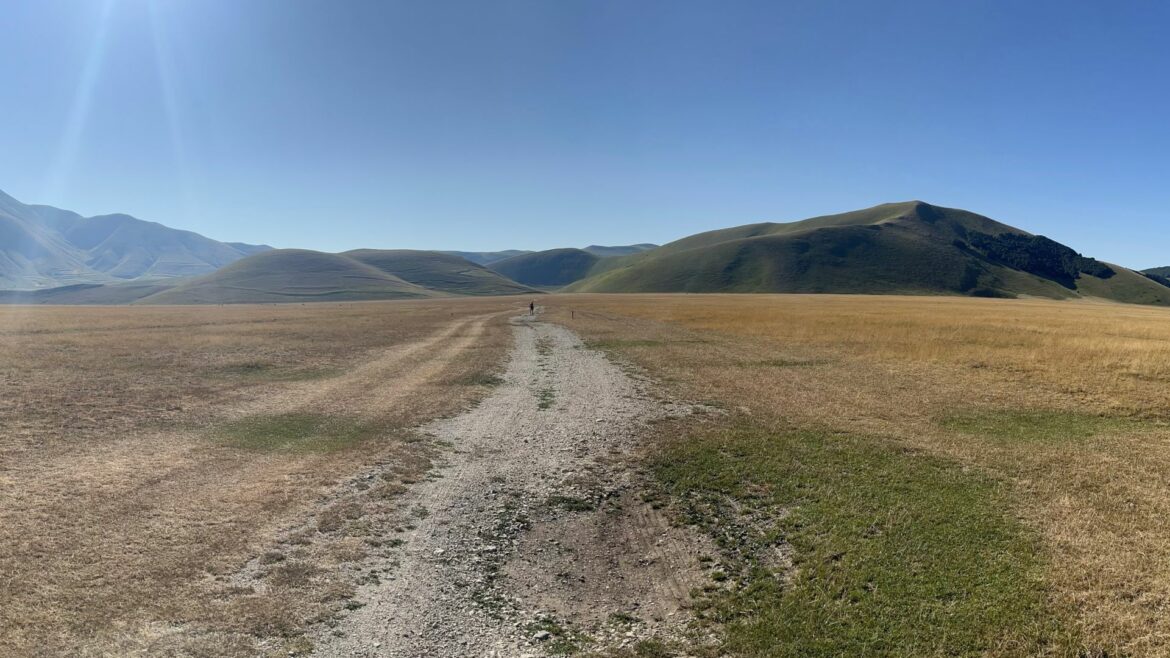
Alberto and Giulia’s journey began in Campi, then continued towards Castelluccio, one of the most beautiful natural areas in the region, where they were able to see up close the splendor of the landscapes, famous for the flowering of the Monte Vettore lentils.
It is a breathtaking natural spectacle, where the plateau becomes a palette of colors because between spring and summer wildflowers and legumes bloom, bringing colors to a land deeply marked by the scars of the earthquake.
The biggest scar is visible precisely on Monte Vettore, where a single large line almost 25 kilometers long was created, running along and splitting in two the entire western side of Monte Vettore and the Redentore.
In Castelluccio, one of the symbolic towns of the earthquake, the couple then met the canine units of CNSAS, with the operators and their dogs, who kindly agreed to answer a short interview that we had specifically prepared for them.
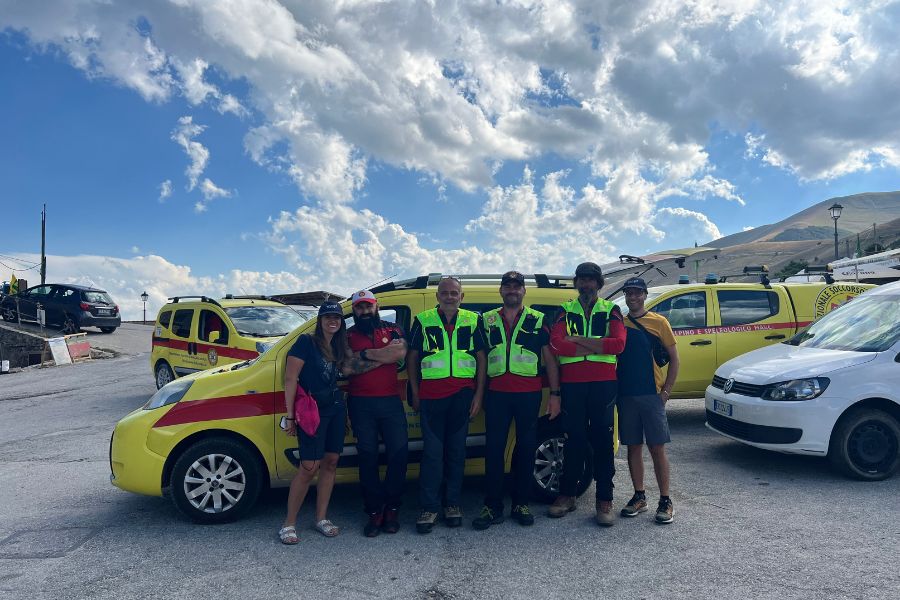
Group photo! Alberto and Giulia meet the CNSAS rescuers: from left to right Francesco, Stefano, Nico and Fabio; Fabio and Francesco served during the earthquakes that wounded the areas of Central Italy.
The meeting with the rescuers and the four-legged heroes
There is one fact that, first of all, shows how precisely the life of these people and their dogs is organized, from which one can understand how kind it was of them to meet us and answer our questions.
Rescue dogs, in fact, receive very precise training, so much so that it is not usual for them to get out of the rescue vehicle “just” to take a simple walk.
For them, in fact, getting out of the rescue vehicle means being ready for action; in fact, they were already oriented toward an emergency situation, in which to help save lives!
Thanks to the presence and skill of the operators, these sweet wonders “granted” themselves to the interview and we were able to explore together many things about their unique and special world.
Alberto and Giulia therefore met the operator Nico, with his dog Zico, a four-year-old German Shepherd working in a surface search canine unit, and Stefano accompanied by two four-legged hearts: Penny, nine years old, working as a scent-detection dog, and the small and very sweet Manuela, in training, three months old.
In the group of rescuers there was also Fabio, working in the national scent-detection team with his dog Peppo, about four years old, and Francesco, the station chief for the province of Macerata of the Mountain Rescue.
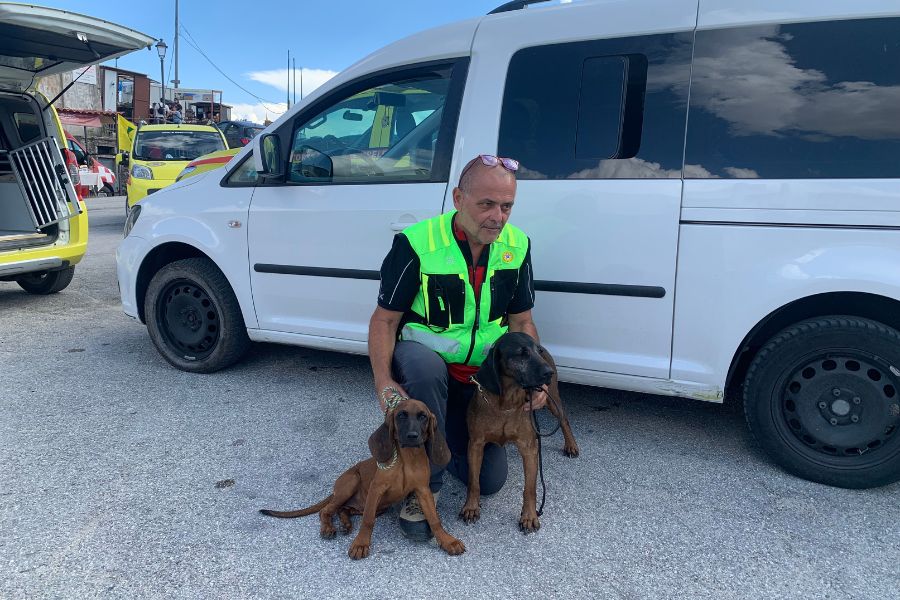
Stefano with the wonderful 9-year-old Penny and the sweetest Manuela, only 3 months old.
The choice of the rescue dog
Is there a preferred breed to become a rescue dog?
Stefano told us that it is important to choose a dog with the right character traits and that they carry out, where and when possible, an analysis of the parents, that is, of the bloodlines.
The idea is to start with a dog that has an extra bit of drive to achieve the best possible result, making the most of the gifts that Mother Nature has given to the little furry ones, above all the sense of smell. Then they proceed by conducting an evaluation of the physical characteristics and of the type of work that rescue dogs will have to do.
That is why, in the field of scent-detection dogs, for example, breeds such as hounds or similar are used more frequently, even if the team we met has among its ranks a splendid Hovawart, a big dog who became part of the team as a trial to evaluate the inclusion of other breeds.
For surface interventions, instead, shepherd dogs are used more, therefore German Shepherds or Belgian Malinois Shepherds.
In essence, it all starts when dogs are puppies, the moment when a character assessment is made; then the dogs are started on specific training, depending on the type of sector and the type of activity.
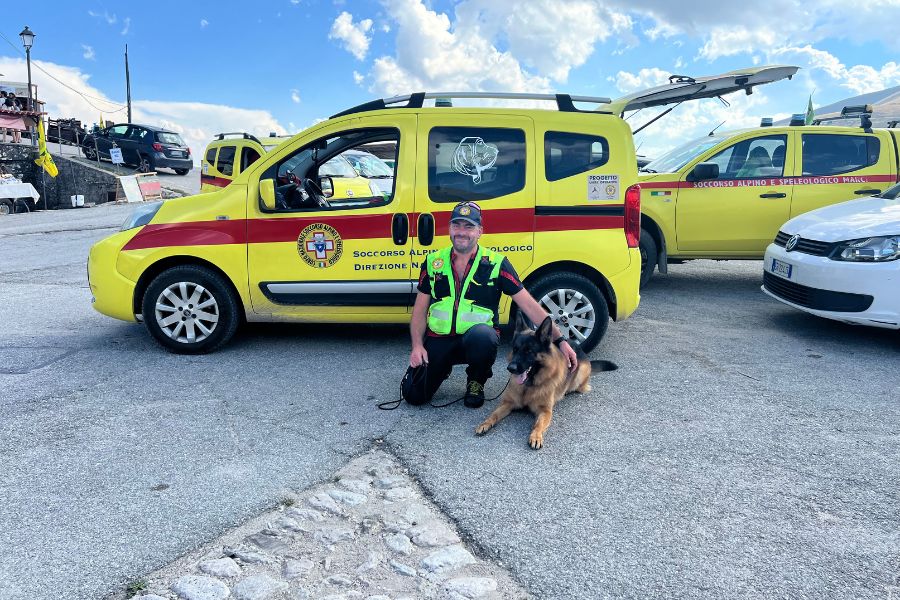
Operator Nico with his four-legged hero, Zico.
The importance of the dogs’ intervention
How great was the value of rescue dogs in post-earthquake interventions?
According to the operators, the dogs’ intervention was, in some moments, truly fundamental for the rescues that were carried out.
Just to try to imagine the magnitude of what happened, which is something unimaginable, here are some of Francesco’s words about a very moving event:
“Well, surely it was a very significant, touching and particular episode, starting from the scene we found ourselves in front of, so something that, let’s say, one cannot even reach with imagination.
They were very hectic hours among all the rescuers who were present on the earthquake site. Everything was made, obviously, difficult by the situation, by the dangers that were on site. An episode I remember in Amatrice: when we arrived early in the morning, it was 4:30 – 5:00, and there was still a smell of gas.
This was something that marked me. Just as when, unfortunately, at a certain time of day, we had even run out of spinal boards and we had to use the door and window frames of the houses. Exactly, in the morning we had to retrieve frames to unfortunately carry away people.”
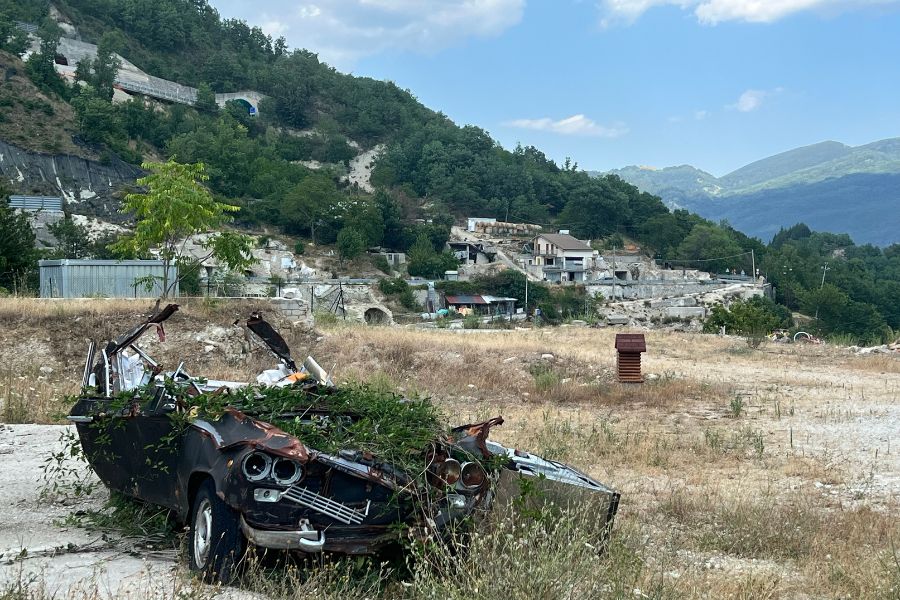
A symbolic image of the trauma left by the earthquake in Pescara del Tronto: a completely destroyed car, due to the high-magnitude event of 6.0 on the Richter scale.
This, instead, is Fabio’s thought regarding the importance of the dogs in those hours: “Specifically, in the confusion, the hecticness of the moment it is difficult to remember an exact episode.
I believe that the intervention of the dogs was, in some moments, truly fundamental for the rescues that were carried out that night. I took part as a technician, just like Francesco.”
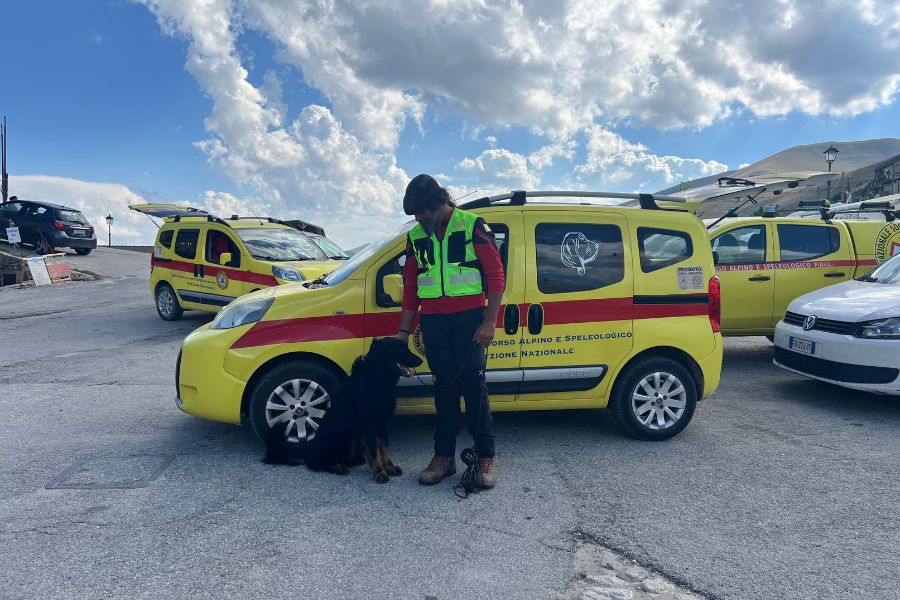
And here is Fabio with his four-legged heart, Peppo.
The bond between the dog and the handler
What kind of bond is created between handler and rescue dog?
Nico told us that everyday life is certainly what increases the dogs’ performance. What the operators, and we, call work, for them is everyday life, and it is play and fun.
You can see it from when the operators put on their uniforms, when they take their backpacks from home: the little furry ones start wagging their tails, happy to want to go with them.
So, in this sense, the fundamental characteristic of a search dog, whether surface or scent-detection, is being inclined to play and to interact with humans.
So much so that Nico told us that he and his dog live practically in symbiosis. The first thought when he gets up in the morning goes to him, just like the one before falling asleep.
So everyday life is their strength: we are talking about a life in common, about a particular relationship that is established with one’s own dog, about a very strong bond where you have to adapt to each other.
The dog adapts to the handler and the handler to the dog; both adapt to each other’s character, sometimes smoothing out the edges.
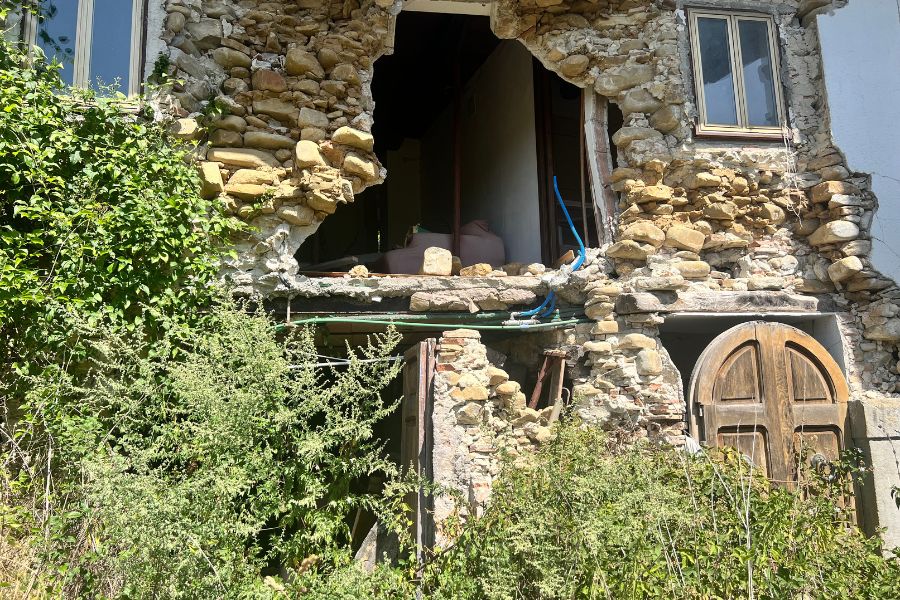
The wounds left by the earthquake are still visible in these beautiful lands.
The rescue dog in his operational work and beyond
How do four-legged heroes spend their days when they are not on duty?
The answer is that, in everyday life, dogs are kept in training, through both physical and operational training.
For the operators this is also a passion, which joins with the passion of being rescuers.
The two words that describe these moments are complicity and rapport: dog and handler basically become a single figure, because the handler is a playmate who becomes their brother.
Jokingly, the rescuers told us that today the little furry ones are their “business partners” and that when the dogs retire, they will become their big brothers.
And precisely with regard to the right rest for the four-legged heroes, they try to make this moment come as late as possible.
In this regard, Fabio told us that his 14-year-old dog, after retirement, became the owner of the house and of his armchair. He tries to improve his life, to keep him as serene as possible, sharing everyday life in the exciting memory of all the years they worked together.
His life companion gave him a lot and now – Fabio confided to us – it is right that he gives a lot to his four-legged heart.
In conclusion, exactly as happens in everyday life with our best friends, with our loved ones, with our dear ones, the feelings you experience in having a four-legged hero by your side are many and indescribable.
They are huge emotions, because dogs are true companions, both in everyday life and in the risk of life itself.
To experience a part of it together, we collected the interview in this video:
Now, if we think about the role of these people, the mind runs to their commitment, to the choice to live a life that, from one moment to the next, may require taking enormous risks to save the lives of others.
This is much more than a mission: it means being ready to drop everything and report for duty in any situation, even while having dinner with one’s family, aware that the risk is great, but the importance of saving human lives is truly unimaginable.
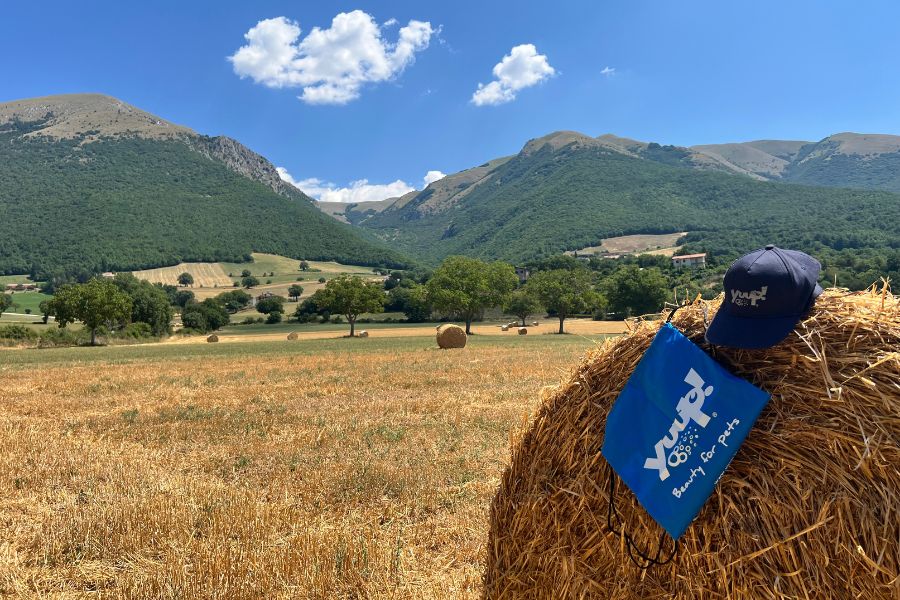
Alongside those who chose to stay and rebuild their life and community.
Let’s support hope
The nights of the earthquakes are still etched in the people who live in the quake-stricken places and, even though several years have passed, these people still do not have a home they can count on, because they often live in containers.
In these places, however, the light of mutual help shines, and you can breathe an atmosphere of solidarity not only among people but also in the natural environment itself, where it is easy to encounter animals such as horses in conditions of absolute freedom who support one another lovingly.
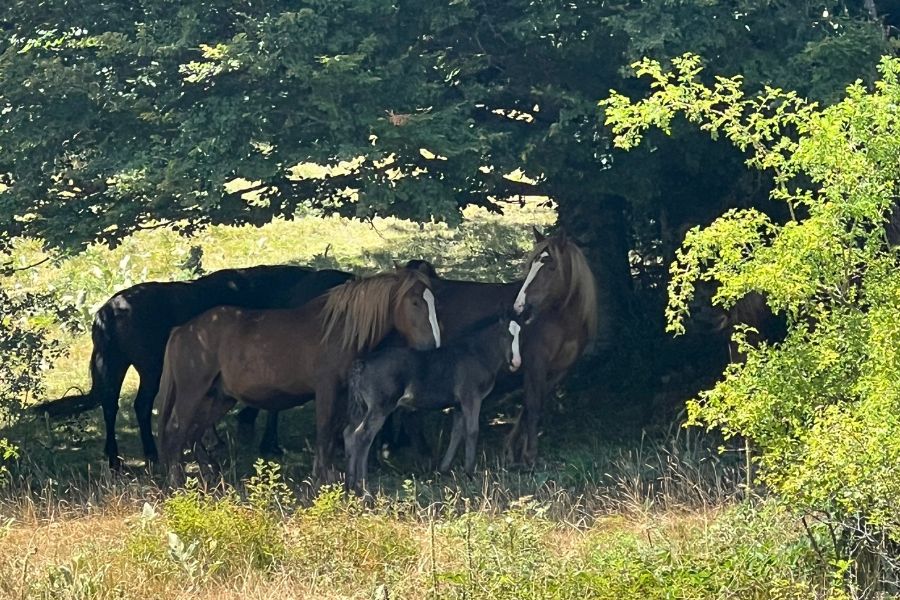
A family of horses in the shade of a tree near the glacial-origin ponds called “Pantani di Accumoli”, on the border between the Sibillini and the Laga.
The people who live in these areas share everything: they cook together, stay together and, above all, they have chosen to commit themselves to rebuilding what was there, to save the territory from depopulation.
This is the mission of the Back to Campi project, which focuses on shaping various social activities for the rebirth of the community in Campi di Norcia.
Roberto Sbriccoli and his fellow citizens chose to stay in Campi di Norcia, so the Pro Loco became their home, a refuge for over seventy displaced people.
For months they slept on camp beds, sharing spaces, meals and hopes. And when the SAE (Emergency housing solutions), the post-earthquake little houses arrived, Roberto was the last to leave the facility.
He is a promoter of the “Cammino nelle Terre Mutate” and he never stopped in the rebirth project: with “Back to Campi” a campsite, a swimming pool and a sports facility were created, with the aim of attracting tourists and visitors who can help bring life back to these places.
For this reason, we decided to donate to the association the entire proceeds from the purchase of one of our best sellers, the Pink Velvet serum, for a duration of 30 days, so that this dream can become a reality with the unmistakable flavor of tenacity, strength and hope.
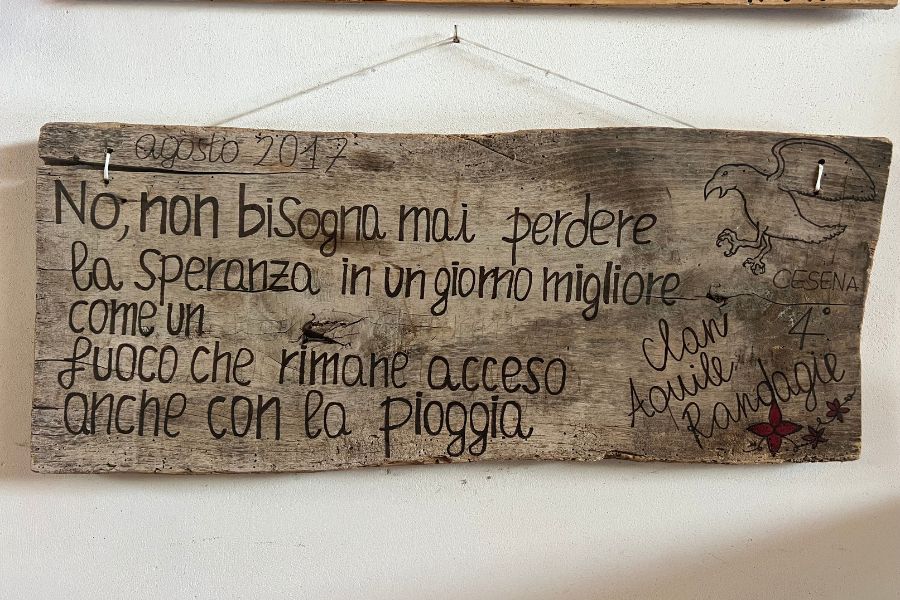
The hope-filled phrase engraved on the wood, which is hanging inside the Pro Loco of Campi.