- What dog stripping is: meaning and definition
- Does stripping hurt the dog?
- Stripping vs shaving: what is the difference?
- What trimming is and how it differs from stripping
- Which dogs are stripped? Breeds suitable for stripping
- When dog stripping is done and how often to repeat it
- How to do dog stripping: tools and procedure
- Rely on Yuup! products to care for your dog’s rough coat
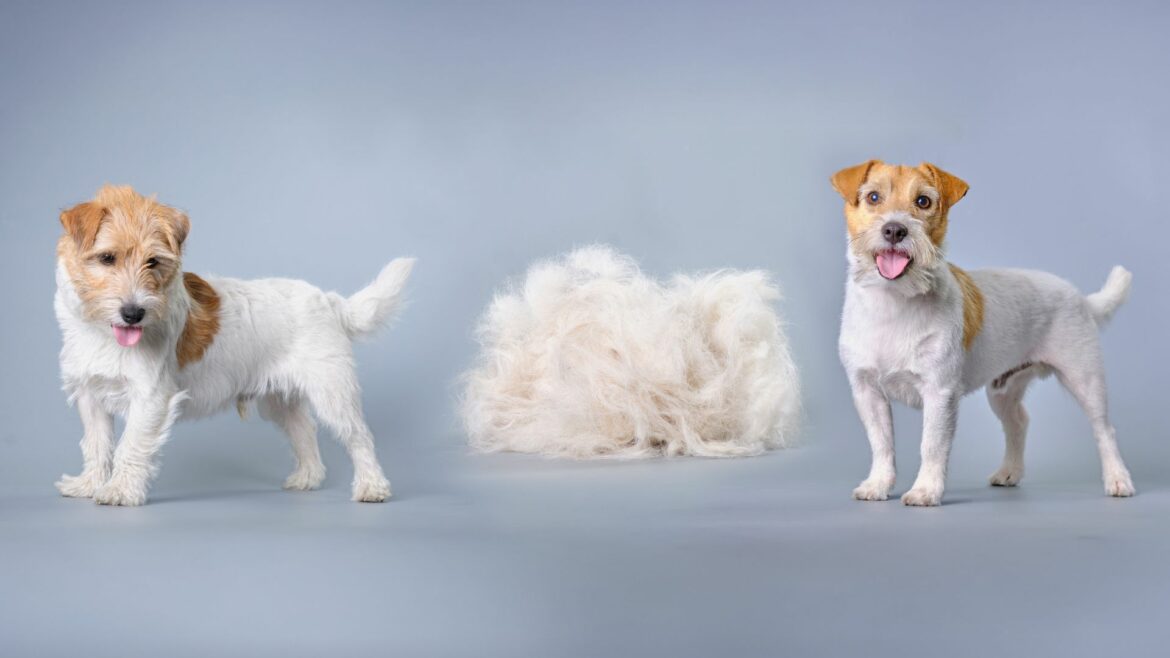
It is one of the most important grooming techniques, because it allows some dog breeds to be freed from the fur that has finished his life cycle and that, otherwise, would not fall out on its own.
We are talking about dog stripping, a treatment that goes far beyond aesthetics, and that can be considered 100% a solution that brings well-being and health to our four-legged friends.
The problem is that, often, stripping is little known and understood, at least in the technique and in the benefits it reserves.
In this article, therefore, we see what dog stripping is in detail, which breeds need it, who can do it and which products help make the treatment simpler and more pleasant for our little heart.
What dog stripping is: meaning and definition
Stripping is a specific grooming technique for hard-haired, rough and bristly-haired dogs, which consists of the manual removal of dead fur directly from the root (the fur that has completed his life cycle and does not fall out naturally).
Stripping serves to maintain the health of the dog’s coat and skin, because this process helps free the skin, allows new fur to grow and prevents skin problems such as irritations and dermatitis.
It is fundamental that this treatment be carried out by an expert groomer, since incorrect execution can lead to discomfort for the dog.
“To strip” in English means, in fact, “to undress” and, in our case, this word has precisely the meaning of “to remove,” “to take away” and also “to free.”
Why ever is it necessary to do it? The point is that in some dog breeds the dead fur does not fall out on its own and so we need to give it a “paw” to do so.
Which are these breeds? Basically, all those with rough, hard and bristly fur.
Of course, if we lived in a natural environment and could let the dog run around every day among meadows and woods, he would probably manage to do the stripping himself, perhaps by rubbing against bushes, rolling on the ground or using any hold that would allow him to remove that fur that has become “extra.”
But we all agree that, in modern life, this is not possible, which is why dog stripping is so important, because it removes dead fur and allows new fur to grow.
But not only that… what would happen if the dog’s dead fur stayed there where it is and no one removed it?
The answer is strong skin discomfort, as the dead fur would form a sort of barrier that would no longer allow the skin to breathe and this could create dermatitis, irritations, redness and also bad odor.
In addition, if the little heart were not subjected to stripping, he could end up with a coat that loses his stiffness and becomes increasingly “woolly,” thickened and messy, which certainly would not be good for his health.
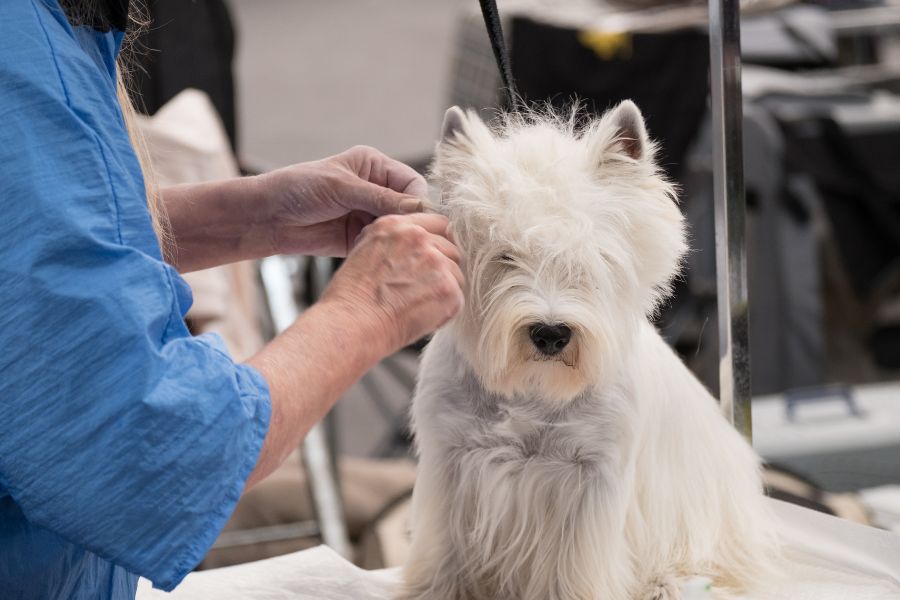
Dog stripping is not painful, as long as it is performed with skill and experience.
Does stripping hurt the dog?
To understand whether stripping hurts the dog, let us briefly go back to the concept of the three life phases of the fur:
- Anagen: the fur grows;
- Catagen: growth stops and the fur prepares to fall out;
- Telogen: the fur falls out to make room for the new one.
This last phase, the one of fur loss, is the protagonist of dog stripping, because in little hearts with hard, rough and bristly coats, the fur is “designed” to be removed when it reaches this phase.
Too bad that nowadays dogs cannot do it on their own, but at a certain point in the cycle, the bond of the fur with the follicle naturally loosens.
This is why dog stripping must be performed precisely at this moment, when the fur is mature and about to fall out, because this way it will not be painful at all, quite the opposite!
The expert groomer knows this very well, observes the dog, understands whether it is the correct moment for stripping and proceeds to do it with a technique that, carried out by a professional like him, makes it painless.
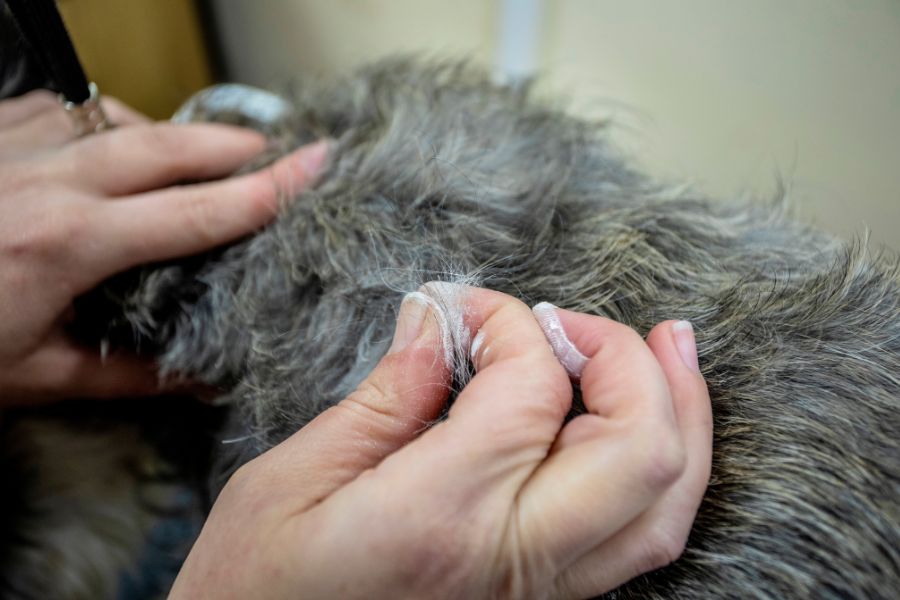
Dog stripping must be performed by professional groomers.
Stripping vs shaving: what is the difference?
It is legitimate to ask what the difference between stripping and shaving is; here is a table that explains it:
| Technique | Action on the fur | Effect on the coat of rough, hard and bristly-haired dogs |
|---|---|---|
| Stripping | Removal of the fur from the root | Eliminates dead fur, maintains the natural hardness and pigment of the coat. The length of the coat is maintained |
| Shaving | Shaving of the fur without removing the root | Over time, it alters the structure of the coat, making it less defined and less protective. Moreover, in this case the coat is shortened and the lengths are not maintained |
In summary, we can say that stripping is like a shedding that simply needs to be helped to be removed.
What trimming is and how it differs from stripping
And what is the difference between stripping and trimming? “To trim” means “to neaten” and trimming is precisely the finishing technique that is usually done after stripping to define the shape of the coat and make it more harmonious.
Basically, with stripping the dead fur is removed, while with trimming the coat is finished and shaped based on desired aesthetic, the client’s requests or breed standards in case the dog participates in shows.
Stripping and trimming: when are they used together?
The typical sequence is this:
- First, stripping is performed;
- Then one proceeds with a gentle bath with soothing shampoo;
- The furry one is dried carefully;
- Finally, trimming is carried out.
Trimming can also be useful between one stripping session and another, so the coat always remains well cared for and tidy.
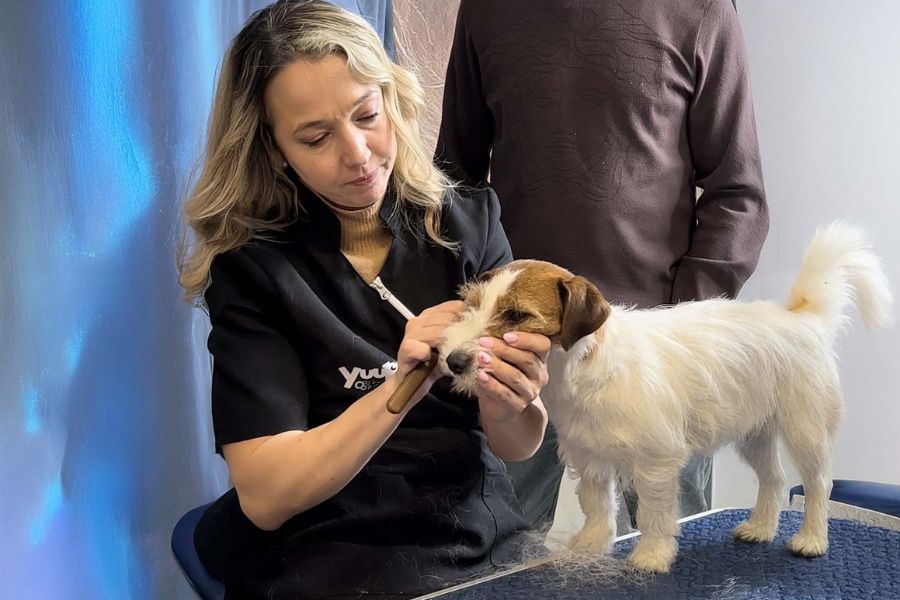
Sonia Merati, Yuup! Master Groomer, performs stripping, showing it to the class of our collaborators visiting from China and Taiwan.
Which dogs are stripped? Breeds suitable for stripping
Dog stripping is needed for breeds with hard, rough and bristly fur, which have specific characteristics as we have described in this article dedicated to the differences in fur among dogs.
Here are the breeds that need to undergo stripping:
- Fox Terrier
- Scottish Terrier
- Jack Russell Terrier
- West Highland White Terrier
- Border Terrier
- Schnauzer
- Wire-haired Dachshund
- English Cocker Spaniel
- Italian Spinone
Naturally, mixed breeds that have this type of coat also need to be “stripped.”
Why some breeds need stripping
Fur in general is a natural protection for dogs but, in particular, hard, rough and bristly fur (called wire-haired) performs a super protective function, like a natural “shield.”
If we think about it, in fact, the dog breeds that have this type of fur are mainly hunting dogs or come from lands such as England, which have a wild nature, rich in brambles and brushwood.
The same applies to rain and humidity, because rough, bristly and hard fur is very waterproof, a characteristic that protects dogs from a rainy, humid climate, in short, not very “friendly.”
These peculiarities must be maintained and stripping does exactly this: it removes the dead fur so that new fur can grow with the very same characteristics.
Conversely, shaving would be an unsuitable and also dangerous choice, because it would change the characteristics of the coat, which from strong and robust would become woolly, soft, not suited to the physiology of dogs that have this type of fur.
When dog stripping is done and how often to repeat it
As seen, stripping must be done at a very specific moment in the life cycle of the dog’s fur, namely when it is detaching from the hair bulb.
The professional groomer knows this moment, which is why it is always fundamental to rely on expert hands.
As for the frequency of stripping, it depends from dog to dog, but basically it is performed every 60-90 days.
What happens if I do not strip my dog?
The concept is that if stripping is not done, the fur that has completed his life cycle remains there and “suffocates” the skin, preventing the birth of the new one. The consequences can be:
- Discomfort and/or skin problems such as irritations, dermatitis… because the skin becomes more sensitive and “suffocates” because of excess fur;
- Weakening of the follicle, with consequent abnormal growth if some stripping sessions were skipped and they were resumed after some time;
- Possible loss of pigmentation, meaning the color of the coat can fade and lose tone;
- Possible loss of the natural waterproofness of the fur and, therefore, less protection.
How to do dog stripping: tools and procedure
Many people wonder how dog stripping is done and whether this treatment can be done at home.
Let us repeat that stripping is a procedure that requires knowledge and manual skill, so DIY is strongly discouraged, unless one has specific knowledge in this matter.
Here are the stripping steps:
- The space is prepared with the tools and products needed;
- A light de-shedding of the undercoat is carried out if necessary;
- The specific stripping powder is applied, which makes the operation easier thanks to its gripping power and prevents redness;
- With confidence and a clean gesture, the fur is “pulled out” where needed with the hands or with the appropriate stripping knives.
During stripping, one must not be afraid, or pull gently; instead, a clean “pull” is needed so as not to cause pain to the furry one.
Pauses must still be taken between one pull and another to make the procedure more comfortable for the dog.
At the end of the stripping, one proceeds with a soothing-action bath and then the little heart can be carefully dried and, if necessary, one can proceed with the finishing, the trimming we talked about a few lines above.
Stripping tools: knife, powder and finger cots
To achieve optimal results in stripping, suitable tools and products are needed, and they must be of excellent quality.
Everything can start with products for the care of the dog’s rough and hard coat, which allow it to be cleansed without ever altering the natural texture of the fur.
The rough coat is very beautiful, not soft at all, but hides a great pitfall, because if it is not correctly hydrated it can end up breaking.
It is therefore important to choose a shampoo that does not alter the natural texture of the coat and that, at the same time, has a good hydrating effect, such as Yuup! Crisp Coats Shampoo, available both in the Home version for care at home and in the more concentrated Yuup! Professional Crisp Coat Volumizing Shampoo proposal.
Another ideal product for the bath of little hearts with rough, hard and bristly fur is the Texturizing Shampoo from the Professional line, which nourishes and hydrates, giving immediate body and volume to the coat, while always respecting the natural texture of the fur.
And now the stripping tools. The right ones truly make the difference and make the procedure simpler and safer:
- The stripping knife: it is the essential tool to perform detailed and safe work. In the Yuup! proposal, the stripping knife is made with a high-quality wooden handle, which offers a comfortable and secure grip, while the blade is in English steel, sharp and durable;
- Body stripping powder: stripping powder is a product that helps the procedure because it has a gripping power that makes the pull easier. Yuup! Stripping Powder is also composed of a special blend of cosmetic and pharmaceutical powders with Zinc Oxide with a soothing action and strictly without chalk;
- Ear stripping powder: in some breeds of furry ones, fur renewal in the ears is more complex to manage and Yuup! Ear Stripping Powder makes the operation easier thanks to the blend of cosmetic and pharmaceutical powders with gripping power. Moreover, this blend contains antibacterial and refreshing ingredients such as Cajeput essential oil, White Tea Tree, as well as Zinc Oxide, which performs a soothing and refreshing action;
- Latex finger cots for stripping: finger cots are used to pull the fur in a more practical and safe way, without damaging the skin, and Yuup! ones are made of high-quality latex, resistant and elastic. Moreover, they are in size small to adapt easily to the hands and guarantee greater precision during stripping;
And to have all the products needed to perform correct and beneficial stripping for the dog, the complete easy stripping line is available.
Rely on Yuup! products to care for your dog’s rough coat
The dog’s rough, hard and bristly coat needs attention and cuddles, but with the right products and the appropriate grooming techniques it can always remain strong, healthy and robust, as its nature requires.
On our blog you can find many articles dedicated to how to take care of the dog’s fur, such as how to treat the undercoat, how to manage shedding and much more!
Do you want to discover how stripping is done on a Scottish Terrier? Watch the video by Yuup! Master Groomer specialized in hard-haired breeds Stefano Vesigna.