- Dog age: how it is calculated
- Dog age table for small, medium and large sizes
- How many years can a dog live?
- Why do dogs live less than humans?
- How to make a dog live longer?
- How to estimate a dog’s age without knowing the date of birth
- How to understand if a dog is aging?
- Dog age: frequently asked questions
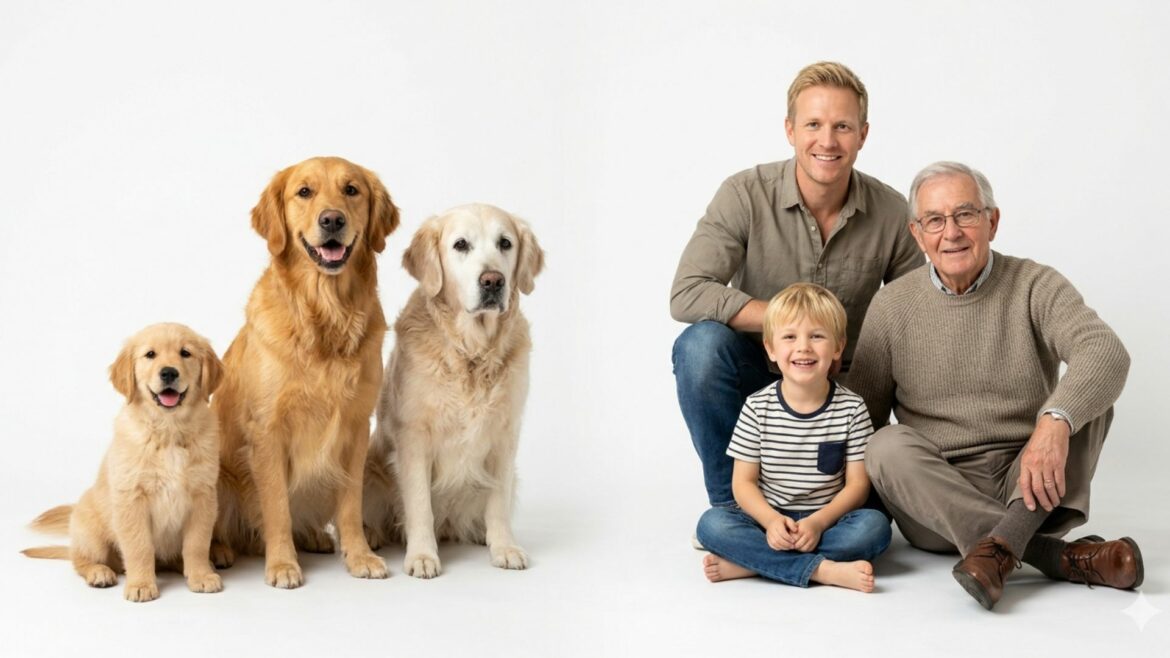
Young rebels or wise little grandparents? Many people wonder what a dog’s age is in human years and this question is quite profound, because choices of care and attitude toward him can depend on the answer.
The point is that everything and more has been written and said on the topic of dogs’ age, including some imaginative urban legends.
The most famous one says that to establish a dog’s age in human years, his actual years must be multiplied by seven.
True or false? False, this simplification is now outdated, because science has understood that dogs’ “human” age varies based on breed and size.
Another legend says that when the first little white hairs appear, the dog is irreparably elderly or that, on the contrary, if his little teeth are strong and very white, he is still in the flower of youth.
True or false? The reality is that there is no absolute rule, because much depends on what lifestyle the little heart has had and also on his genetic heritage.
The good news is that today there are practical tools such as tables and specific physical signs that help estimate dogs’ age, even without knowing the furry one’s date of birth.
Therefore today we see how dog years are counted and, above all, how to make sure they can have a long life, but above all a healthy and super happy one.
Dog age: how it is calculated
Let us begin by debunking the “7-year” myth, according to which dogs’ human age corresponds to their years multiplied by seven. Is the furry one 5 years old? Then it is as if he were 35 human years old. And if he is 13? Oh, what an oldie! In this case, the dog would be as many as 91!
Scientific research has made it possible to define dogs’ “human” age more correctly and, according to the Kennel Club, which refers to the American Veterinary Medical Association, dogs’ age can be divided in this way:
- The first year of the dog’s life corresponds to about 15 human years;
- The second year of the furry one’s life “is worth” 9 human years, therefore when the little heart is 2 years old it is as if he were about 15+9 = 24;
- From the third year onward, each dog year is worth 5 human years. If the dog, for example, is 7 years old, the calculation is 15 (first year) + 9 (second year) + (5 actual years of the dog x 5) = 49 human years, estimated and approximate.
What is the decisive variable for defining a dog’s human age? The answer is size, because large-sized dogs tend to have a shorter life expectancy than smaller dogs.
It is good, therefore, to always make a distinction between the various dog sizes and for this reason it is useful to rely on a table that summarizes dogs’ age converted into human years.
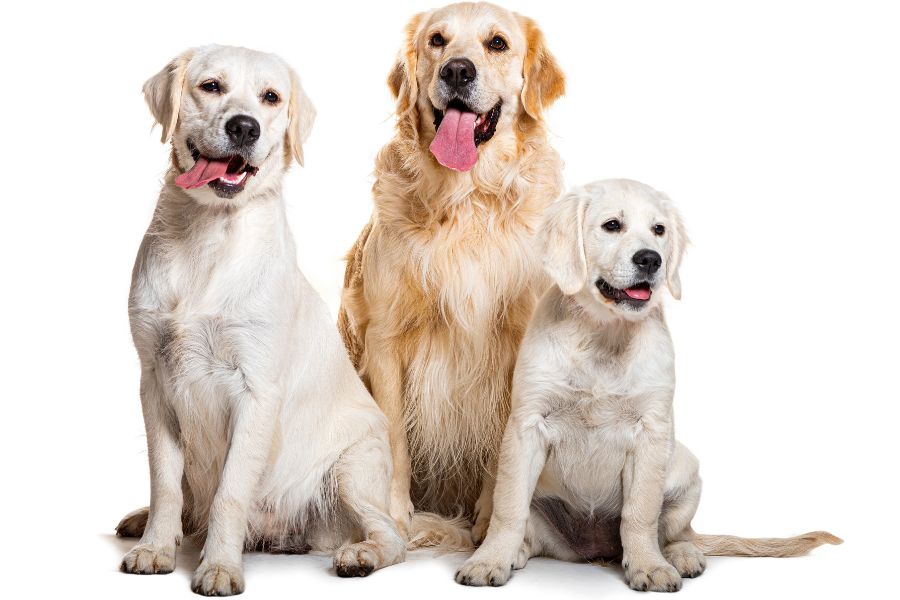
Three dogs of different ages: puppy, adult and senior.
Dog age table for small, medium and large sizes
To understand the estimated human age of dogs, here is a table based on information from the Kennel Club. From here, it can be noted how much size affects the dog’s age.
| Dog’s age | Small size (up to 9.1 kg) | Medium size (9.5-22.7 kg) | Large size (23.1-45.4 kg) | Giant size (over 45.4 kg) |
|---|---|---|---|---|
| 1 year | 15 | 15 | 15 | 12 |
| 2 years | 24 | 24 | 24 | 22 |
| 3 years | 28 | 28 | 28 | 31 |
| 4 years | 32 | 32 | 32 | 38 |
| 5 years | 36 | 36 | 36 | 45 |
| 6 years | 40 | 42 | 45 | 49 |
| 7 years | 44 | 47 | 50 | 56 |
| 8 years | 48 | 51 | 55 | 64 |
| 9 years | 52 | 56 | 61 | 71 |
| 10 years | 56 | 60 | 66 | 79 |
| 11 years | 60 | 65 | 72 | 86 |
| 12 years | 64 | 69 | 77 | 93 |
| 13 years | 68 | 74 | 82 | 100 |
| 14 years | 72 | 78 | 88 | 107 |
| 15 years | 76 | 83 | 93 | 114 |
| 16 years | 80 | 87 | 99 | 121 |
How many years can a dog live?
This is the question of questions, because if on the one hand we know that human life expectancy is longer than that of dogs, on the other hand we would like it not to be so and for our four-legged heart to always stay with us.
As we explored in this article dedicated to how long a dog can live, there are factors that are truly crucial for his longevity, but research tells us that the average life expectancy of a dog is 12.5 years and, in detail:
- The average longevity of a small-sized dog is 12.7 years;
- In medium sizes it is 12.5 years;
- In large sizes it drops to 11.9 years;
- Giant-sized dogs have a shorter life expectancy, ranging from 8 to 12 years.
There is a lot of research on this topic and, based on research published in Nature, among the breeds that live the longest there are often small-sized dogs, which in studies generally turn out to be longer-lived than medium, large or giant ones.
The West Highland White Terrier is cited with a median longevity between b, much higher than that of more imposing breeds such as, for example, the Rottweiler, which has an estimated life expectancy between 8.0 and 8.4 years.
The research also highlights that mixed-breed dogs have a so-called “survival advantage” compared to purebred dogs, which translates into a life expectancy that is about 1.2-1.3 years longer.
As always happens, there is the exception that proves the rule which, in this case, is called Bluey, an Australian Cattle Dog who lived as long as 29 years and 5 months, a paranormal age that still amazes everyone today!
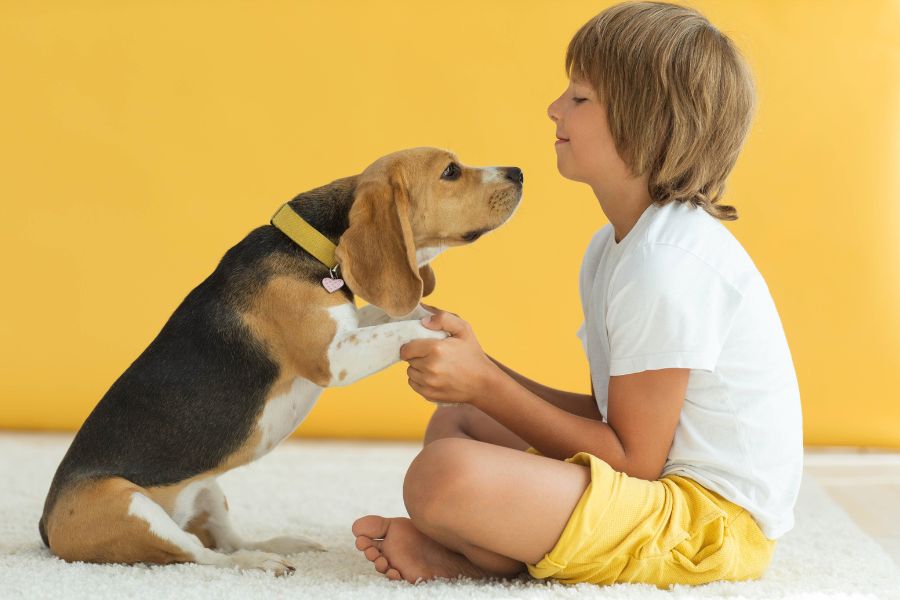
Dogs have an organism that follows faster rhythms, which is why they mature and age earlier.
Why do dogs live less than humans?
Dogs live less than humans because their organism follows faster rhythms. After all, furry ones grow faster, reach maturity earlier and, above all, age earlier.
It is as if everything were accelerated and this can also be understood from vital parameters, because in the adult dog the normal heart rate varies on average from 70 to 120 beats per minute, while a human at rest has a range of beats per minute that goes from 60 to 100.
It goes without saying that this, unfortunately, makes the heart work more and, consequently, the whole organism, with a more rapid deterioration over the years.
The same applies to breathing: the average respiratory rate of the dog varies from 18 to 34 breaths per minute, while in humans it is between 12 and 20.
Basically, in dogs metabolism and physiology are more accelerated and this leads to faster aging compared to people. This is particularly visible in large-sized dogs, who mature and age more quickly, which creates more “biological wear” and therefore increases the risk of contracting age-related diseases.
How to make a dog live longer?
So far we have been giving numbers 😌, but now that we are aware of how long a dog can live on average, it is good to consider that, beyond statistics, longevity depends a great deal on quality of life, daily well-being and shared time.
Not to mention love, which is vital for the dog, also because it leads to making all those choices that help him stay strong and healthy over time.
As happens for us humans, there are in fact aspects that favor longevity and the most relevant are:
- Regular movement: daily walks and trips out of town (even better if in nature) are fundamental for the dog’s health and well-being. They are so from a physical point of view, because they allow muscles, bones and joints to be kept healthy and weight under control, and they are also so from an emotional point of view, because they allow the little heart to have a “social life” and discover new places where he can enjoy the world. Naturally, the dog’s size, physicality and age must always be considered in order to best calibrate the routes, so that the furry one always finds himself walking on roads or paths that are suitable, without ever getting fatigued or tired.
- Care of the fur and skin: the dog’s health passes through the care of the fur and skin, and frequent brushing is a true moment of control and well-being. Brushing keeps the fur clean, tidy and facilitates renewal, therefore it deserves to be done with professional products and supported by tools such as the PinkMassage which, thanks to the soft silicone bristles, gently stimulates the skin, promoting microcirculation. PinkMassage acts by pressure on the skin, promoting blood circulation, reducing fluid stagnation, naturally exfoliating and helping the removal of dead cells. Moreover, it contributes to improving the distribution of shampoo during the bath, a key moment for the dog’s well-being, which deserves to be done with the right frequency and with products suited to his physicality, such as those available in the Yuup! catalog.
- Quality nutrition: nutrition is the key to a healthy and balanced lifestyle. It is important to organize meals so that the dog can count on a safe and protected place, where he can enjoy his food in peace. The food must be balanced and complete, to give the little heart all the nutrients he needs, as explored in this article dedicated to dog nutrition. And then there is the hydration chapter, fundamental for his survival, therefore the dog must always have a bowl of fresh and clean water available.
How to estimate a dog’s age without knowing the date of birth
How do you calculate dogs’ age if we do not know the year of birth? If we have adopted an adult little heart, especially if coming from a shelter, there are physical signs that help understand the dog’s age and the veterinarian can provide an estimate by observing teeth, eyes, coat and, in general, the tone of the body.
Let us always remember that the age of a dog whose exact date of birth is not known cannot be established with precision, because the attention and care received can make a dog seem younger and, conversely, their absence can speed up the aging process.
The teeth
The little teeth are a rather useful clue for estimating the dog’s age. Baby teeth appear from 3 to 5 weeks of life, permanent ones come out between 4-5 months, completing by 7 months, therefore if the dog is a puppy this is a key indicator for estimating his age.
If, instead, the dog is adult, the age evaluation can be based on wear and on the possible presence of problems such as tartar, inflamed gums and/or tooth loss. Broadly speaking, the teeth of a young dog tend to be white and healthy, while over the years they become more opaque, especially if dental hygiene has been neglected.
Attention, however, because an adult dog who has received good dental care and has followed a correct and balanced diet can have beautiful white and strong little teeth, which is why the analysis of the dog’s age does not stop only at the teeth but continues with the fur and the eyes.
The fur and the eyes
Fur and eyes offer precious clues for evaluating the age of a dog whose date of birth is not known.
In young dogs the fur is often soft and uniform, as we explained in this article dedicated to the care and growth of the dog’s fur, while in adult and senior little hearts it begins to become rougher and duller.
Moreover, with age, little white hairs can appear around the eyes and mouth, but also in this case caution is needed, because some dog breeds such as the Golden Retriever develop greying of the fur earlier.
And again, watch out for the optical effect, because dark coats tend to oxidize and the optical contrast between white hairs and dark hairs can make one think of the dog’s aging, when perhaps it is just some sporadic little tuft.
As for the eyes, one of the most typical signs of dogs’ age is the slight blue-grey veil that appears in elderly dogs. It is called nuclear sclerosis, it is linked to cataracts and can appear, especially in senior little hearts, after seven years of age. Basically, if the eyes are more veiled and opaque, perhaps with reflections tending toward blue, the dog may be adult or senior.
Important: to estimate the dog’s age, a multifactorial approach is needed, one that considers many characteristics of the body. A reliable estimate works by addition or by exclusion and can be made by the veterinarian, which is why it is always better to ask him for the dog’s estimated age, so as to adjust as much as possible regarding nutrition and other aspects of the furry one’s life and care.

To estimate dogs’ age, it is useful to look at the fur, the eyes and other characteristics of the body.
How to understand if a dog is aging?
There are physical and behavioral signs that help understand that the dog is entering his “senior” phase. They are also useful if we do not know our dog’s age:
- White hairs appear on the little muzzle, around the eyes and around the paws (but pay attention to breeds that develop greying of the fur early, such as Golden Retrievers);
- We notice that the dog is less lively, sleeps much more and takes naps more frequently;
- Movements are slower, there is muscle stiffness and the dog has difficulty getting up or climbing stairs, especially upon waking or after a little nap;
- The eyes are more opaque or with a slight veil;
- The dog eats less or changes food preferences;
- The little heart feels colder or is more sensitive to climate changes;
- The dog hears less and we notice this also because he responds more slowly to usual calls;
- The dog has a less toned posture and we notice that muscle mass is reducing (also due to less physical movement);
- The four-legged love is more tired during and after walks or trips out of town;
- We notice changes in behavior, such as irritability, cases of disorientation and also more requests for physical contact and reassurance.
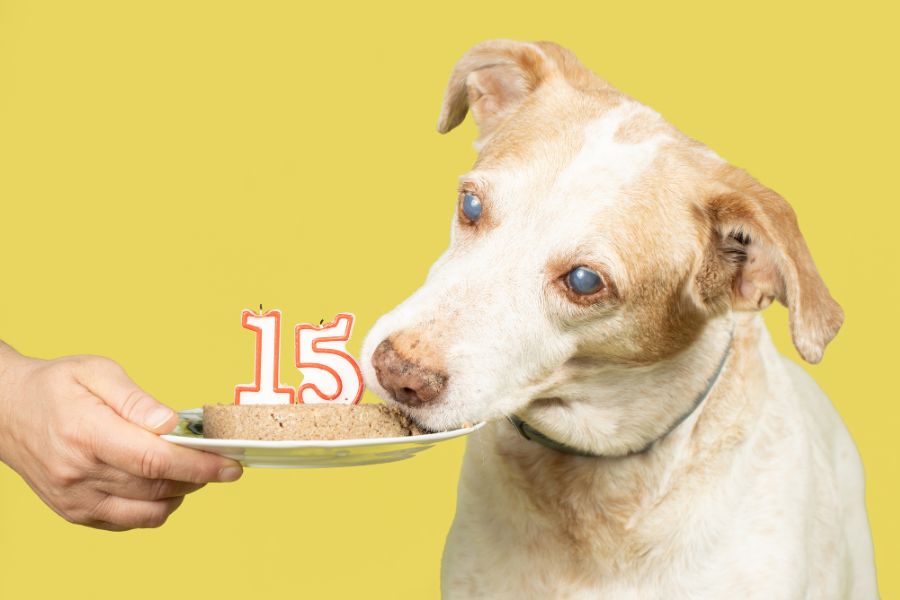
Dogs’ age can be measured with tables, but what matters is the love, care and affection we give them.
Dog age: frequently asked questions
-
How old is a 7-year-old dog?
It depends on the size: a small-sized 7-year-old dog is equivalent to about 44 human years, a medium-sized dog to about 47 human years and a large-sized dog to about 50 human years, while a giant-sized dog to about 56 human years.
-
How old is a 12-year-old dog in human years?
It depends on the size: a small-sized 12-year-old dog is equivalent to about 64 human years, a medium-sized dog to about 69 human years and a large-sized dog to about 77 human years, while a giant-sized dog to about 93 human years.
-
How old is a 14-year-old dog in human years?
It depends on the size: a small-sized dog at 14 years is equivalent to about 72 human years, a medium-sized dog to about 78 human years and a large-sized dog to about 88 human years, while a giant-sized dog to about 107 human years.
-
How old is a 15-year-old dog in human years?
It depends on the size: a small-sized dog at 15 years is equivalent to about 76 human years, a medium-sized dog to about 83 human years and a large-sized dog to about 93 human years, while a giant-sized dog to about 114 human years.
-
Is a dog old at 8 years?
It depends on the size: a small-sized dog at 8 years is equivalent to about 48 human years, a medium-sized dog to about 51 human years and a large-sized dog to about 55 human years, while a giant-sized dog to about 64 human years.
-
Which dog lives the longest?
The longest-living dog breeds are small-sized ones and studies indicate in particular the Jack Russell Terrier and the West Highland White Terrier. Mixed breeds also have high life expectations.
Today we have seen that dogs’ age can be “converted” into human years and how to do it with tables that are the result of scientific studies.
What matters, however, is always the quality of life of the little hearts, and being aware that each phase corresponds to different needs.
Whether it is an unstoppable puppy, an adult in the fullness of his form or an adorable senior, the care we dedicate is what makes the difference, always.
This applies to nutrition, movement and also to hygiene and well-being, which is why you can choose products designed for puppies and sensitive skins, explore the Home Line for everyday care and choose among shampoos, conditioners and masks the ideal products to cuddle the four-legged little heart and always guarantee him the hygiene, well-being and beauty he deserves!