
The third Thursday of November, World Philosophy Day is celebrated every year, a recurrence promoted by UNESCO to underline the value of philosophy for the development of human thought, for every culture and every person.
On the occasion of this recurrence we have chosen to talk about a theme that could fill pages and pages of books, blogs, web portals, for its vastness: philosophers and animals, that is, how over the course of history philosophers have interpreted the human-animal relationship.
The subject is enormous, so it will certainly be a limited journey, but one that we hope can give rise to some food for thought because, deep down, one of the aims of philosophy is precisely this: to allow the mind to reflect, reason, and formulate thoughts on the purpose of existence and beyond.

For Pythagoras, the equality between animals and human beings is absolute.
Philosophers and animals: a journey through history
Pythagoras was the first philosopher to defend the sacredness of the animal kingdom. We are in 570 BC, when he states that the soul is immortal and migrates among living creatures; therefore every being in life must be considered of the same nature.
This thought evokes reincarnation, a pillar of Hindu religious culture, while in Buddhism animals are considered sentient beings who follow the cycle of Samsara, that is, they die and are reborn in different forms.
Western thought did not contemplate, and rarely contemplates even now, reincarnation. This is why Pythagoras’s philosophical position on animals appears to us today as unique and, certainly, “out of the chorus.”
All the more so since a legend tells that he had tamed a she-bear that was afflicting a town, simply by caressing her, feeding her, and asking her not to attack people anymore, something that, again according to legend, then came to pass.
Our journey into the human-animal relationship through the thought of philosophers continues with Empedocles, physician and disciple of Pythagoras, according to whom there is a profound commonality among people, animals, and the divine. According to the philosopher there exists, in fact, a “breath” that makes us one single thing, so that it is unthinkable to feed on animals, because it is as if we fed on other people.
Such compassion recalls Hesiod, a poet of the 7th century BC, according to whom humans and animals suffer in the same way. According to Lucretius, instead, in 99 BC, animals love one another as happens among humans, dream like humans, and during the night relive what they have experienced during the day.
We can say that this latter philosophical vision comes very close to what has been discovered by science over time. Today, in fact, numerous studies have shown that, indeed, animals dream, such as those carried out by Michel Jouvet in the sixties and reported in this article of National Geographic.
And what about the position of Diogenes the Cynic: scholars report that he was the first to define himself with the term “dog.” He, in fact, boasted that his enemies called him that, and he argued it with these words: “I wag my tail joyfully toward those who give me something, I bark at those who give nothing, I bite the rascals.” (Source Studio Humantias)
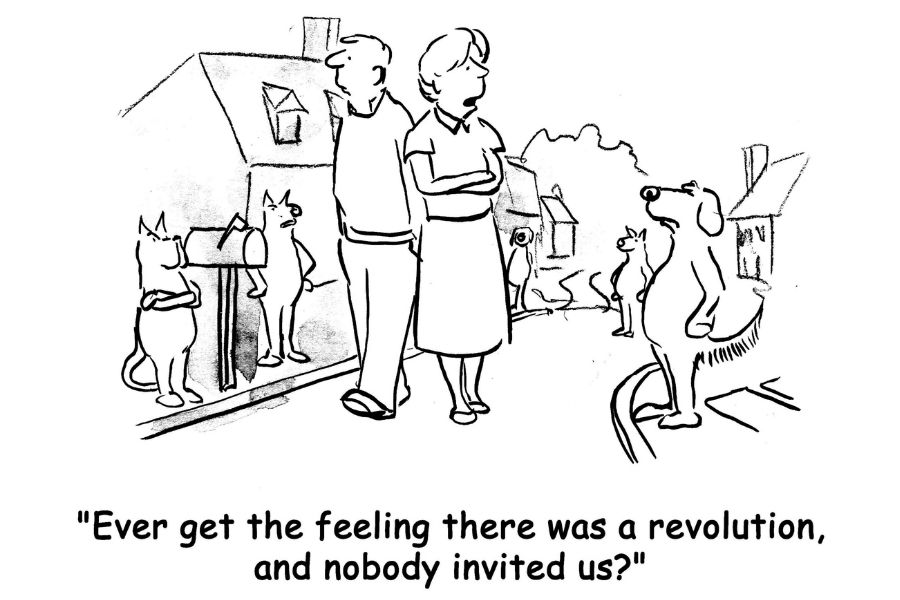
“Have you ever had the feeling there was a revolution going on… but no one invited you?”
What distinguishes humans from animals according to philosophy?
As seen, for Pythagoras and Emepdocle, animals are living beings on a par with people, but not all philosophical doctrines have naturally thought so over the centuries, on the contrary.
Aristotle, in 384 BC, was one of the first philosophers to make a clear distinction between the characteristics of people and those of animals, defining and arguing them precisely with regard to character.
Aristotle speaks of a gentle character for the ox, indomitable for the wild boar, intelligent and timid for the hare, vile for the snake, vain for the peacock, cautious for the goose, courageous and noble for the lion, passionate, affectionate, and obedient for the dog.
According to the Greek philosopher, there can be many aspects in common between the character of animals and that of humans, but the human is the only species capable of deliberating, that is, of making a decision and, moreover, is the only one who has “perception of good and evil, of just and unjust and of other values.”
In other words, humans are distinguished from animals because the divine has given them the “logos”: reason and language.
Scientific evolution over the years has, however, shown that it is not exactly so, but it is good to place Aristotle’s philosophical thought in the era in which he lived, where the concept of a “sentient being” was not yet developed, at least from a scientific point of view.

Ah… if furry little ones talked like their humans, people would certainly get more exercise!
The key to sentience
A word complicated to pronounce but simple to understand: sentience is defined like this by the Treccani encyclopedia: “Being sentient, with particular reference to animals, considered as beings endowed with biological characteristics and prerogatives proper to human beings.”
There are many studies that have demonstrated animals’ ability to feel emotions, as we told in this article, so it seems natural that philosophy has, over time, moved toward thoughts and reflections that place them on a par with the human race.
One of the most famous examples comes from the United States.
Peter Singer, Professor of Bioethics at Princeton University, is considered one of the most authoritative (albeit sometimes controversial) philosophers for his work on animal rights.
And his 1975 work, Animal Liberation, is considered a watershed, because it brought to the eyes of public opinion the issue of the ethical problem of the relationship between humans and animals.
Among Singer’s quotations, some very intense, there is this one: “It is only when we think of human beings as nothing more than a small subset of all the beings who inhabit our planet that we can realize that, by elevating our species, we simultaneously lower the relative status of all the others.” (Quote: Wikiquote).
Yes, many contemporary philosophers today embrace an idea of sentience, which stands in opposition to a word that over time has taken on a negative value, “speciesism.” Speciesism is, in fact, the faculty of attributing to human beings a higher status than other animals.
We can therefore conclude this journey with the thought of a contemporary philosopher, Jacque Derrida, who in his famous book “The animal that therefore I am” asks himself a fundamental question: is it possible to establish a boundary between human and animal?
“There is no Animal in the general singular. Separated from the human by a single indivisible limit. One must realize that there are ‘living beings’ whose plurality cannot be gathered into the sole figure of animality simply opposed to humanity.”
This is one of his quotes (Quote: Wikiquote), which can suggest a philosophical pacification or, as is beautiful and desirable, open up still more food for thought on this theme so broad and rich in nuances.
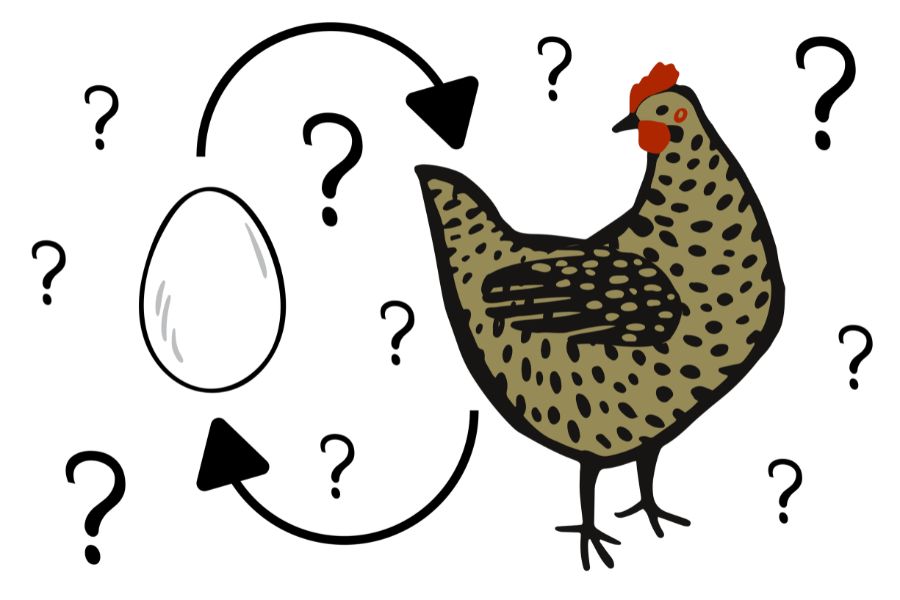
The question of questions: which was born first, the egg or the hen?
Which was born first, the egg or the hen?
With the rhetorical question “Which was born first, the egg or the hen?” we indicate the complexity of being able to give an answer about the very origin of life.
It is certainly a scientific topic, but it takes on dense philosophical implications when we reflect on the fact that the hen was certainly an egg and therefore developed into an animal.
Naturally, the human being is also an animal, and a stimulating question could be: what if animals, including the dog, were the stronger and more developed species, instead of the human being?
If things were the reverse of how we are used to thinking, what would happen?
We have seen that many philosophical thoughts consider the human being on a par with animals, while others affirm his superiority.
In fact, in many cases we love all living creatures, we respect them and protect them, while in others (unfortunately still many, as we have recounted in this article) we mistreat them.
The interesting question to ask, then, is: how would animals behave toward us, if they knew they were the dominant species from multiple points of view?
Reflecting on this theme can open the mind to new ways of relating to the realm of fauna, with the hope that sooner or later we may arrive at a collective consciousness that considers every living being as an equal, without ideologies of superiority or domination.
There is a single word that can free us from the weights and sufferings of life: Love.
Yuup!’s philosophy
Philosophy becomes practice when it puts a truth one believes in into action.
For this reason, we have created a dedicated page where we tell our philosophy and the way we integrate it into our actions, with the claim “A consciously green choice.”
The page can be found at this link and is a space where we tell about our commitment to cosmetic products for dogs and cats with a green soul.
Protecting the little furry ones and those who take care of them is the basis of our philosophy; it is what we believe in and it is what we practice every day by creating cosmetics free of harmful substances and which, with conscious ethics, say yes to an INCI (list of ingredients) that is clean and respectful of the environment, even if it is not mandatory for animal cosmetics, unlike human cosmetics.
Moreover, we have always said NO to animal testing, and this unwavering position underscores our thinking: animals are creatures that must be respected, protected, and loved on a par with every living being.