The title of this scene could be “High Noon in the Kitchen with an Escape at Full Paw Speed”. You have your new dog brush in your hand and look at your four-legged heart with a determined gaze. You think that, finally, the time has come to brush him properly.
He looks at you too, but not with a gaze as determined as yours, perhaps a more suspicious one.
You take one step forward, he takes two steps back, finally you manage to get closer and, at the first brush stroke, he turns into an eel and makes an undignified escape, making sure, moreover, that you cannot follow him.
The result? A new brush that is not used properly and your little heart’s knots laughing away in his fur, as if to say, “Try to get rid of us, if you can!”
This scene is much more common than we might think, and the problem is almost never a lack of consistency in brushing, but rather the dog brush itself.
A universal dog brush, suitable for all furry friends, is not the right choice, because it is important to choose one based on the characteristics of the coat, such as fur length, texture, the presence of an undercoat and also the size of the dog.
Moreover, brushing is essential, but it is fundamental to make it as pleasant as possible, especially when those knots that want to win at all costs are involved.
What should we do, then?
The answer is certainly to incorporate the Shine Detangling Spray, the product that can truly transform brushing, especially on medium, long or curly coats, because it helps detangle the fur and makes brushing easier and gentler.
In this article, we will also see which dog brush to choose in a super quick way, thanks to a table that, in just a few seconds, will allow you to find the right tool for your four-legged friend.
And then there will be lots of useful tips to try to turn that brush into a lovely magic wand that brushes the dog for us.
No, we are joking, no magic, but technology, ergonomics and very specific features that can make the dog brush a comfortable, easy-to-use tool, capable of doing its job well and, above all, of turning the next high noon showdown in the kitchen into a pleasant and peaceful moment for both of you.
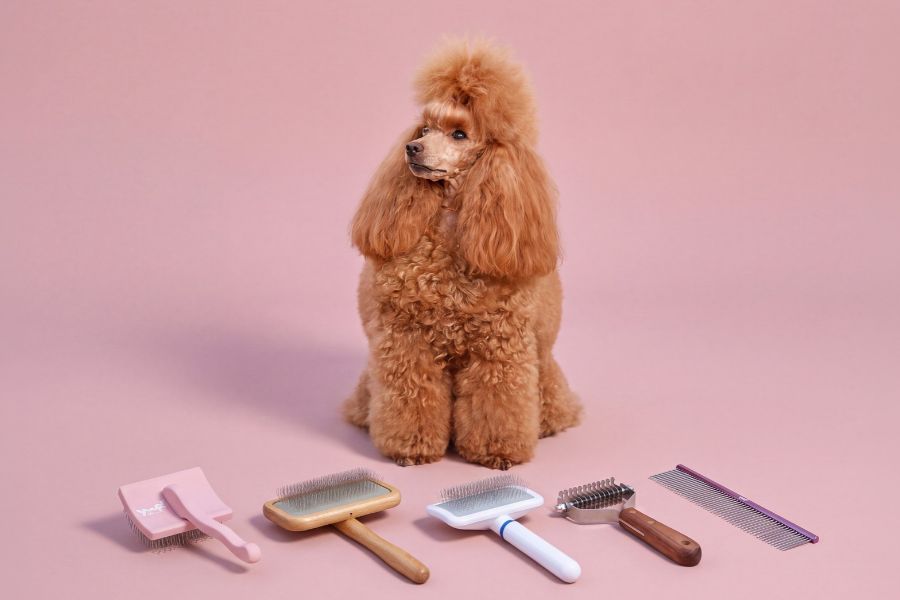
Every coat has its own tool: the choice starts with the fur.
(Image created with AI Firefly)
Is brushing your dog good for him?
Yes, brushing is good for your dog, in fact, it’s extremely beneficial, as long as the right brush is used.
But why should you brush your dog?
Because brushing:
- Removes dead hair;
- Prevents the formation of knots;
- Distributes sebum;
- Allows you to check the skin and the possible presence of parasites;
- Keeps the coat neat and shiny.
These are all essential aspects of our four-legged friend’s well-being.
But if we use unsuitable dog brushes for this routine, we risk doing more harm than good, because we may, of course unintentionally, cause irritation, redness and, in more serious cases, even small wounds on the skin.
Furthermore, if brushing is forced and unpleasant, our furry friend will end up associating this moment with something unpleasant, if not even painful, with the result that he will be increasingly likely to run away in the blink of an eye.
To make brushing an enjoyable moment for both of you, you therefore need a dog brush suited to the characteristics of his coat, one that can meet the needs of different dog coat types and, if you’re wondering how to choose it, there are four very clear criteria to consider.
- Hair length: very short, short, medium or long;
- Hair texture: smooth, curly or coarse;
- Presence and density of the undercoat: because not all coats are the same and some require special attention;
- Dog size: to choose a tool of suitable dimensions, comfortable to use and that allows us to work carefully and within the right amount of time.
Dog brushes: what types are there?
Slicker brushes, combs, grooming gloves, rakes and deshedding tools are all types of dog hair brushes worth knowing about, because they help take care of the coat, each in their own way.
Let’s see what their characteristics and differences are, and which one to choose to best brush our furry sweetheart.
The slicker brush
The slicker brush is a rather “muscular” dog brush, because its metal pins open up the coat, separate the hairs, remove dead hair and help detangle small knots.
It is particularly suitable for medium, long, curly and thick coats, but must be used gently to avoid irritating the skin.
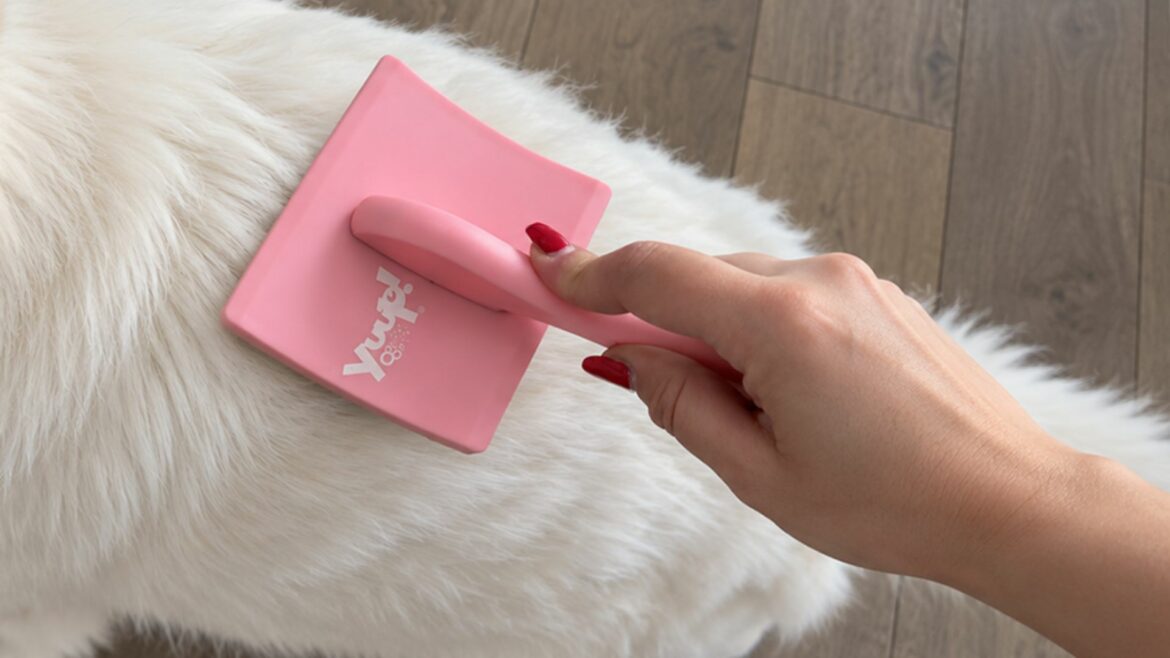
Furthermore, the slicker brush must be of the highest quality and have a good ergonomic grip, like PinkBrush and PinkBrush Mini, slicker brushes equipped with dense, angled stainless steel pins to penetrate the coat and collect excess hair super effectively.
PinkBrush is ideal for medium and large dogs, while PinkBrush Mini, thanks to its more compact head, is perfect for small furry friends and for reaching difficult areas such as paws, armpits and muzzle, even in larger dogs.
Be careful, the slicker brush is not suitable for all coats, especially very short ones, and should not be used to pull out tighter knots, which require specific products and tools.
The comb
Let’s bring the dog comb onto the scene, an essential tool in the daily brushing routine and a more “refined” one, because it is mainly used to check that no knots remain after brushing. If it glides from the roots to the tips without encountering any obstacles, the job is done!
For a thorough check, there are PinkComb and PinkComb Mini, professional combs with rounded stainless steel teeth, arranged at different densities.
PinkComb is ideal for checking long coats, while PinkComb Mini is perfect for small furry friends and for finishing the most delicate areas, such as the muzzle and topknot.
The rule is always the same: proceed gently, without forcing if you encounter a knot.
Gum brush and massage brush
Ah, the gum hand brush and the dog grooming glove! They are among the tools most appreciated by our furry friends, because they are gentle on the skin and ideal especially for short coats.
And the real pampering comes with PinkMassage and PinkMassage Mini by Yuup!, professional massage brushes with soft silicone bristles that stimulate microcirculation and provide a pleasant feeling of well-being.
Perfect before, during and after bath time, they also help distribute shampoo and conditioner evenly. PinkMassage is ideal for medium and large dogs, while PinkMassage Mini is designed for small and medium-sized dogs.
This way, brushing at home can become a real moment of relaxation!
Wooden brush with flexible steel pins
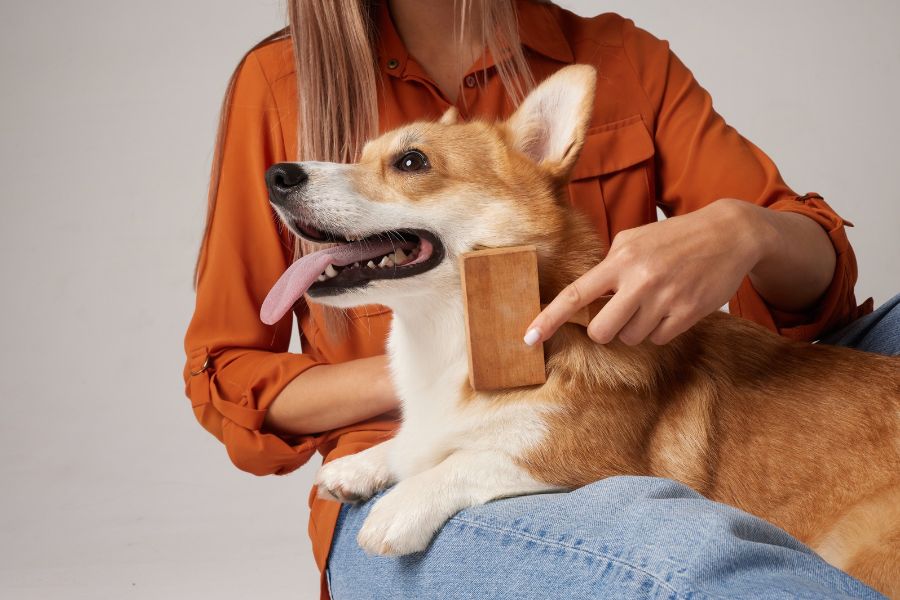
Part brush and part slicker brush, this tool is ideal for removing dead hair and detangling small knots without stressing the skin, thanks to its flexible pins. Available in different sizes, the wooden brush is especially useful for long and thick coats.
Undercoat rake and deshedding tool
When shedding season arrives and our furry friend leaves reminders of himself on every sofa, the rake and deshedding tool come onto the scene. The first reaches and helps to ‘gather’ the thickest undercoat, while the second helps remove the excess. These are tools that must be chosen and used carefully and belong to the professional grooming world. Discover the professional Yuup! rakes and deshedding tools.
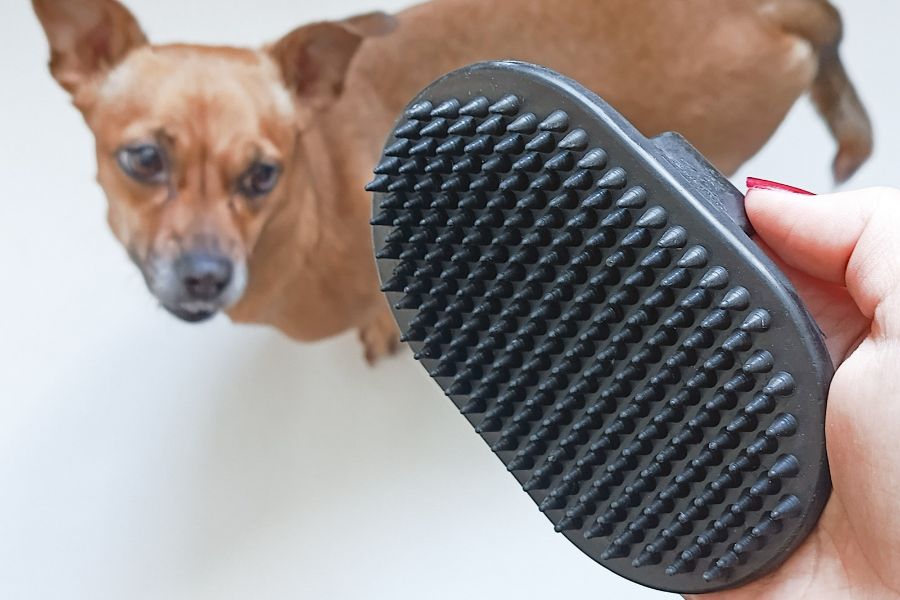
The hand brush for dogs is ideal for removing excess hair and polishing the coat.
Stripping tools
Stripping is a grooming technique that requires skills and professionalism, dedicated to dogs with hard, coarse and wiry coats. In this case, dead hair is removed manually directly from the root, and a stripping knife is used to do so, not a brush.
Thanks to stripping for wiry coats, our little sweethearts can be freed from dead hair that would prevent the growth of new hair, but be careful, because if there are already matted knots, it is necessary to use dematting tools with the utmost caution.
Stripping knives are professional tools because stripping itself is a technique performed by a groomer and must be carried out with the utmost care and awareness if you are not a professional.
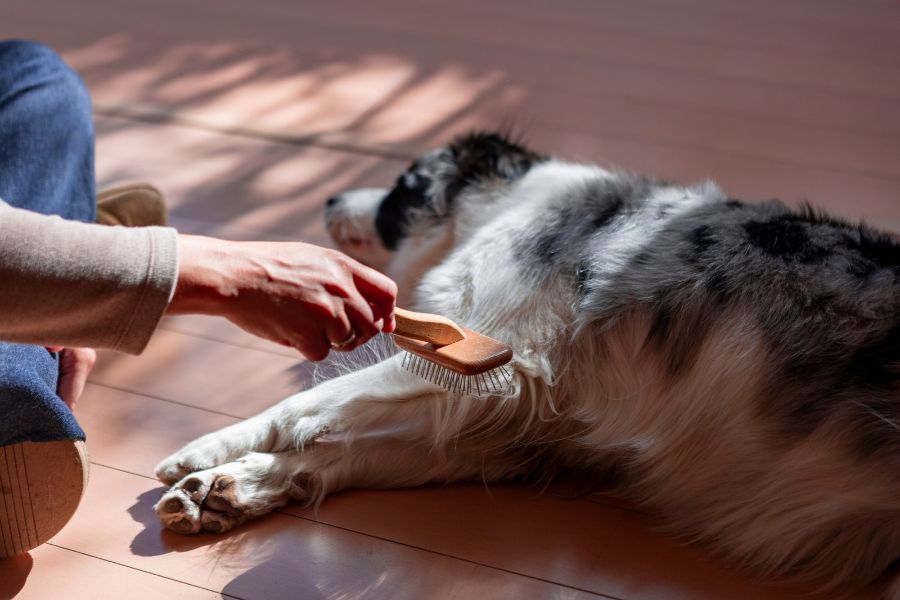
The slicker brush helps separate the hair, remove dead hair and detangle small knots.
Which brush should you choose based on coat type?
It’s time to understand which dog brush is best suited to your needs, so here is a table that compares coat types, breed examples, main tools, finishing tools and how to use the Glossing and Detangling Spray.
Discover the dog brush best suited to your furry sweetheart:
| Coat type | Breed examples | Main tool to use at home | Finishing | Glossing and Detangling Spray |
|---|---|---|---|---|
| Very short, without undercoat | Boxer, Doberman, Dalmatian | Gum hand brush or dog grooming glove | Comb | Always |
| Short, with undercoat | Labrador, German Shepherd, Corgi | Slicker brush | Comb | Always |
| Medium or long, with undercoat | Golden Retriever, Border Collie, Australian Shepherd | Slicker brush | Comb | Always |
| Long and silky | Maltese, Yorkshire, Shih Tzu | Soft slicker brush or brush with flexible pins. During bath time, use the massage brush | Comb | Always |
| Curly or woolly | Poodle, Lagotto Romagnolo, Bichon | Slicker brush | Comb | Always |
| Wiry or coarse | Jack Russell, Schnauzer, West Highland | Wooden brush with flexible pins | Periodic professional stripping when needed | Always |
Brush for short-haired dogs
What is the best brush for short-haired dogs? First of all, let’s debunk the myth that short-haired dogs don’t need to be brushed, quite the opposite!
Certainly, short coats are less demanding than long ones, but they need to be brushed to clean them, remove dead hair and promote the overall health of the coat and skin.
Short hair and short wiry hair
The ideal brush is one with soft bristles, which removes dead hair, distributes sebum and polishes the coat without irritating the skin. If the hair is short and wiry, stripping also comes into play, a technique that should be entrusted to a professional groomer.
Short hair with undercoat
Well, here things change! To reach the undercoat, you can use a slicker brush with suitable pins and, if there are knots, it is better to use the Glossing and Detangling Spray, without forcing the brushing.
Brush for long-haired dogs
Long-haired dogs
Poodle, Shih Tzu, Maltese, Yorkshire Terrier, Cocker, Setter, Border Collie and Papillon: for these furry friends, the ideal combination is a slicker brush plus a comb, with the Glossing and Detangling Spray always playing a leading role!
The slicker brush does most of the work, the comb checks that no hidden knots remain and the Detangling Glossing Spray prepares the coat for brushing, avoiding annoying pulling. All accompanied by breed-specific products, to respect the needs of the coat and skin.
Long-haired dogs with thick undercoat
Collie, Akita Inu, Shiba Inu and Australian Shepherd: here the undercoat is really abundant and during shedding season it can cause more than a few headaches!
The right combination is a slicker brush and a comb, always accompanied by the Glossing and Detangling Spray. The slicker brush helps remove dead hair, while the comb checks that there are no tangles.
The goal should never be to remove as much hair as possible, but rather to eliminate dead hair to facilitate natural coat renewal, all while respecting the skin and coat. If you want to learn more, discover more about caring for your dog’s undercoat.
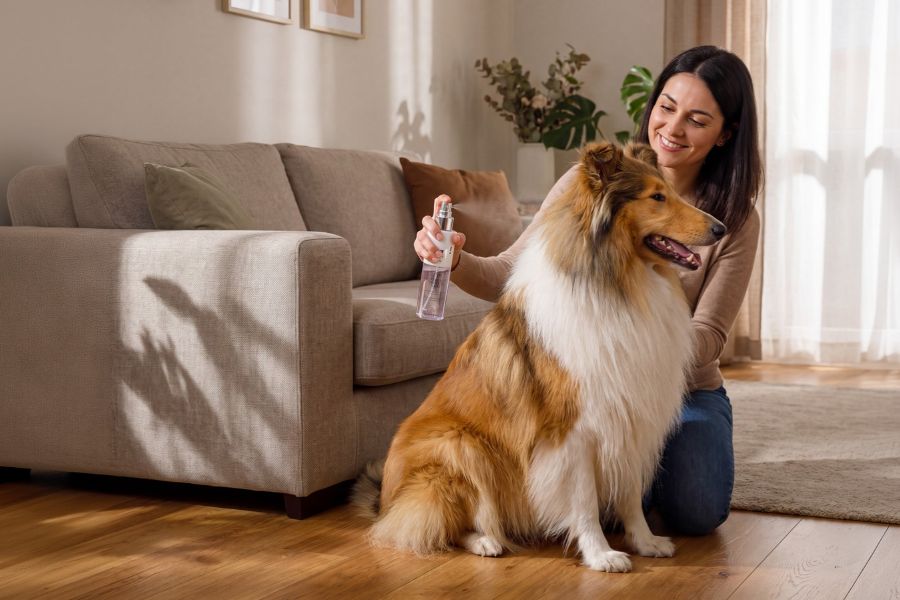
Yuup! Glossing and Detangling Spray should always be used before brushing because it makes it easier and keeps the coat strong, shiny and well-structured. (Image created with AI Firefly)
Why the brush should always be paired with the Detangling Glossing Spray
How to detangle your dog’s knots? The queen of all answers is to use the Detangling Glossing Spray. Keep in mind that brushing dry and tangled hair creates friction, static electricity and pulling. The Detangling Glossing Spray lubricates the hair fibre, allows the brush pins to glide smoothly and makes brushing less uncomfortable, so there is a much greater chance that your dog will accept it better.
It is a dog hair detangler with a world of beneficial properties, because the Yuup! Glossing and Detangling Spray provides a restorative and moisturising action thanks to Quaternised Keratin, in synergy with Creatine and the Vitamin C+E+Panthenol complex.
In this case, the Glossing and Detangling Spray for long-haired dogs is much more than a brushing ally, because it keeps the coat strong, structured and shiny day after day.
P.S. We haven’t mentioned it yet, but it’s always a good idea to get your furry sweetheart used to brushing from an early age, so that it becomes part of his routine, especially if it is done with the Glossing and Detangling Spray for dogs, which makes it more pleasant.
The detangling routine involves always applying the Detangling Glossing Spray, separating the hair with the slicker brush and using it, then gently running the comb through the coat and finishing with a few drops of product to refine, nourish and add shine to the coat.
The four-step routine for detangling knots
Here is the routine for detangling knots in four practical steps:
- Spray the Glossing and Detangling Spray onto the coat and, if necessary, apply a little more to ‘at-risk’ areas such as behind the ears, under the armpits, on the chest and under the belly;
- Open up the coat with the slicker brush, starting from the base;
- After using the slicker brush, gently run the comb through the coat to check that there are no remaining knots or tangles;
- Apply a few drops of a product that provides the perfect finishing touch, such as Revive Intensive Oil, which nourishes and adds shine, or Keratin Serum, which restructures the hair and seals its cuticles.
These steps may vary from case to case, as you can read in this article on how to brush your dog correctly, which also answers one of the most frequently asked questions: how often should you brush your dog?
The most common mistakes when choosing a brush
When brushing our four-legged sweetheart, we need to pay attention to certain mistakes that, even when made with the best intentions, risk making brushing ineffective or, even worse, uncomfortable and painful for our furry friend.
Here are the five most common ones to know about and avoid!
1.Using a human hairbrush
A human hairbrush is not designed for a dog’s coat and, especially if it has rigid pins or ones that are not suitable for his skin, it risks causing irritation or breaking the hair. It is therefore essential to always choose a specific dog brush, designed to respect the characteristics of his coat and the sensitivity of his skin.
2.Pressing too hard with the slicker brush
The slicker brush is a wonderful tool, but it must be used with the right amount of pressure, because its metal pins can cause redness and small lesions on the skin, which in more serious cases can lead to persistent irritation and infections. In addition to the physical discomfort, the risk is that our sweetheart will end up considering brushing an appointment to run away from as fast as his paws can carry him, something we must try to avoid as much as possible!
3. Using a deshedding tool if we are not professionals
The deshedding tool is a specific instrument for working on the undercoat and should not be used on dogs that do not have one. Furthermore, it must absolutely be used by someone with the necessary skills, such as a professional groomer.
4. Using a tool that is too large or too small for the dog’s size
To each his own size! A medium-large dog needs a dog brush with a wide surface, allowing you to work on larger sections of the coat, while a small-sized sweetheart needs a more compact tool that ensures precision even in hard-to-reach areas. Choosing the correct size allows for better brushing, avoids unnecessary strokes and makes the job more comfortable and faster, both for us and for our furry friend.
5. Persisting with a particularly stubborn or matted knot
Some knots seem to have decided never to go away, no matter what, but insisting with the brush, pulling or trying to untangle them at all costs risks really hurting the dog. In these cases, it is important to have the necessary skills to use specific tools, such as a dematting tool, which requires particular care because it can injure the skin if used incorrectly. If, on the other hand, the coat is very tangled or even matted, the best solution is to turn to your trusted groomer, who will know how to assess the best way to intervene without causing unnecessary discomfort and suffering.
And what if the skin is red or the coat needs more intensive care? It is better to avoid DIY solutions and seek professional advice. A groomer can take care of a stressed, damaged or matted coat using the most appropriate techniques and products.
The golden rule is that brushing your dog should be an act of care and well-being, never a test of endurance, neither for us nor for our four-legged love.
To recap:
- Brushing at home is essential to ensure our dog’s well-being;
- What we need is a brushing kit paired with a comb to choose between the standard PinkComb (medium-large size) or PinkComb Mini if our sweetheart is small-sized;
- Always use the Glossing and Detangling Spray to make brushing more pleasant, beneficial and even fragrant;
- Always finish brushing with a moment of sweetness, perhaps with a biscuit and lots of extra cuddles!
And who knows, perhaps the next high-noon showdown in the kitchen will finally turn into a lovely wellness and beauty session, without any escapes and, after a good brushing, with lots of extra scratches for our furry sweetheart.