Many people think that a dog in an apartment spends a life limited by the few square meters, especially if he does not have green spaces available where he can run around freely.
And yet, living with our four-legged friend in an apartment is not only possible, but it can become an easy and pleasant life experience, provided that it is well thought out, organized and oriented toward his well-being in a total way.
The first aspect to consider is this: the perfect apartment dog does not exist, rather there are breeds that adapt better to life in this type of home compared to others.
That said, it is fundamental to always keep in mind that, regardless of his breed, the dog is an individual in his own right, with his needs, his necessities and his unique personality.
In this article we therefore see tips for living with a dog in an apartment, what aspects to evaluate before cohabitation and how to welcome and manage the little four-legged heart.
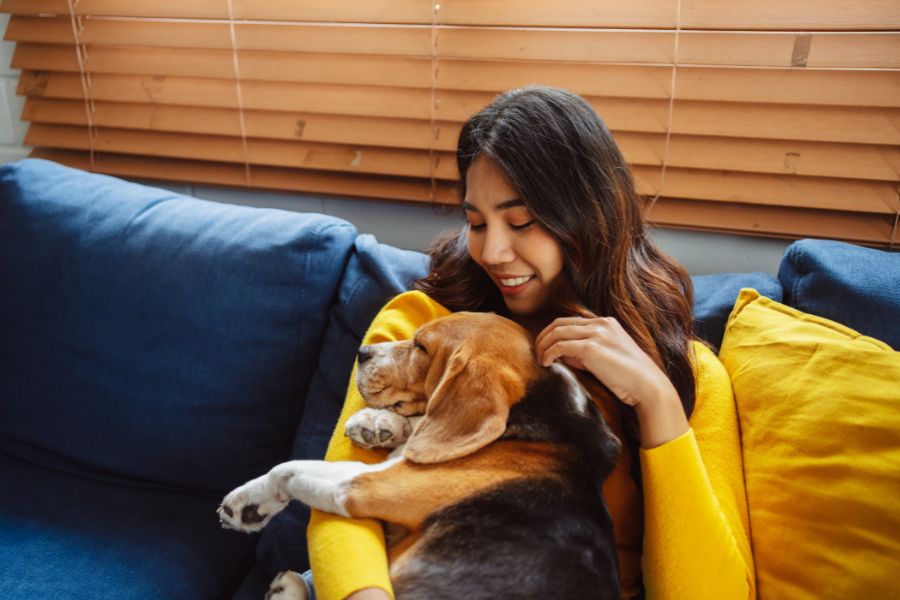
For an apartment dog, the size of the house does not matter: for him it is important to stay where we are, exactly glued to us!
Aspects to evaluate before getting a dog
There are factors that deserve to be considered carefully before deciding to live with a dog in an apartment:
- Let’s start with the most important one, the pre-adoption consultation, a fundamental step, especially for those who adopt a little furry one for the first time. Talking with a dog trainer, sharing one’s needs, motivations, daily habits and the housing context, allows you to make a conscious and responsible choice, respecting the needs both of the future four-legged companion and of the family that will welcome him.
- Let’s check the rental contract. If we live in a rental it is fundamental to check the contract, because a clause may have been included that does not allow keeping dogs (or animals in general) in the house. If this clause is absent, then we can welcome the little furry one with us, but it is always good practice to inform the property owner. Ah, the clause cannot be added to a signed contract, but only inserted at the renewal stage.
- Attention to condominium rules: only the clause in the rental contract can forbid keeping an animal in the house, but if there is a condominium regulation it is important to consult it. In fact, there can be rules on the use and cleaning of common areas (for example mandatory leash or collection of droppings) or public peace (avoid that the dog causes disturbance or causes damage to the condominium residents and to the building).
- Is there enough space at home? As we wrote a few lines above, the choice to keep a dog in an apartment requires a continuous demonstration of love and depends on how we take care of him. For example: a 60 kg Great Dane can live in an apartment, his character is docile, calm and he loves the sofa, but it is important that he is taken outside to stretch his legs and walk in the open air every so many hours. Instead, a Border Collie with an explosive character, who loves running outdoors, would feel limited, frustrated and bored, and would need to let off steam continuously. Let’s therefore try to make a decision that ensures the little furry darling an amount of space that is right and adequate for his size, his character and his needs.
- Will we be able to take care of him as he deserves? This question goes beyond the fact of living or not in an apartment, but it must be considered if we are thinking of having a dog. It is, in fact, important to ask ourselves if we will want to commit to giving him all the affection and care he deserves.
- And is the dog suitable for apartment life? The answer, once again, is that everything depends on one aspect: being able to take care of him. If the little darling is loved and cared for, taken out often for walks and allowed to let off steam, his life is complete. No other space is needed, because he is happy next to us. And we are his world. Of course, there are dogs that, by breed, have a kinesthetic motivation and therefore for movement (like the Border Collie, but also like a small and exuberant Jack Russell!). If the motivation is not satisfied, episodes of frustration can arise in the dog that he will try to vent in “alternative” ways, such as for example chewing our shoes or some part of the home furniture :). That is why it is important to carve out a portion of space all for him, also defined by his size, with his kennel positioned in a quiet area. In the same way, it is fundamental to guarantee a space where he can drink and eat in serenity, away from doors or areas of frequent passage.
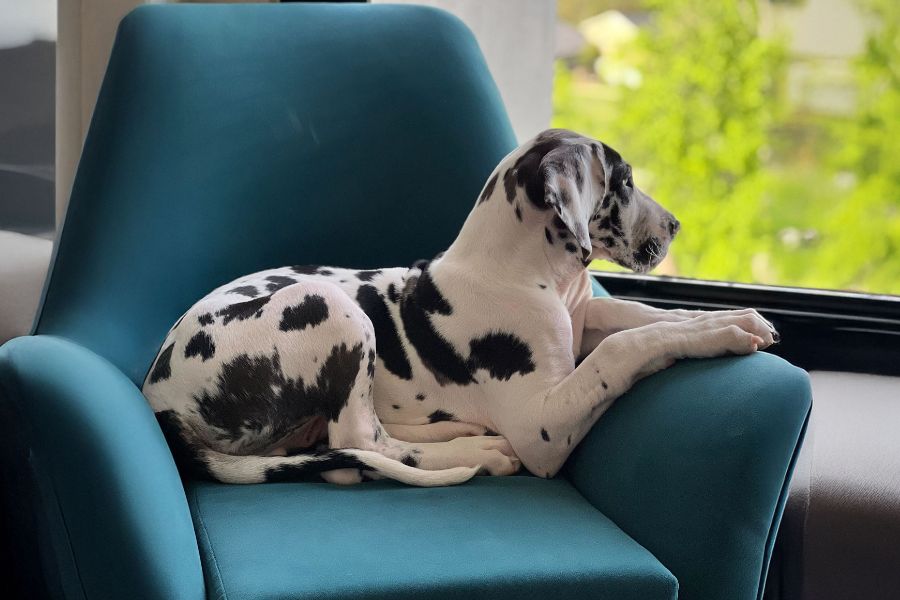
Dogs can certainly live in an apartment, provided that their well-being and their health are ensured!
Which dogs are suitable to stay at home
A very important clarification: if we are not sure we can best respect walking schedules and the dog’s primary needs because (for example) work life does not allow it, we cannot expect to get a dog and leave him closed at home all day.
We must be able to guarantee him the well-being he deserves! So here are the traits to consider when we evaluate bringing a dog home:
- Our character and our habits: if we are aware of being not very active people, it is not a good idea to choose, for example, an energetic Border Collie, because we would not manage to let him blow off steam properly and he would suffer a lot! This also applies if the apartment has a garden: the little furry one would suffer, because he would need ever-new stimuli and to sniff and experience the territory, rather than always smelling the same smells. Basically, if we know we are “lazy” it is good to choose a calm dog and that does not need continuous outlets.
- Size: a small or medium-sized dog is easier to manage at home, simply because he needs less space to move around.
- Temperament: it goes without saying that a dog with a docile temperament can live more serenely in a small context and with continuous stimuli such as, for example, footsteps in the corridors, human traces on the stairs or the need to take the elevator, an issue that brings us to the next point.
- Housing context (especially the floor of the home): it is good that a large dog that lives on higher floors has the elevator available. If he had to face four flights of stairs every day, in fact, he could run into joint problems, especially if repeated several times a day. At the same time, the “important” size would not allow the pet-mate to pick him up in case of need, an aspect instead feasible with small-sized little furry ones.
- Need for physical activity: there are some dog breeds that have a lot, indeed a great deal, of need to run and let off steam, while for others a gentle walk in the park can be enough.
- Ability to relax: also in this case the stimuli of apartment life play an important role, because they can be continuous and unpredictable, especially in very large and crowded condominium buildings. A dog that by inclination is calm can certainly live these situations with more serenity.
Dog breeds most suitable for apartment life
Given that there is no single rule and that a lot depends on temperament and the need to do “physical activity”, the little furry breeds that are usually more suitable for apartment life are:
- Pug, French Bulldogs and English Bulldogs: they are dogs that do not have great needs in terms of movement (indeed, they are big lazybones!), moreover they are sweet, affectionate and small or medium-sized.
- Cavalier King Charles Spaniel: these adorable little furry ones can live well in an apartment because they are small-sized, they bond a lot with family life and they do not have particular needs for movement.
- Shih Tzu: these dogs are usually so good, calm and sociable, that they adapt to the spaces that are offered. In addition they are small-sized and do not have particular movement demands, except for healthy daily walks.
- Dachshund: lively, yes, but very attached to the home and the family, Dachshunds are dogs that can live well in an apartment.
These are some examples of dog breeds suitable to stay at home, that is, that can live well in an apartment and, naturally, we also include mixed breeds in the list, always taking into account their size, their character and the need for daily movement.
These breeds can adapt well to the apartment housing context, but then it is up to us to understand and welcome the specific needs and necessities that our dog can show us.
Besides, it is still a cohabitation, where we also try to meet the needs of our four-legged friend, and there can be the need to “adjust the aim” or modify some life habits, for the well-being and happiness of both.
Better male or female dog in an apartment?
When we decide to welcome a dog at home the question comes spontaneously: better male or female dog in an apartment?
The point is that there is no “better” and there is no universal answer, because between male dog and female dog there are no substantial differences in terms of adaptability to spaces.
The issue is different if there are already dogs that live with us. In this case, it is more likely that a dog will serenely welcome another one of the opposite sex, but it is not a written rule, indeed! Everything depends, in fact, on the individual subjects.
The advice is to evaluate with a dog trainer the possibility of introducing a second dog in the same context, to understand how to make the cohabitation serene.
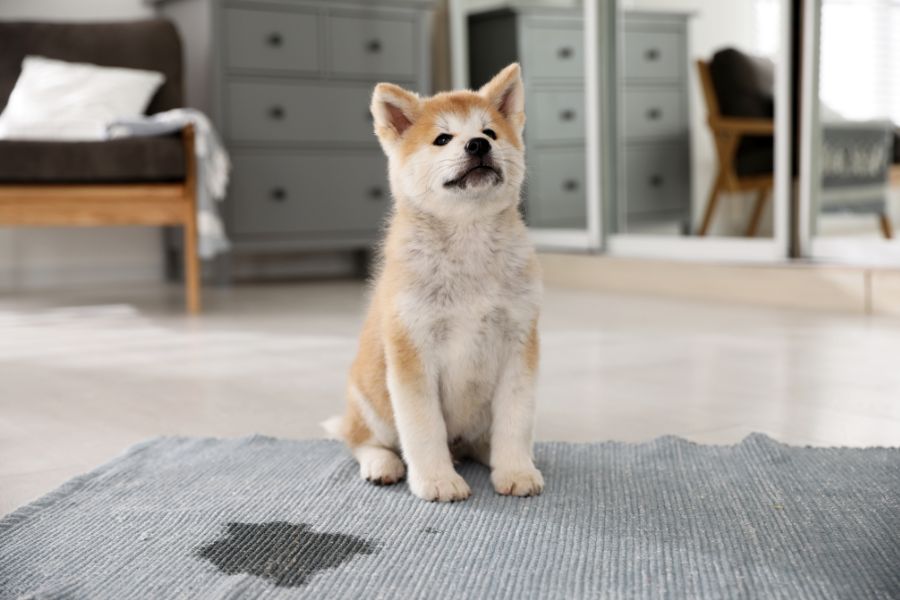
It is important to gradually get the dog used to staying alone at home and always remember to take him outside for his needs, especially before it is too late.
What to do as soon as a puppy arrives at home
When a new dog arrives at home we are welcoming a real new member of the family.
The first 48 hours are important: time, calm and organization are needed to accompany him in the right way.
The dog must be able to have a kennel available (indoor or outdoor or both, depending on the spaces available) and a bowl for water and food of suitable size for his size. We can place them in a place that is easy to reach, quiet and not in a passage area, that is not too exposed to the sun but not dark either.
Regarding bureaucratic and health aspects, such as microchip and vaccines, they are fundamental and usually you already receive the documentation with the vaccines carried out, but it is important to complete the cycle provided by the veterinarian.
Nutrition is just as central: being a little puppy, he needs a food designed for his age, for example specific kibble for puppy.
Hygiene is another indispensable piece. The bath can only be done after completion of the vaccination cycle (therefore from three months onward), using delicate products suitable for sensitive skin.
Naturally, it is necessary to keep not only the dog but also the shared spaces clean: if he goes on the sofa or on the bed, his hygiene protects all members of the family. Cuddles, attention and daily cleaning are therefore the basis for a serene and healthy cohabitation from the very first minutes in which we welcome the little darling with us.
A separate chapter deserves to be dedicated to the dog’s education. We can in fact ask ourselves how to keep a dog in the house and make sure that he behaves in a respectful way of our spaces and our life habits.
The advice is to always ask for support from dog trainers. The experts, in fact, can tell us which path to start and from what age to begin, to transmit to him both the basic behavioral rules and those linked to the management of daily life at home.
In this way we will help the dog develop the skills necessary to live serenely and face with safety the different situations he will encounter. At the same time, we will learn to understand him better, correctly interpreting his signals and needs, and thus building an authentic, deep and lasting bond with our four-legged friend.
If you want to discover how to take care of a puppy at home in the best way, we recommend reading our article on what to do to manage a puppy in an apartment. You will find all the information necessary to best face cohabitation, including important details on vaccination prophylaxis and microchip insertion, fundamental for the health and safety of your new four-legged friend.
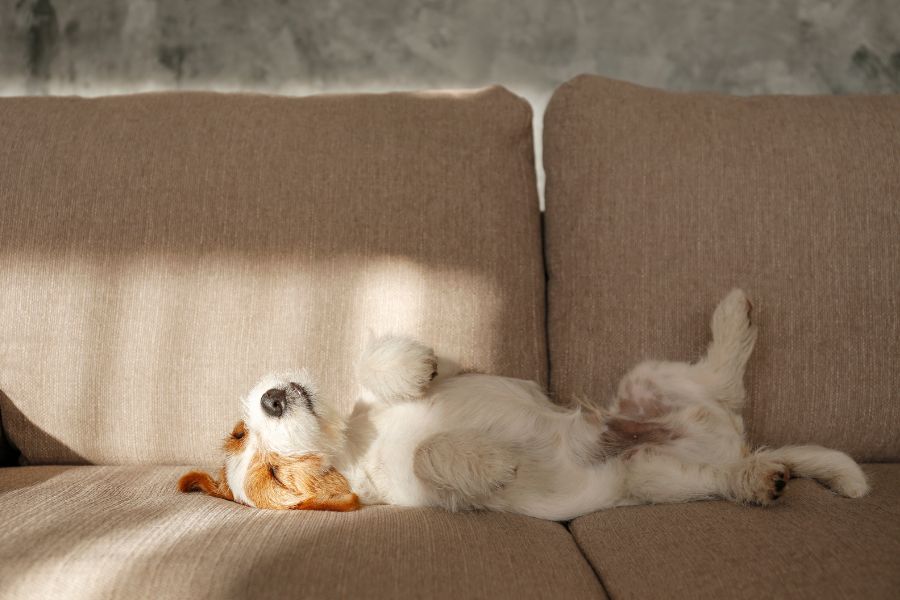
If the dog is our world, we are his universe: before adopting let’s think about the time to dedicate to him, for his well-being.
Dog alone at home: how to manage it
Leaving a dog alone at home is a common concern, but what do we have to evaluate to best manage this situation? Dogs perceive time differently from us humans and a lot depends on the dog’s breed, age, temperament and also the education he has received.
Here is a basic estimate:
- Puppies should never stay alone at home for more than two-three hours. The little ones in fact need constant attention, frequent meals and also closer breaks for their needs.
- Adult dogs generally tolerate staying at home alone for five-six hours, but they must be accustomed gradually. A question that many people ask themselves is: can the dog stay alone at home for ten hours? It is a common question and the answer is that it is a long time that the dog spends alone, therefore, if we have to get a dog to leave him alone most of the day, what sense can it have to do so? How could he be happy without our presence if the center of his world is precisely us? Let’s always remember that adoption must be evaluated with full awareness of having to welcome the needs of another living being.
- Senior dogs deserve a separate discussion, because they can have needs for greater care and to take more walks a day for their needs. From this follows a shorter time in which they can stay at home alone.
The problem, at every age and in every condition, is the so-called separation anxiety, which can be avoided by maintaining a regular routine of schedules, both for absence from home and for meals and walks. It is also important to create a clean, well-organized home environment with kennel and bowls and, even better, “equipped” with dog toys.
In all this, it is important to gradually get the dog used to staying alone at home and, if we have doubts, or if we see that our dog is struggling, it is good to ask the dog trainer how to proceed, so that moments of solitude are never understood as possible abandonments, but rather as part of a normal daily routine.
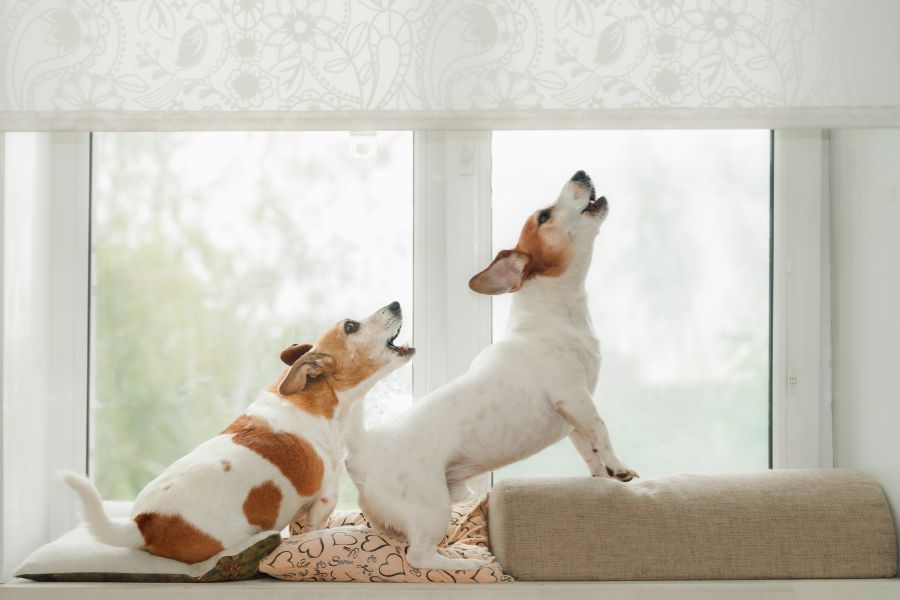
Two furry friends: less loneliness and love squared!
The advantages of having two dogs at home (and the aspects to consider)
A solution to make the dog feel less alone is to keep two with us but, also in this case, it is necessary to evaluate the pros and cons of this choice.
Certainly two dogs at home alone face in a more serene way the pet-mate’s absence during the working day, but this means doubling commitments and expenses and being ready to help the little darlings “bond”, with patience, time and gradualness if they do not yet know each other.
Of course, if the dogs will live in an apartment it is very important to also consider the space available, but if the cohabitation works and there are the prerequisites for a healthy and happy life, the advantages and benefits for everyone will be enormous, starting from the double waves of love with which we will be overwhelmed every day!
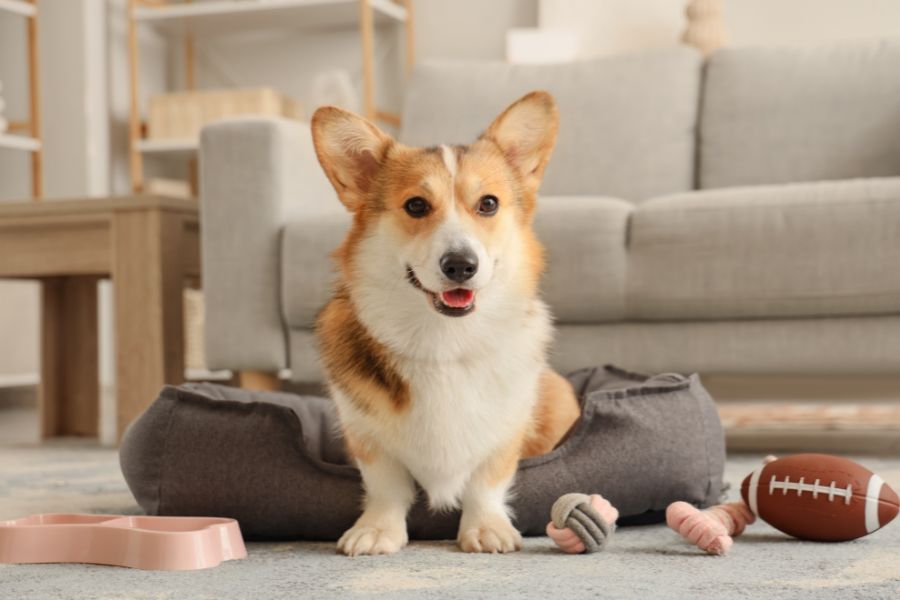
Dog toys fill the waiting time and multiply joy in shared moments.
Games to play with the dog at home
How to stimulate the dog mentally and physically inside the apartment? And how to avoid a dog being afraid at home, perhaps because he feels alone and fears being abandoned?
As seen, it is fundamental to gradually get the dog used to being alone in the apartment, but let’s always consider that boredom is always an enemy of the little furry ones’ physical and mental well-being.
For this reason, if we are out of the house for work and commitments for many hours, it is important to “equip” the home to make it a place where dogs can feel good.
There are games to do with the dog at home and that can be left at their disposal when we go out, which help prevent boredom and anxiety, such as search games, interactive puzzles, and movement games that do not require too much space.
Some examples? We can hide small snacks in the house letting the dog find them thanks to his sense of smell, like a sort of tasty treasure hunt. Then, we can take games that help the dog have fun such as interactive ones or chew toys.
There are therefore mental activation games for dogs such as, for example, Kongs, rigid containers where we can put food, so the dog will have to figure out how to get it out, or the cube ball, a cube with a ball inside that the dog will have to manage to extract. On the market there are many different dog games and getting them to accustom the little darling to staying alone at home is an excellent idea to make him more calm and happy.
To conclude, in this article we have seen how to live with a dog in an apartment, which factors to consider to welcome a baby little darling and how to best organize spaces and times, so that the dog can count on a home that makes him safe and happy from every point of view.
With good will, organization and a lot of love, every home, even an apartment, can in fact become the refuge and the nest where to live a life full of joy for us and for our little four-legged heart.
Article written with the consultation of Chiara Festelli, Dog Educator.