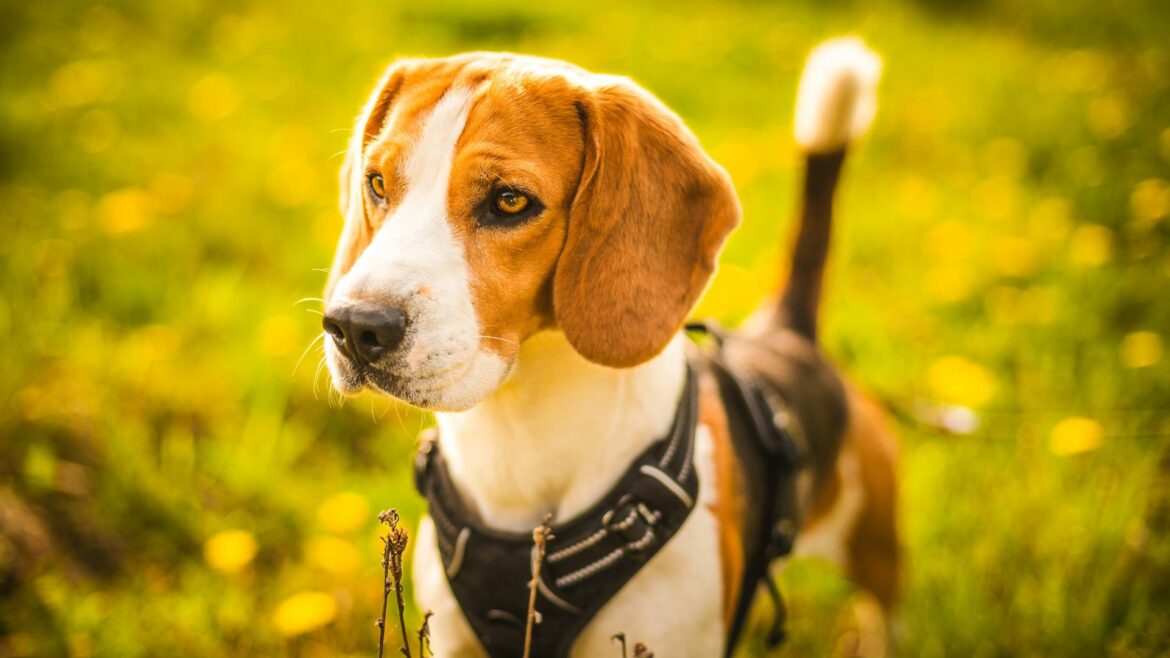
The dog’s harness is much more than an object: it is a choice that can influence his well-being, his health and also his relationships both with humans and with other little furry ones.
Harness and leash can become Christmas gifts (or for any other occasion, including the little heart’s birthday) but, at the same time, they are also tools that must be chosen with care and attention, because the dog’s physical, emotional and also psychological well-being depends on them.
For this reason our advice is: if you want to give a Christmas gift to your little heart or to the dog of a loved one, first of all find out about his issues or habits in order to choose the best gift.
And now let’s explore together which types of dog harness exist and how to put it on correctly, right after we move on to talk about the dog leash.
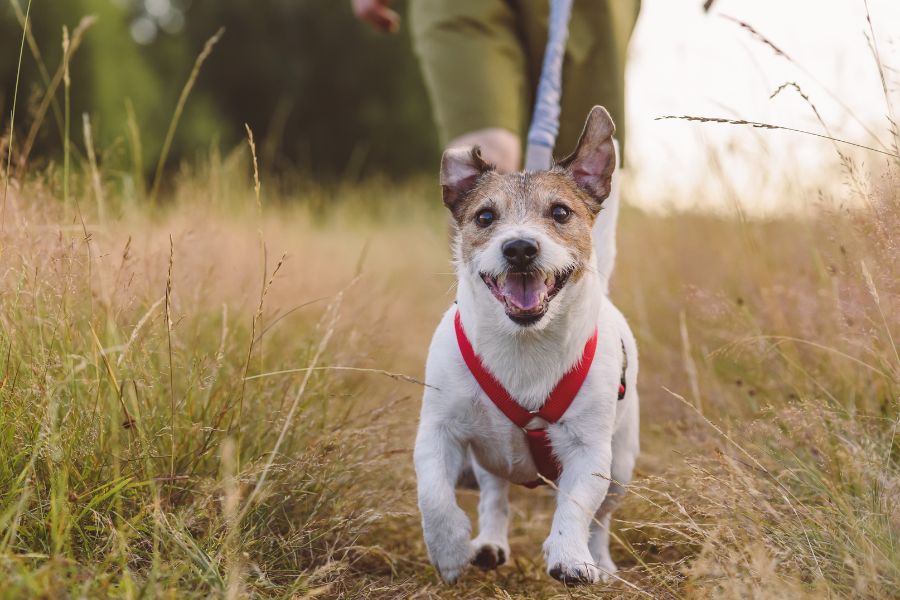
With a comfortable harness, the world is more beautiful to discover!
Why is the dog’s harness so important?
Unlike the collar, which is placed only on the dog’s neck, the harness involves a good part of the little furry one’s body and, consequently, it influences movement and weight balance.
An incorrect influence on movement and an imbalance of weight caused by the harness can, in fact, lead to health problems and also to relational difficulties.
It is therefore essential to choose the harness model most suitable for the characteristics of our little furry one, in order to guarantee him excellent comfort and maximum freedom of movement, while at the same time making sure we can manage the leash with ease.
But which harness should we choose?On the market there are many types of harness, different in fit and also in how they distribute weight on the little heart’s body. Here are the most common types of harness.
H-shaped harness
Also called the “Roman-style” harness, this harness is suitable for almost all dog breeds and sizes. It is made with two straps that surround the neck and the chest, connected by a strap positioned on the back and one on the dog’s belly.
It distributes weight in a balanced way and, at the same time, allows the dog to move freely. Moreover, it is a harness that is simple to put on and also to adjust.
X-shaped harness
This harness model is also called “scapular” because it is made with two straps that press on the dogs’ chest and that cross on the shoulders (for this reason it is called X-shaped).
This harness allows a decent level of control, but the dog’s shoulders are compressed and this can limit movement. Moreover, putting on this harness is a bit invasive and complicated, so much so that in some cases it can also create problems for the dog’s shoulder joints.
Y-shaped harness
A “Nordic” harness, as it is also called Swedish, Finnish or Norwegian. It is made with two straps, one around the chest and one around the breast that join at a right angle, creating a Y.
We can define it as a middle way between the H-shaped harness and the X-shaped harness. To be sure that this type of harness does not bother the dog, it is essential to adapt it perfectly to the dog’s measurements. Unlike the H-shaped harness, which can also be left a little looser, for the Y-shaped one it is necessary that the fit is not “generous”. A wide Y harness would limit the shoulder movement of our four-legged friend.
Now that we have seen the different characteristics of harnesses, we can state that the H-shaped one is considered the best from several points of view: in fact, it distributes weight well, is easy to put on, and allows good control of movement, while leaving the little furry heart free to move.
Then it must be considered that every dog has a different physique and every piece of equipment, harness or leash, must be evaluated based on the dog’s needs.
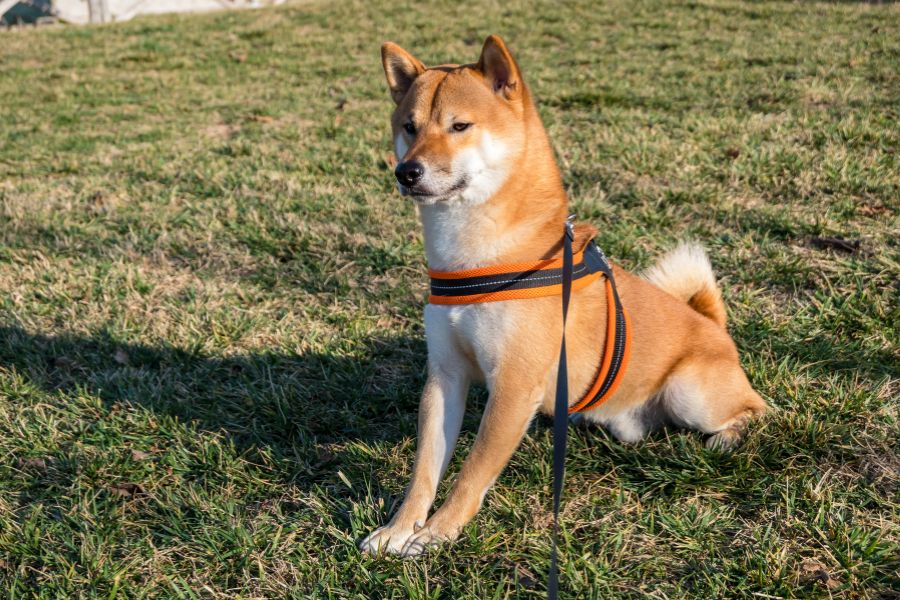
The harness is much more than an accessory: it is safety, well-being and protection for our four-legged little hearts.
How to choose the right harness for the dog
When we choose the harness for dogs, we always and in any case pay attention to their needs.
Besides the model, in fact, we must consider some essential factors to guarantee the dog’s well-being when he wears the harness:
- Size: it must be suitable for his size;
- Adjustability: we must be able to adjust it easily;
- Quality: it is always advisable to invest in a quality dog harness, made with non-toxic and sturdy materials;
- Specific needs: Greyhounds, for example, are dogs with a special chest conformation, which requires a specific harness for them.
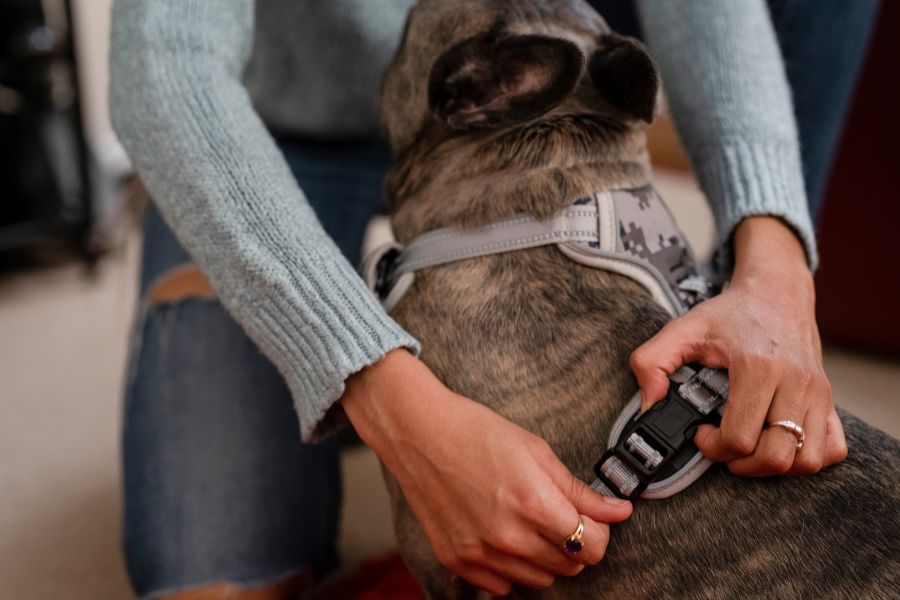
The perfect recipe for putting the harness on our dog? Speed, precision and a nice pinch of patience, all seasoned with a generous dose of cuddles!
How do you put a harness on a dog?
It is difficult to give a single answer to this question, because a lot depends on the harness model chosen.
The first times, when we are getting him used to the harness, we can reward him if he has worn it willingly, maybe with a nice “good boy”, which must never be missing, possibly accompanied by a nice little biscuit and a super dose of caresses.
If, instead, the little furry heart does not want to know about wearing it, we can try to understand what the causes are: does he suffer from the movements needed to put it on? Are the harness straps too tight? Or, maybe, is he simply scared about what can happen afterwards, because he associates it with the walk, which for him is not a pleasant moment?
Every little furry heart is unique and if we notice difficulties in making him wear the harness, the advice is to ask for support from a dog trainer, who can help us understand the reasons for this behaviour and how to act accordingly to solve it.
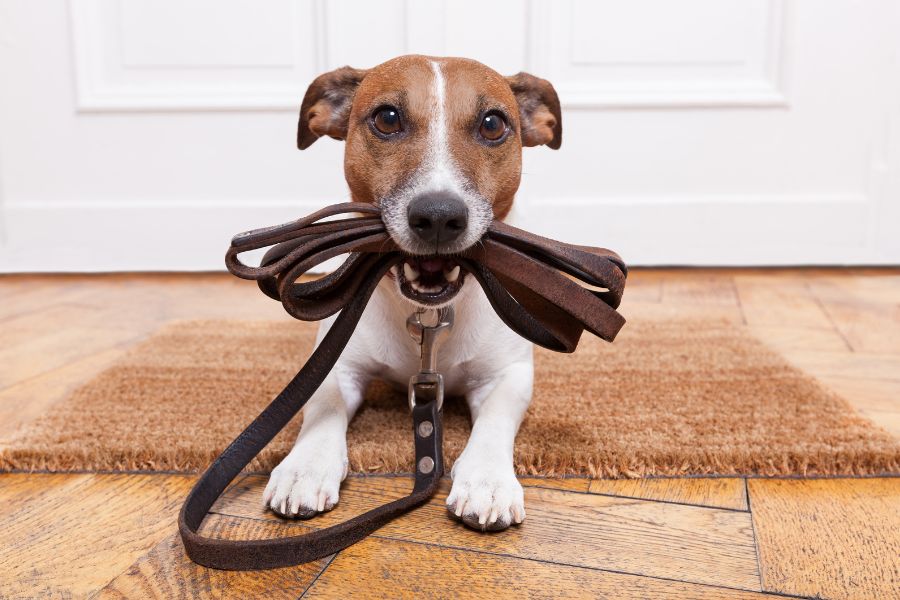
“Hey, do you see me? I’m here! It’s walk time! (But look at these humans, you always have to explain everything to them…)”
Leash: which one to choose?
Let’s move on now to the dog leash. On the market there are different types: let’s take an overview and see some tips to choose the best leash based on the needs of our little furry heart.
Fixed 150 centimetres
Classic 150 cm leash (the length required by law), made in different materials, from fabric to nylon, from metal chain to leather.
PRO: it is a leash that offers good control over the little furry one and can work well in narrow and crowded environments.
CONS: it could be too limiting and not guarantee the right room to manoeuvre, because it is not extendable. If the leash is made of rigid materials it can be complex to handle for petite people.
Adjustable 150-300 cm
The most widespread leash model, it can be lengthened and shortened as needed.
PRO: well calibrated, it respects the legal distance in public places (Here is the text in the Official Gazette)
CONS: sometimes not suitable for large sizes (managing a large dog with an adjustable leash requires a few more precautions; let’s remember that the distance the dog can cover corresponds to the run-up the dog could take if frightened or if prompted to react for the most varied reasons).
Flexi
Extendable leash up to ten metres with a locking mechanism.
PRO: useful for rescue dogs, who are not used to being close to humans, to get them used to the idea of the leash but without constraints.
CONS: not recommended for the dog’s urban life, because he can get confused and no longer understand at what distance he has to stay from humans and from his peers; moreover it can become dangerous if not handled correctly. If you want to allow the dog to “feel free”, the long line is preferable. For the dog, through the flexi leash, there is the perception of continuous tension, due precisely to the mechanism of “instant rewinding of the line”.
Long line
A line that reaches up to 20 metres.
PRO: it allows giving space without letting the little furry one loose, as we told in this article dedicated to dogs in the mountains.
CONS: it must be used only in environments where there is a lot of space.
In this case, if the choice falls on the fixed leash, the advice is to prefer a model made of elastic materials, which allow reducing weight and maintaining practical handling of the dog.
Let’s complete the list of available dog leashes with the hands-free one, a type that is used during sports activities such as Canicross and that is attached around the waist. This is a very particular leash solution, not suitable for everyday life.
Double leash: yes or no?
A much-debated issue is that of the double leash, that is, a single leash that splits into two ends when the little furry ones are two.
Is it a choice to consider? The pro is that when we have more dogs on a walk we can handle them with one hand only, but the con is that the single little heart may not have enough space available and may find himself “forced” by the other to take certain postures, to sniff certain places or to take certain directions… thus finding himself in fact limited in his freedom.
For this reason we feel we can recommend the use of two separate leashes, in order to guarantee the necessary space for each four-legged friend.
How to choose the leash?
In our opinion the choice of the leash must always be well thought out and, even better, the result of a discussion with a dog trainer, who can give the right advice on the type to choose.
Basically, let’s consider that the leash must offer:
- Safety for us and the dogs;
- Complete well-being during the walk
- The right freedom of movement depending on the space (public, natural, free, with restrictions…)
In this regard, let’s remember that there are very clear rules on how and where to take the dog on a leash.
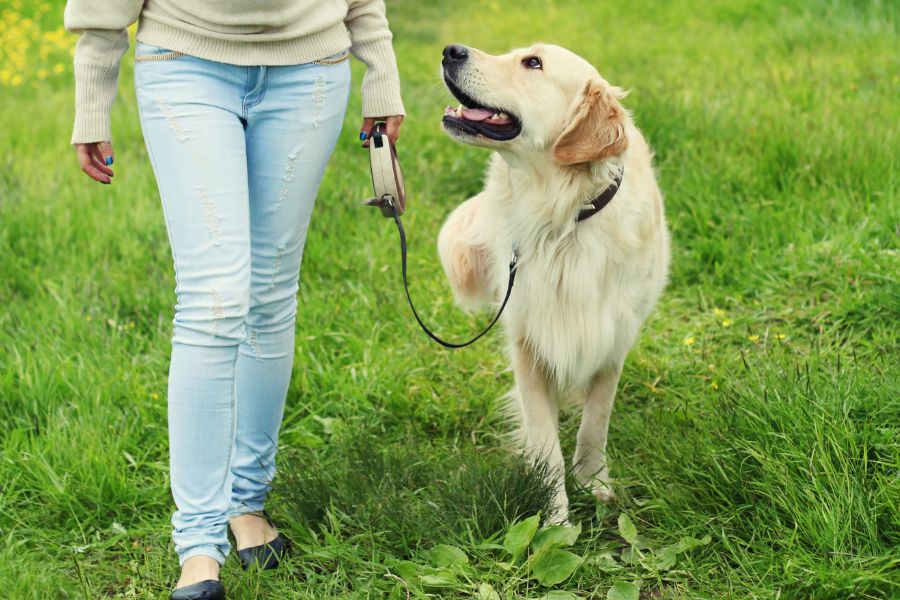
The leash is the tool that guarantees serene walks for everyone, so… let’s choose it with care!
Is the leash always mandatory?
To sum up, the leash must always be used in urban areas, on streets, on public transport, and it must not be longer than one and a half metres.
The leash may NOT be worn in common spaces, specific areas defined by municipalities (dog exercise areas or some beaches), and in natural areas such as open countryside or mountains.
Be careful though, because even in the mountains there are limitations, as we explained in this article.
But my little heart is good… he wouldn’t hurt a fly!
How many times have we, unfortunately, read and heard phrases like this, which lead people to let dogs loose even where they shouldn’t.
Every dog is the best and sweetest creature in the world for the pet mate, but this does not mean that the judgment is realistic.
There are, in fact, too many variables to consider when we are out walking, such as the behaviour of other dogs he may meet along the way, as well as people, especially children who are discovering the world and can hardly resist wagging little fluffy bundles…
Moreover, if the dog notices a possible danger (even if it is not really a danger, but for him at that moment it is) he may go into protection of the pet mate and, at that moment, react instinctively to defend him.
Whatever the dog’s character is, it is therefore essential to keep him on a leash in public places and this is a rule of well-being and safety for everyone, therefore it must be respected.
Beyond the fact that not using the leash when it is prescribed can lead to very steep fines (up to 250 euros), let’s remember that the dog can cause damage to things or people, even very serious, jeopardizing his and our future.
Today’s advice, therefore, is to always respect the rules! This decision, combined with the choice of the most suitable harness and leash for our furry love, can ensure great walks for everyone, both on the streets of metropolises and on enchanting mountain trails. And even if it’s raining outside, there are simple solutions to live the moment of the walk at best. Discover them here: dogs and rain, don’t give up the walk!
Article written with the consultancy of Chiara Festelli, Dog Educator.