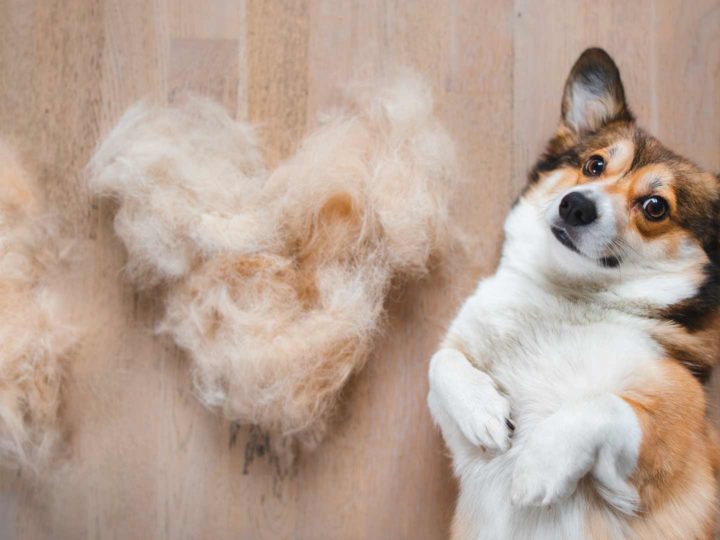
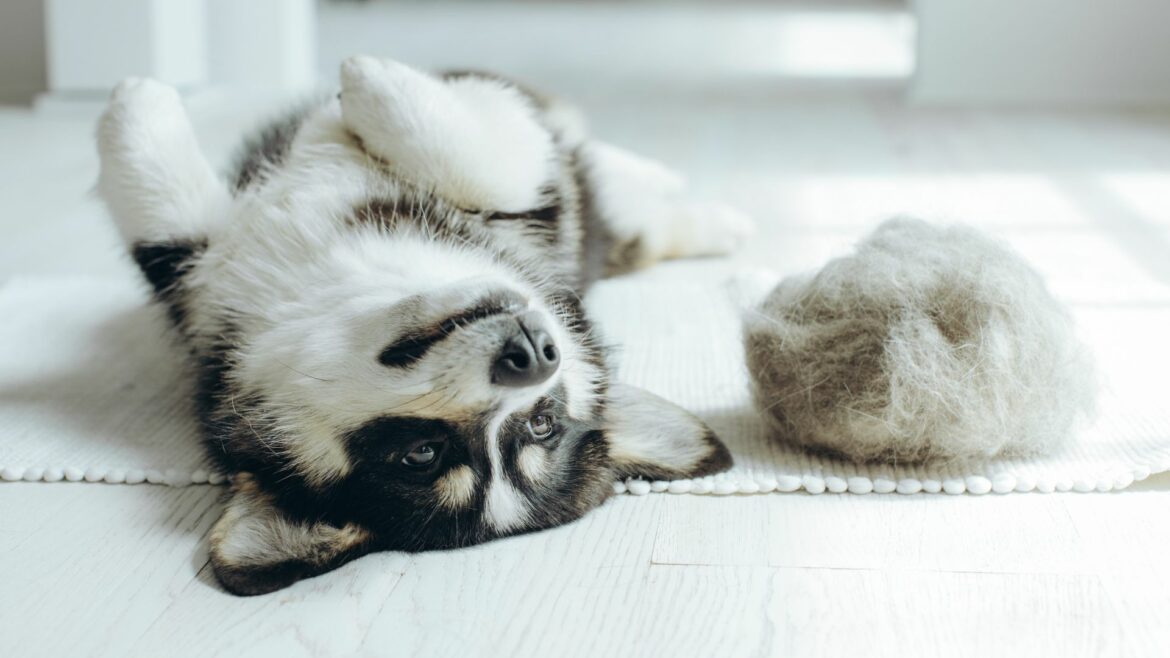
Ah, the dog’s shedding! We wake up one morning and something at home doesn’t add up: the floor is all covered with little hairs and the color of the dog bed (or the couch) has become very similar to that of our beloved pet…
What is happening?
The dogs’ shedding period has begun, indispensable for them, but often a bit demanding for us humans.
So let’s see what dog shedding is, why it happens at certain times of the year, whether it affects all the furry ones, and what to do to prevent this ‘boom’ in hair loss as much as possible.
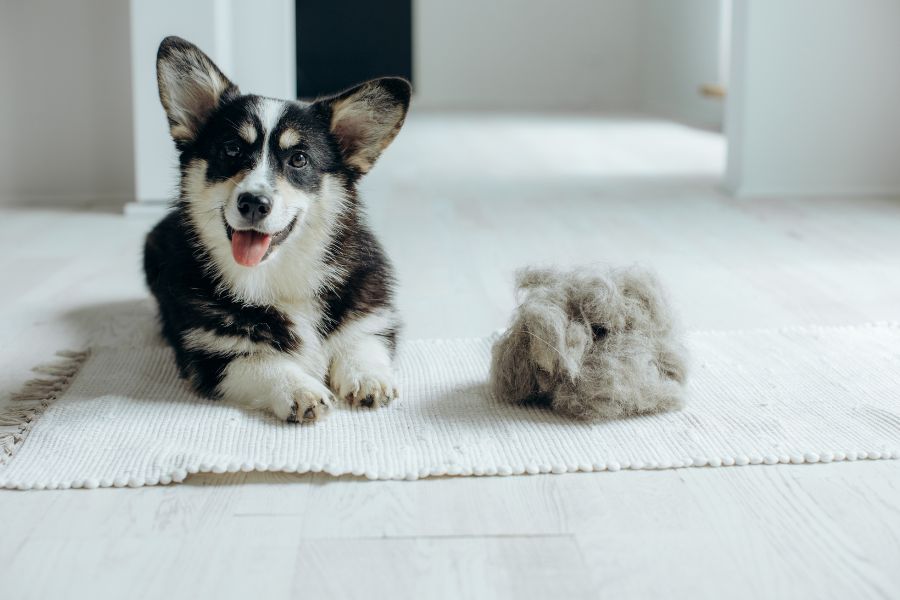
3, 2, 1… Rolling fur ball incominggggg!
What is dog shedding and why does it happen?
Dog shedding is a natural process by which the little sweethearts lose the undercoat to renew the coat.
The undercoat is a layer of soft, woolly hair found under the coat, and not all dogs have it (we will talk about it in more detail in a few lines).
What triggers shedding
What determines the loss of the summer hair and the growth of the winter one is not the lowering of temperatures, but rather the increase in the hours of darkness compared to the hours of light.
For this reason, the intensity and duration of the phenomenon can vary not only according to the breed – the very furry dogs have a longer shedding precisely because they lose more coat – but also in relation to the time the animal spends indoors or outside. A dog accustomed to living outdoors will in fact undergo a shorter and more intense shedding compared to one that spends a lot of time indoors, under artificial light that shortens the hours of darkness.
Generally, dog shedding has a duration ranging from 3 to 7 weeks.
When is the shedding period for dogs?
We can understand dog shedding as a sort of “change of season”, because it occurs mainly in two periods of the year, in spring and in autumn.
We recognize it right away when it arrives; it means just one thing: little balls of hair rolling all over the house floor!!
Spring shedding allows the dog to prepare for the arrival of summer: the heavier undercoat “gives” way to lighter, less full-bodied hair, so that the dog can stay cooler.
Autumn shedding in dogs, on the other hand, has the opposite purpose: to replace the light undercoat of the warm season with a thicker layer, a sort of “fur” that will protect our little sweetheart during the coldest months of the year.
Change of hair in the dog: the life cycle
Dog shedding, as has been seen, is therefore a predominantly seasonal process, which should not be confused with the natural replacement of the hair, which occurs all year round because the hair has a life cycle composed of three specific phases:
- Anagen: the phase in which the hair is born and grows;
- Catagen: the phase in which the hair has reached its length and “stops,” that is, it no longer grows;
- Telogen: the phase in which the hair dies, detaches from the follicle, and falls.
This process is natural and it is good that it occurs, because it shows that the dog is in good health.
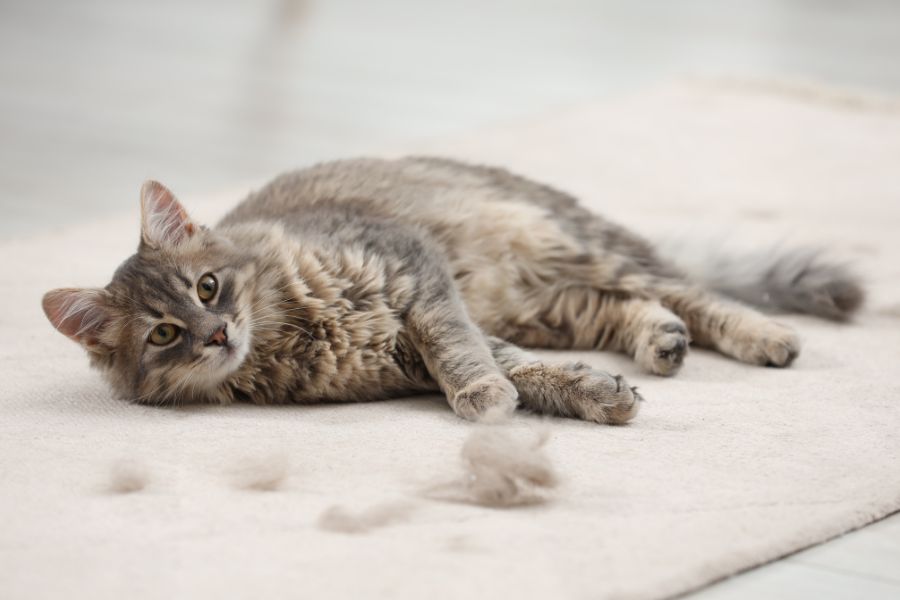
“I’m not shedding; I’m adding an animal-print design touch to the couch”
Does cat shedding work like dog shedding?
Yes, cat shedding follows the same principle as that of dogs: it is a process that happens twice a year, in spring and in autumn, to allow kitties to count on less and sparser fur in summer and on a nice protective fur coat in winter.
Which dogs shed?
Shedding is a process that concerns only dogs that have an undercoat.
How can we tell if our dog has an undercoat? As we explained in this article dedicated to the dog’s undercoat, move aside the main hair and take a quick look: if we see small, denser hairs that surround the primary hair, that is the undercoat.
Not all dogs have it, there are breeds in which the undercoat is very abundant, while in others it is absent.
For example, the Labrador, the German Shepherd and the Samoyed are dogs that have an undercoat and therefore shed, whereas little sweethearts like the Poodle, the Maltese and the Yorkshire do not have an undercoat and therefore do not shed.
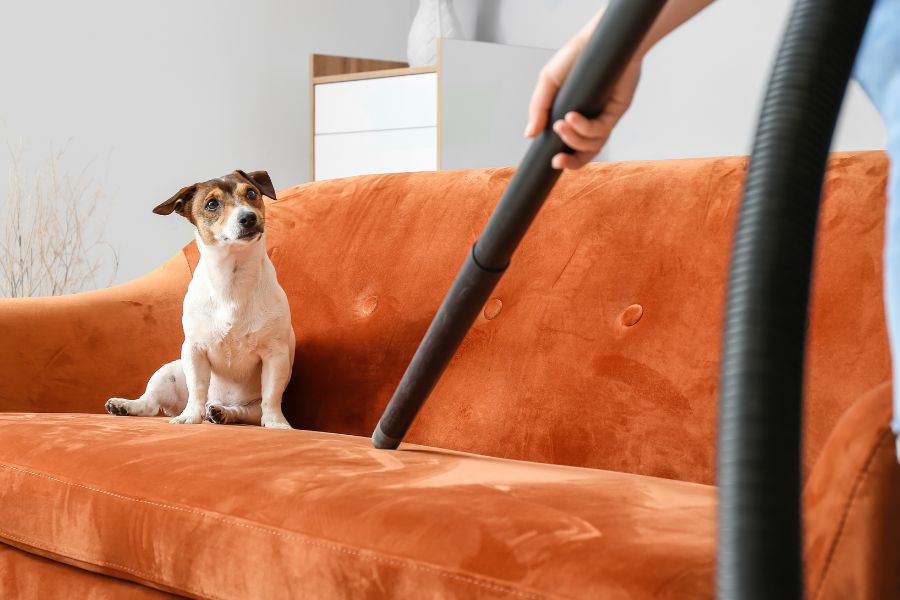
“Uh… let’s hope they don’t want to vacuum me too!”
Should we worry if the dog loses a lot of hair?
If we notice that the dog is losing hair in clumps and this worries us, when in doubt we ask our trusted veterinarian for an opinion.
Basically, the shedding process can be abnormal if the dog loses hair only in one or more spots, leaving the skin exposed. If the skin is visible, in fact, it may be alopecia and it is good to ask the veterinarian for advice.
If, on the other hand, the little sweetheart loses clumps of hair, even lighter than his primary hair and underneath there is new hair, then it is precisely shedding.
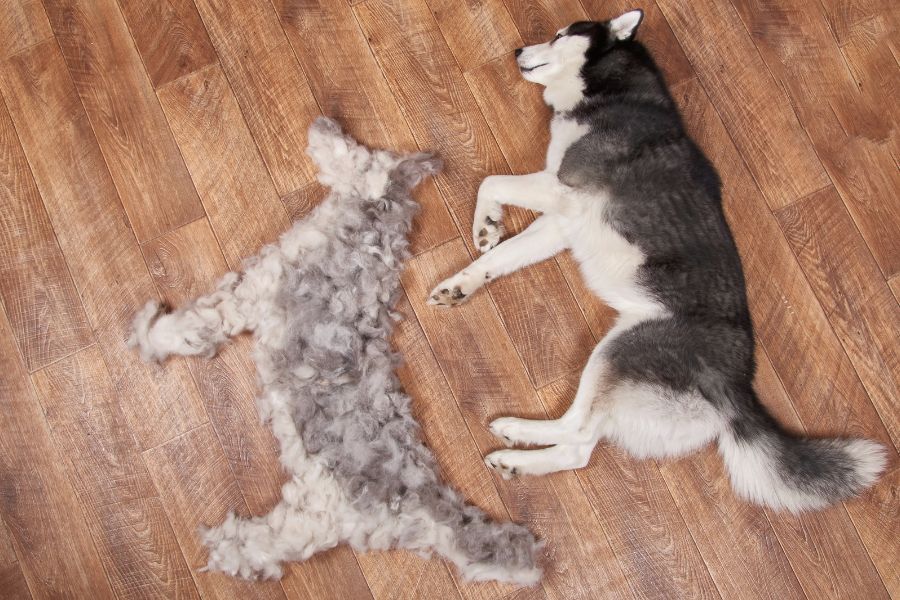
Find the differences!
How to avoid being flooded with hair during dogs’ shedding?
“Seems like having another dog in the house… quote.” — a typical phrase of despair after brushing in full shedding! 😊
First of all, if the dog is shedding, one absolutely must NOT clip it. Pets with hair and undercoat should not, in fact, be clipped, because this could risk damaging the coat, making growth uneven, and even forming areas without hair.
To manage dogs’ shedding as well as possible, it is important to take care of their coat, in particular the undercoat, not only when we are “at the last minute,” but with dedication all year round.
In what way? By taking care of their hygiene with suitable products, made with natural ingredients and respectful of skin and coat.
It is therefore indispensable to always brush the hair with care, so that knots or mats do not form. This contributes to their well-being and allows us to arrive at the shedding period with a strong, well-detangled coat.
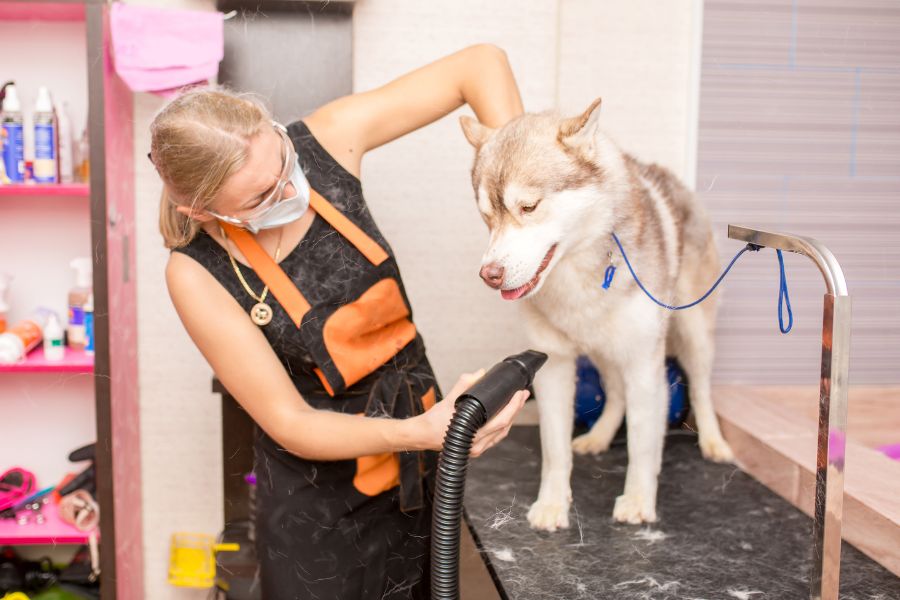
During the dog’s shedding, it is very important to take the furry friend to a trusted groomer.
3 tips to best manage dog shedding
Here are 3 simple tips to manage the dog’s shedding:
- Let’s keep an eye on climate change, the temperatures, and the first hairs on the floor: in this way we won’t suddenly find ourselves submerged by rolling fur all over the house, but we will be able to notice in advance the ‘outfit change’ of our little furry one. It would also be great to jot down, year by year, the exact period when shedding begins and ends, so we’ll know how to adjust for the following year;
- After a short time from the start of shedding we can take the furry friend to our trusted groomer who, thanks to a good blower, will help us empty the undercoat that is detaching from the coat. Then a nice scented bath can follow and, surely, our four-legged heart will come back to us lighter;
- A volumizing bath can help: yes, because a little bath with Volumizing Shampoo and Volumizing Mask and their special ingredients will help the undercoat to detach properly from the coat, giving volume and lightness to the coat of our four-legged friend.
Beyond these tips there is one last but no less important: to comb and brush our pet carefully:
- If the coat is knotted and brushing turns out difficult, let’s start with a wide-toothed comb, helping ourselves with specific natural products, such as Glossing and Detangling which, thanks to targeted ingredients with a detangling action, makes it easier to eliminate knots and mats;
- Let’s brush the pet frequently but without ever forcing, calmly and gently, preferably using tools that make the operation easier, such as our professional slicker Pink Brush, which goes deep and collects more fur;
- The fur cannot ‘molt’ all at the same moment, so if we see whole tufts sticking out, let’s not remove them by force, but let’s wait for them to come away while we brush and cuddle our little furry treasure.
These tips help to remove the dog’s excess dead hair without attacking the coat and skin and, above all, without stressing him.
We know that dogs’ shedding is a decidedly complicated phase to manage, because the hairs accumulate everywhere, from the couch to clothes, and they also have the superpower of flying… so we can find them in the most unexpected places in the house!
Let’s therefore try to pay attention to when it happens, so that we can adjust ourselves for the years to come; let’s rely on our trusted groomer and, at home, let’s make everything simpler by using targeted products and tools.
To conclude, let’s always try to maintain serenity, facing this moment for what it is: a phase in the little sweethearts’ life, indispensable for their well-being and their health.