- Why it is important to take care of the dog’s fur
- Normal fur vs continuously growing fur: the differences
- Why do some breeds have continuously growing fur?
- Dog breeds with and without undercoat: how to treat it
- Complete classification of canine coats
- How long does the dog’s fur take to grow?
- How to stimulate healthy fur growth
- 5 golden rules for coat care
- The right tools for fur care
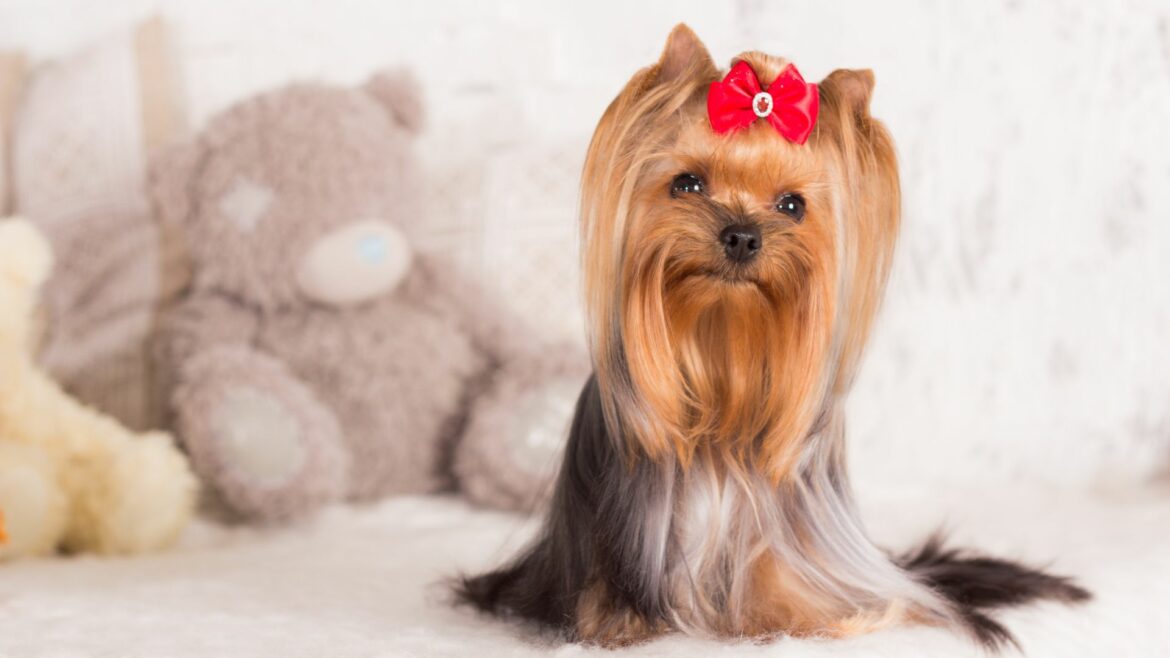
The beauty, uniqueness and health of dogs also pass through their coat. Every furry one has a combination of characteristics that makes his fur special and different from that of any other dog.
Structure, growth and care needs vary based on breed and individual characteristics. For this reason, in this guide you will find useful information to understand what type of fur your dog has and how to take care of it in a conscious and effective way.
The fur will be the absolute protagonist of this in-depth guide and we will answer some very common questions: why do some breeds have continuously growing fur while others follow different cycles? How much time is needed for the fur to grow? Which attentions help keep it strong, healthy and beautiful over time?
Why it is important to take care of the dog’s fur
To understand the value of coat care, it is useful to introduce the topic of the undercoat, a soft, dense and woolly secondary layer, located under the coat, with a fundamental function of thermoregulation. The undercoat helps the little heart maintain an adequate body temperature, especially during the colder periods.
Top coat and undercoat perform vital functions for the dog’s well-being.
- Protection: the coat protects the skin from the sun and from UVA and UVB rays, as well as from atmospheric agents such as cold and rain. It also represents a natural barrier against parasites and small traumas;
- Thermoregulation: the undercoat, when present, and the top coat collaborate in maintaining a balanced body temperature throughout the year;
- Social communication: the fur is considered a true sense organ, because appearance and odor participate in social and sexual interactions between dogs;
- Health indicator: as happens with human hair, strong and shiny fur reflects a condition of general well-being. A full-bodied, soft and luminous coat, with a pleasant odor and a balanced texture, represents a positive sign for the health of the little heart.
Daily care of the fur and skin allows us to observe any changes and to intervene with attention in the presence of parasites, nutritional deficiencies, allergies or systemic disorders.
When the fur appears dull, an important signal emerges that invites us to take care of general well-being, as we also explore in this article dedicated to how to make the dog’s fur shiny.
Normal fur vs continuously growing fur: the differences
Normal fur with undercoat
Normal fur with undercoat is also defined as bilayer and is composed of guard hair, the guard hairs, and the undercoat which, as we have seen, performs a function of skin protection and thermal insulation.
Here are its main characteristics:
- Defined growth: the fur grows up to a genetically established length and then stops;
- Shedding: shedding is that fundamental physiological process that allows little hearts to renew the coat through the loss of the undercoat. It generally happens twice a year, in spring and autumn, and has an indicative duration that goes from 3 to 7 weeks. In this article we have explored dog shedding and how to manage it in detail;
- Follicular cycle: shedding is part of the follicular cycle, which represents the natural renewal of the fur and takes place throughout the year.
The life cycle of the fur is composed of three phases:
- Anagen: phase in which the fur is born and grows;
- Catagen: phase in which the fur has reached its length and maintains a stable condition;
Telogen: final phase in which the fur completes its life cycle and detaches from the follicle.
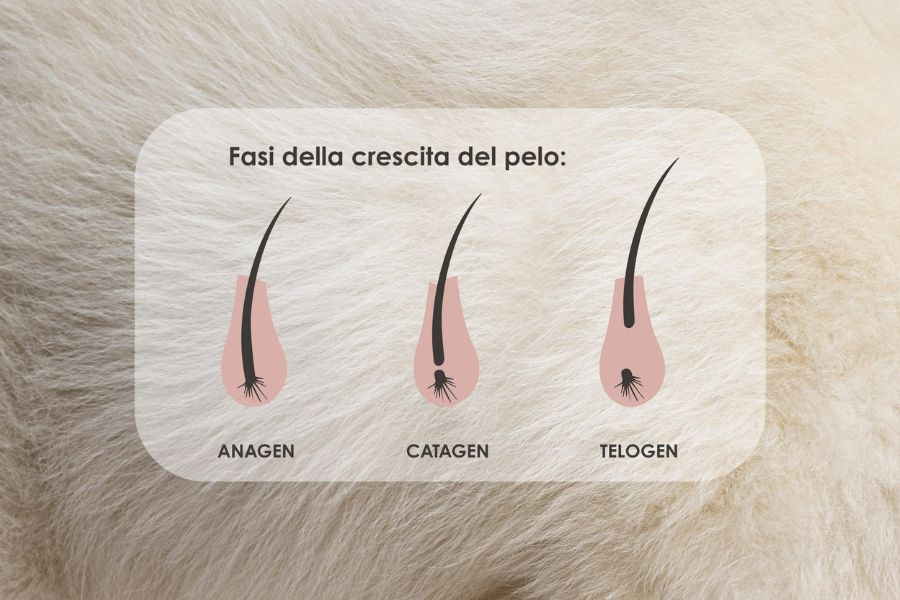
The three phases of fur growth: Anagen, Catagen, Telogen.
Continuously growing fur without undercoat
Continuously growing fur works in a similar way to human hair. It is a single-layer coat that follows a prolonged and constant growth cycle, with the possibility of lengthening over time.
Here are its main characteristics:
- Single-layer structure: the coat is mainly composed of guard hairs. In some breeds the undercoat is present in a reduced or almost nonexistent quantity. This structure favors continuous and progressive growth, a characteristic that makes grooming a fundamental practice. Cuts are usually carried out every 4–6 weeks, based on the speed of fur growth.
- Limited coat renewal: the fur follows a gradual and discreet renewal process. In little hearts that have a small amount of undercoat, the renewal is light and not very evident.
- Prolonged follicular cycle: the Anagen phase, in which the fur grows, can last several years. The Telogen phase, in which the fur completes its life cycle and detaches from the follicle, is short or not very marked.
A practical example helps to better understand the difference between the two types of coat. The Poodle has constantly growing fur and must benefit from regular cuts to keep the coat in balance. The Border Collie, instead, has fur that reaches a defined length and then naturally maintains its shape over time.
Attention! In this context, the reference concerns exclusively the cutting of the fur. Daily coat care and grooming at home represent precious and indispensable practices for every breed, regardless of the type of fur, because they contribute to the hygiene and general well-being of the little heart.
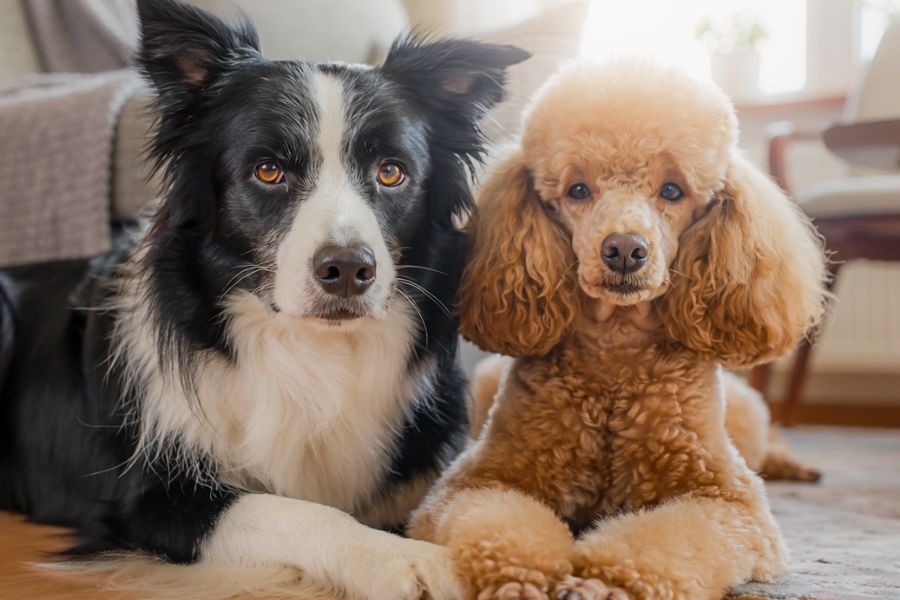
On the left: normal fur with undercoat (Border Collie). On the right: continuously growing fur without undercoat (Poodle).
Why do some breeds have continuously growing fur?
Let us start from the fact that dogs originate from majestic wolves, animals endowed with a thick coat and a rich undercoat.
According to several studies and also according to some international canine organizations, over time characteristics such as long coats and low fur loss have been favored, therefore more desirable because more manageable in the domestic life of dogs.
This can explain why today many dog breeds have a coat where the fur remains more in the Anagen phase (of growth), and less in the Telogen phase (of loss).
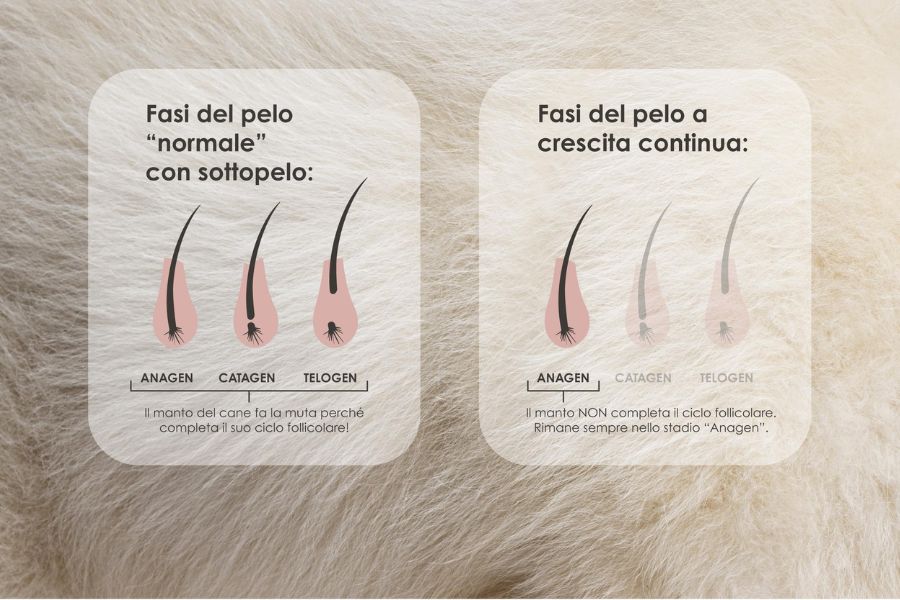
Continuously growing fur remains in the Anagen phase much longer than normal fur.
Dog breeds with and without undercoat: how to treat it
Dog breeds with undercoat
Here is how to correctly treat the fur of breeds with undercoat (Akita Inu and Siberian Husky, Border Collie, Cocker Spaniel, Jack Russell Terrier, Labrador and Golden Retriever, Australian Shepherd, German Shepherd, Pomeranian, Samoyed and West Highland White Terrier):
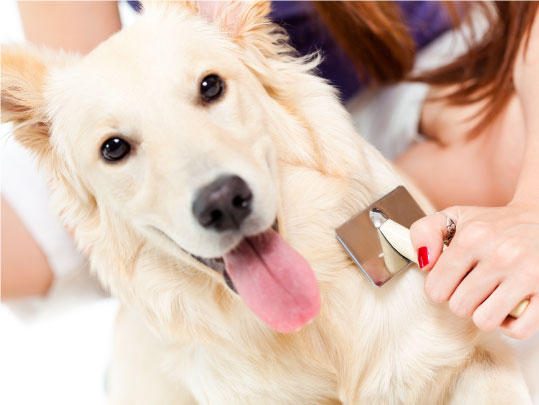
- Brush at least once a day (better twice) using quality tools such as slicker brushes or long-toothed combs that help remove dead fur without damaging the top coat. When the dog sheds, intensify brushing;
- Taking the dog to grooming in advance to prevent the acute phase of shedding can be a good solution, in this way large deposits of fur on the floor at home are avoided;
- Give targeted baths, without overdoing it (here you can find advice on how to wash the dog at home), using specific shampoos and conditioners for the color, length and texture of the coat;
- Dry the little heart thoroughly, with lukewarm air and brushing during drying;
- The question is: grooming yes or no for dogs with undercoat? Even though these furry ones have fur that grows up to a certain point, grooming is more than recommended.
Moreover, for convenience, we are now dividing between dog breeds with undercoat and dog breeds without undercoat, but some breeds are “debated” because they have varied coats and are not clearly without undercoat.
Let us remember that grooming is a true hygiene and beauty treatment, which is good for all little hearts, regardless of their type of fur.
Dog breeds with continuously growing fur
And here, instead, is how to treat dog breeds with continuously growing fur (Poodle and Toy Poodle, Lagotto Romagnolo, Maltese, Shih Tzu, Yorkshire Terrier).
- Brush the little heart daily, with the use of high-quality tools;
- Give the bath with specific products to remove dirt and excess sebum. Prefer products suitable for the characteristics of the coat (color, length, texture);
- Dry carefully, also because growing fur can more easily retain moisture;
Regularly cut the fur to ensure comfort and hygiene. Dog breeds with fur that continues to grow are more subject to knots and mats (if the fur is medium or long) and shortening it also helps to maintain a tidy and functional shape, but also to prevent knots and mats from forming (more frequent if the coat is medium, long and especially curly);
Complete classification of canine coats
In addition to structure (with/without undercoat), coats are classified by length and texture:
By length:
Very short coat (less than 1 cm):
- Very short fur with continuous renewal, typical of breeds such as Dobermann, Boxer, Dalmatian, Pinscher, should be brushed 2-3 times a week with quality tools;
- The bath can be done once every two-three months, but much depends on the dog’s habits (if, for example, he gets very dirty, an extra bath is ideal, without ever exaggerating so as not to weaken coat and skin).
Short coat (1-3 cm):
- It is often dense fur, typical of breeds such as the German Shepherd, and should be brushed at least two-three times a week, preferably with a short-toothed comb;
- The bath can be done once every two months but, also in this case, it depends on the habits of the little heart.
Medium coat (3-7 cm)
- It can be smooth or wavy, often associated with the undercoat and shedding, typical of Australian Shepherd, Cocker Spaniel and Bernese Mountain Dog, and should be brushed at least 3 times a week and every day if there is shedding;
- The bath can be done once a month, unless the furry one gets dirty before.
Long coat (over 7 cm):
- Typical of breeds such as the Afghan Hound, it can be with or without undercoat and requires mandatory daily brushing;
- The bath can be done once a month and here you can find an article on how to best treat the long-haired dog.
By growth
Continuous
- Typical of breeds such as Poodle, Maltese and Shih Tzu, it requires mandatory daily brushing;
- The bath can be done once a month.
Non-continuous
- Typical of breeds such as Husky, German Shepherd and Setter, it requires frequent brushing, at least three times a week:
- he bath can be done every 40-60 days, unless there are needs that require more frequent baths.
By texture:
- Smooth: therefore straight without waves, like the Beagle or the Fox Terrier;
- Wavy: with light waves, like the adorable Cocker Spaniel;
- Curly: with curls that can be more or less tight, typical of breeds such as Poodle or Lagotto. If you want to explore further, here you can find an article dedicated to curly-haired dogs and how to take care of their fur;
- Rough: bristly to the touch, like that of the Schnauzer and the Fox Terrier.
Every fur has his needs and, as seen, there can truly be many combinations, therefore long fur and undercoat, short and bristly fur, shedding or no shedding…
In any case, it is always useful to ask the trusted groomer for advice, who will be able to give precise indications on the type of fur and on the frequency of brushing and grooming.
At home, brushing and bathing always deserve to be done with quality and easy-to-grip tools and products suitable for the characteristics of the coat, therefore length, type (smooth or curly), but also color, to safeguard the health and beauty of the fur as much as possible.
How long does the dog’s fur take to grow?
If we ask ourselves how long it takes for the dog’s fur to grow, there is no single answer, because the period of fur regrowth varies by breed, by individual factors and also by type of coat.
In general terms, the regrowth times of the coat with undercoat are 4-6 weeks, but in most breeds with undercoat the coat should not really be cut, because it grows up to a certain point and then stops.
In dogs with continuously growing fur, regrowth is visible in 2-4 weeks and, after the cut, can be defined as complete from 6 up to 10 weeks, which is why it is important to cut it regularly.
And the growth of the dog’s fur after shaving? It depends on the breed and on the dog’s characteristics, but if we base ourselves on the typical times of fur regrowth, it is about 6-7 weeks.
Up to what age does the dog’s fur grow? Generally, the fur structures itself from 6 to 12 months of the little heart’s life, but for some breeds (especially large ones) a few more months may be needed.
How to stimulate healthy fur growth
There are factors that influence fur growth:
- Breed and genetics;
- Age, in puppies the fur grows faster;
- State of health, because illnesses or stress can affect the growth and loss of fur;
- Nutrition, because a balanced diet helps maintain a proper renewal;
- Care and love, because if we brush him, wash him and groom him correctly, we contribute to stimulating the proper life cycle of the fur and to keeping the coat always strong, healthy and beautiful.
Many people wonder how to make the dog’s fur grow and the answer lies, therefore, in correct coat management, in controlled and balanced nutrition and in the daily check of the fur, which allows any anomalies that could slow down its growth to be identified.
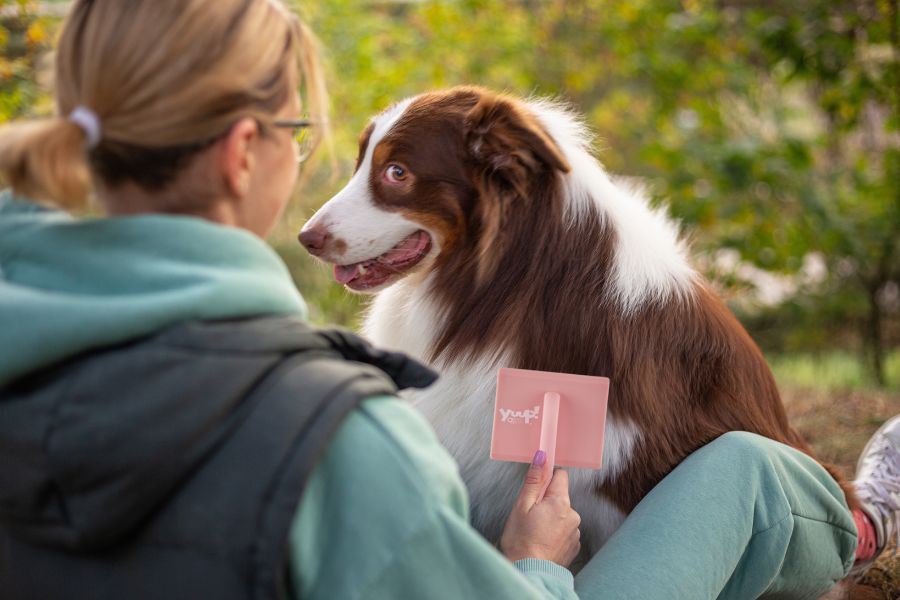
Regular brushing keeps the fur healthy and stimulates skin circulation.
5 golden rules for coat care
Taking care of the dog’s fur is truly an obligation, his health depends on it! Let us therefore summarize 5 universal rules to follow to do it in the best way:
1. Identify the structure and type of fur: with or without undercoat? Length? Texture? It is important to define what type of fur the dog has in the most detailed way possible, because this way his needs can be understood in the best way;
2. Pay attention to shaving, it negatively affects his health, given the thermoregulatory function of the fur;
3. If the fur is continuously growing, let us consider that cutting the fur must be done with the right frequency, which varies based on the breed and also on the uniqueness of the little heart;
4. If the fur is medium-long, the brushing frequency must be higher;
5. Daily check: the fur is the mirror of the dog’s health, therefore it must be checked constantly. If it appears worn, weakened, dull or even problematic (perhaps reddened skin or abnormal fur loss), it is very important to ask the trusted veterinarian for advice.
The right tools for fur care
Yuup! slicker brushes and brushes
To brush and comb the dog in the best way, it is important to be able to have tools available that know how to do their job well and that are comfortable and easy to grip.
These are the characteristics of Yuup! slicker brushes, brushes and combs:
- The slicker brushes are ideal to use for the top coat and in particular for the undercoat;
- The brushes are suitable for all breeds;
- The palm brush works very well on short and sparse coats;
- The combs with wide and narrow teeth (in the Yuup! models you find wide teeth on one side and narrow ones on the other for greater versatility and precision) are control tools for identifying knots to then loosen with the PinkBrush slicker brush;
- De-shedders and rakes are professional tools that allow the downy fur to be removed and thick coats to be thinned.
Bath and care products:
In addition to professional tools for home use and for grooming salons, the products for the little heart’s bath are the basis of caring for his fur:
- Specific shampoos and conditioners for type of fur;
- Detangling sprays that make brushing easier and also help to loosen knots and mats;
- Restructuring serums with Quaternized Keratin, a component that deeply nourishes and hydrates the fur.
Yes indeed, today we have seen that the dog’s fur is a fascinating world that deserves attention and awareness, because his condition tells a lot about the general well-being of the little heart.
Accurate care passes through daily gestures, suitable tools and carefully chosen products and, if you want to explore further, in this article you will find practical advice on how to choose the shampoo for the dog, a precious ally in the coat care routine.