- What is the passport for dogs (PET Passport)
- When the dog passport is needed
- How to get a passport for the dog: step-by-step procedure
- Where to request the passport for dogs
- Procedures to get the dog passport: all the steps
- How much does the passport for the dog cost?
- Duration and renewal of the passport
- Echinococcus treatment: when it is mandatory
- Traveling outside the EU with the dog: what changes
- What happens if I travel without the dog passport
The destination is decided, the suitcases are almost ready and you cannot wait to enjoy the holidays with your four-legged heart? What joy! But, if you have chosen a destination outside Italy, pay attention: to travel, it is mandatory to have a passport for dogs.
Before starting this guide to the dog passport, it is necessary to consider that not all dogs can travel, meaning there are breeds, such as for example some molossers or wolfdogs or shepherds, for which it is forbidden to travel to EU and also non-EU countries. For example, Pit Bull Terriers, American Staffordshire Terriers, Staffordshire Bull Terriers and Bull Terriers cannot enter Germany.
This is only an example, therefore the advice is to always check whether your four-legged heart can leave national borders. Moreover, if you travel by plane, train or ship, check how you must organize the journey (seat, hold…) based on the dog’s breed and age. You can find the information on the websites of the transport companies.
If you still know little about it, have never heard of it or have some doubts about the passport for the dog, no problem: today we will see together what the passport for dogs is and why, if you travel to non-EU countries, you may need additional documents or have to comply with specific requirements, which vary from state to state.
The excellent news is that obtaining a passport for the dog is simpler than you might imagine. So let us see when it is needed to travel in Europe and which documents are required for non-EU countries, how much it costs to request it, where to do it, how many animals can be transported and what the waiting times are.
This way you can have everything clear, arrange the documents and think about the most important thing, which is enjoying the holidays with your furry friend!
A small clarification before starting: in this guide we mainly refer to the dog passport, but the document is also required for cats and ferrets, which are considered companion animals.
What is the passport for dogs (PET Passport)
To travel to EU countries and also outside the European Union, furry ones must have an accompanying document called a pet passport. We call it the dog passport but, as seen, it is also the cat passport and the ferret passport!
It is, therefore, a passport for companion animals and it is a non-commercial document, in the sense that it is needed for furry ones who travel and return home, not for those who travel for sale or exchange.
The maximum number of animals with whom one can travel is five. Once this number is exceeded, it becomes commerce (with all its rules), unless it is demonstrated that they are participating in exhibitions or competitions. In any case, even in this situation, they must be over six months old.
Clarifications aside, without the passport one cannot travel around the world, because it is needed to identify the pet, but also to demonstrate that he has the “credentials” to be able to do so, meaning that he is recognizable and has undergone the mandatory vaccinations to travel around the globe.
If we think about it, it is a bit the same as what happens with us humans who, to move around, need an identity card within the European Union and a passport for other states. Moreover, the Ministries of Health recommend vaccinations for some countries that are travel destinations.
That said, it is important to distinguish the dog passport from the health booklet, because they are two separate documents.
The health booklet is an “internal” document for Italy that is not valid for travel abroad and contains:
- the furry one’s personal data, therefore name, breed, date of birth, even estimated, sex, coat characteristics and any distinguishing marks, microchip code and any pedigree code;
- the pet mate’s data, therefore name and surname, residence and telephone and email contacts;
- the little heart’s medical-health history, therefore the vaccinations done with the dates and boosters, official stickers are usually applied, the antiparasitic treatments that have been done, clinical visits and exams.
Basically, the health booklet can be filled in in more or less detailed ways but, essentially, it photographs the history of the dog, as well as of the cat and the ferret, from the point of view of his health history.
The dog passport, instead, contains:
- the owner’s personal data;
- the description of the pet, with optional photo, name, species, breed, sex, date of birth, even presumed, and coat characteristics, with color and type;
- the pet’s identification data, therefore microchip number with implantation date and location, tattoo number with date;
- the data on the rabies vaccination, which is mandatory for travel, therefore the vaccine specifications, name, manufacturer, batch, vaccination date, validity and authorized veterinarian with stamp and signature;
- the data of the rabies serological test with declaration by the authorized veterinarian, official test results, sample taken, date and other specifications. Moreover, there are data to be entered in case of new tests;
- the data on the treatment against ticks, with the specifications of the product used;
- the data on the possible treatment against echinococcus, a specific parasitic infection;
- the data on the other vaccinations;
- the clinical examination of the pet, with the declaration that the animal is in good health conditions and can face transport to the destination;
- the legalization with date, stamp, seal and signature;
- any other data.
The international health certificate, instead, is the document that the pet needs to travel to non-EU countries and is more specific and variable. Why variable? Because it depends on the state that will be visited.
The Ministry of Health, which is the reference for information on pet passports, specifies that it is fundamental to verify the requirements requested by the countries that are travel destinations, asking the ASL (Local Health Authorities) for information and possibly also the embassies.
In fact, there is no single model of international health certificate, because each state has different rules and requires, for example, additional mandatory vaccinations.
If the dog passport can be understood as a European identity card that lasts a lifetime and is updated at every journey, the international health certificate is a “time-limited” document, a sort of health visa limited to the period of the journey.

The dog passport is needed to travel to any country other than Italy.
When the dog passport is needed
When it comes to traveling abroad with the dog, cat or ferret, the answer is always! The passport for dogs, in fact, is a mandatory document to enter any country that is part or not part of the European Union.
Does anything change if you go by car, by train or by plane, or perhaps by boat? No, the passport must be there regardless of the means you use to travel. In this regard, here you can find our tips on how to travel with the dog by car, train or plane.
And is the pet passport also needed if I stop for only one night? Oh yes, the passport is mandatory for short trips or trips of just a few days, not only for long holidays.

The pet passport is not only needed for the dog, it is also mandatory for cats and ferrets.
How to get a passport for the dog: step-by-step procedure
Documents and necessary requirements
Let us begin by seeing which documents and requirements are needed to obtain the dog passport, but first an important clarification: the passport is issued by the veterinary services of the Local Health Authority (ASL/ULSS) with territorial competence, therefore where the pet mate resides.
Therefore, it is very important to refer to the information that the reference ASL provides regarding the issuing.
The first thing to do, therefore, is to visit the portal of the Local Health Authority and check.
Can it happen that there is no precise information on the web? Yes, it happens and at that point it is better to make a phone call to understand which documents and requirements are needed.
In general, the documents and requirements needed to obtain the pet passport are:
- the certificate of registration of the dog (or cat or ferret) with the Registry of Companion Animals, which is attested through the microchip. Let us remember that the microchip is mandatory for all dogs in Italy and must be applied before requesting the passport, as explained in our guide on registration with the canine registry and the costs of managing a dog;
- the attestation of rabies vaccination, carried out at least 21 days ago and no more than 12 months ago;
- the possible attestation of the rabies serological test;
- the certificate of good health of the animal issued by the veterinarian;
- the photocopy of the pet mate’s identity document and tax code.
Some ASLs may ask to bring the animal to verify the microchip, while others accept only the certificate from the treating veterinarian.
To get straight to the point and save time and energy, it is therefore recommended to check the list of documents required by one’s competent ASL and also verify whether it is necessary to bring the furry one along when requesting the passport.
Where to request the passport for dogs
The request must be submitted to the Veterinary Service of the territorially competent ASL or ULSS, that is, the one where the animal is registered.
Can the dog passport be done online? The answer is no, it is necessary to go in person with all the documents and, as seen, also with the furry little heart if required by the competent ASL, because only in this way can they check his microchip.
Procedures to get the dog passport: all the steps
To save time and get straight to the point, let us immediately clarify what the three concrete steps are to have the dog passport. Then in this guide you will find timings and details:
- First of all, immediately do the rabies vaccination because 21 days must pass from the vaccination date in order to be able to leave. Attention: some countries require the rabies serological test (the blood test that verifies the effectiveness of the vaccine), for this reason the rabies vaccine is the very first thing to do to obtain the dog passport;
- At the same time, it is absolutely necessary to check that the furry one has a microchip or tattoo (meaning he is registered with the canine registry) and is up to date with all the mandatory basic vaccinations. If he is not, everything must be put in order;
- Important: the Istituto Zooprofilattico Sperimentale delle Tre Venezie underlines that the administration of the rabies vaccine must not take place before the application of the microchip, therefore, if the microchip is missing, doing it is the first step to take.
- Secondly, it is good to make an appointment by phone with the local reference ASL/ULSS to book the issuing of the passport. This step is not to be taken for granted because the availability of places and times may be scarce and require organizing oneself with work and personal commitments but, above all, require more time than expected if there are no free slots in the short term.
- The procedure takes little time, about 20 minutes, but the point is to allow enough time for the preventive steps.
How long does it take to get the dog passport?
As seen, the issuing of the dog passport is immediate, but only if all the documentation is in order and, above all, if the four-legged little heart has a microchip and has followed the necessary vaccination cycle.
If this is not the case, additional time must be calculated. In particular:
- if the dog is not yet vaccinated against rabies, it is necessary to wait at least 21 days from the inoculation of the vaccine, because only after this period of time is it considered valid;
- if the serum is needed (rabies antibody titration), consider that this test must be done no earlier than 30 days after the rabies vaccination and, above all, it is necessary to wait 90 days before being able to enter the country that requested it;
- if the dog is not vaccinated against diseases defined by some non-EU states, it is necessary to verify the required timings;
- and, naturally, if the companion animal does not have the chip, it is necessary to consider the time needed to do it, which is the priority because the rabies vaccination must be done after the application of the microchip.
Estimating a standard time is not possible, but the advice is to proceed as soon as possible if the idea of a lovely trip with our pet is in the air.
The advice is to allow enough time, also because we cannot know the timings of the ASLs regarding the appointment to make the pet passport.
Better, therefore, to immediately verify the documents and procedures that are needed and make an appointment in time, so as to be certain of being able to obtain the document before the date of the trip.
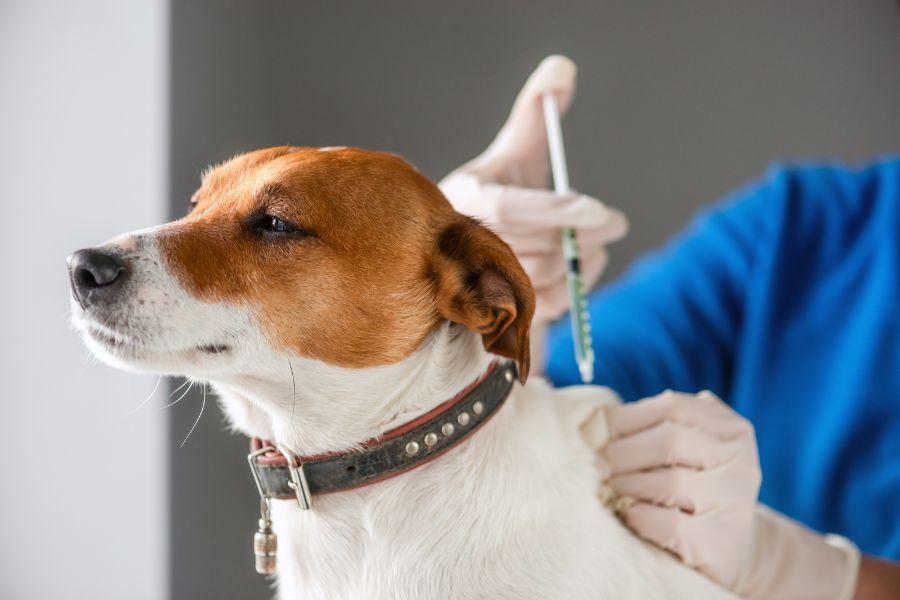
For the dog passport, it is fundamental to consider the rabies vaccination and, for some countries, antibody titration, which is also essential to re-enter the EU from some foreign countries.
How much does the passport for the dog cost?
The cost of the dog passport varies based on the competent ASL and we are talking about an amount between 10 euros and 15 euros, but only if everything is in order, meaning the dog has the chip and has followed the mandatory vaccination cycles.
If this is not the case, additional expenses must be taken into account. We list them with average figures, which may vary from case to case.
- cost of the microchip, from 20 euros to 50 euros, including registration with the Canine Registry;
- rabies vaccination, from 30 euros to 70 euros. This cost varies greatly depending on the veterinarian;
- possible serological test that certifies that the vaccine has been done and is circulating, from 50 to 80 euros but variable depending on the reference veterinarian and the analysis laboratory;
- possible treatment for echinococcus, mandatory in some countries, even European ones, variable based on the dog’s weight, because it is a medicine that must be given a certain amount of time before departure. Usually, it is a medicine with a cost of around 35-40 euros;
- any vaccinations needed to travel to non-EU countries. The cost varies based on the type;
- the payment slip for issuing the passport which, as seen, varies and is estimated between 10 euros and 15 euros.
Duration and renewal of the passport
How long does the dog passport last? As far as the European passport is concerned, there is no expiration date, but attention, because the vaccines that have been registered do expire.
This is why the passport has many boxes that must be filled in with vaccine boosters. Usually the adhesive label of the vaccine used is attached and this is what makes it valid for travel.
Updating the dog passport therefore means proceeding with the vaccine boosters and with the medicines needed to travel whenever necessary. Therefore, it is not necessary to go to the ASL, but only to one’s own veterinarian.
If, instead, the dog passport is completely missing, then it is necessary to follow the procedure at the local ASL that we have described.
When is a new dog passport needed? When it is lost or the document is so deteriorated that it is no longer readable or consultable.
The matter is different for traveling to non-European countries. In this case, the International Health Certificate is needed and this document usually has a duration limited to the journey, meaning it must be redone every time one goes to visit a non-EU country, especially if it is different from the previous one, because the rules vary from country to country.
Echinococcus treatment: when it is mandatory
Echinococcus is tapeworm, a very dangerous parasite that can be eradicated with specific medicines. Some foreign countries require preventive action, meaning that the dog must follow an antiparasitic treatment before entering their borders.
In Europe, this is the case for the UK, Ireland, Finland, Malta and Norway. In these cases, the treatment must be carried out between 24 and 120 hours before entering the country.
Attention, it is necessary to consult the trusted veterinarian to choose the medicine suitable for one’s furry little heart, respect the timings, apply the sticker certifying that the prophylaxis has been carried out on the passport and, above all, monitor over time whether there are other countries that have chosen to include this practice to allow dogs to enter.
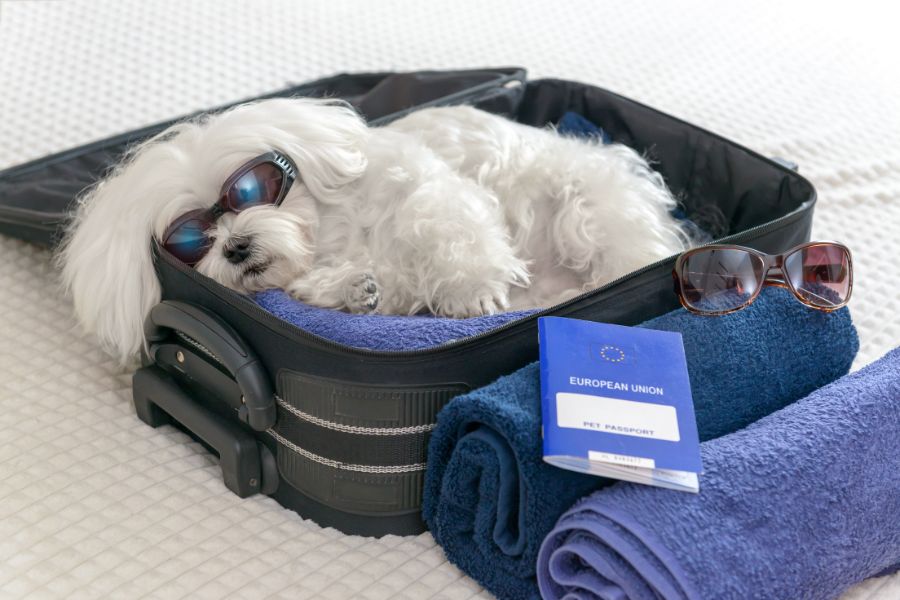
The dog’s passport is valid forever, but it must be updated with vaccinations and any prophylactic treatments required by the countries we will visit with our four-legged friend.
Traveling outside the EU with the dog: what changes
For non-EU countries, the European passport is not sufficient. The International Health Certificate is needed, issued by the official veterinarian of the local ASL.
Some non-EU states require further actions and documents, such as:
- Rabies antibody titration, a blood test that measures antibodies, meaning the degree of protection against rabies. This test is not required for EU countries, but it is, for example, to go to the UK, the USA and Canada. It must be done no earlier than 30 days after the rabies vaccination and, above all, it is necessary to wait 90 days before being able to enter the country that requested it. Therefore, it is good to allow enough time if you know that this test is mandatory. Better to plan six months in advance to be sure of having enough time;
- If you travel beyond European borders with the furry one, re-entry into the European Union is subject to health checks. For all travelers returning from third countries that are not included in the list of low-risk territories, the law imposes the obligation to present the titration test that certifies the effectiveness of the rabies vaccination. How to verify the status of the destination country? It is necessary to consult the official list of exempt territories (indicated in Annex II of EU Regulation 577/2013 in the “Traveling with animals” section of the Ministry of Health or European Commission website). In any case, to avoid the worst-case scenario, meaning having to wait before returning, the safest strategy remains to have the titration carried out in Italy before leaving and to register the valid result directly on the animal’s European passport.
- Any other mandatory vaccinations in certain countries, such as, for example, Distemper, Infectious Hepatitis, Parvovirus, Leptospirosis and Bordetella/Parainfluenza. To know them, it is necessary to get information on the requests of the country and define the times needed. Attention also if there is a plan to move from state to state or country to country, perhaps during a long journey that involves going first to Japan and then to Australia, because these countries may require complementary vaccinations and prophylaxis that must be done before leaving.
What happens if I travel without the dog passport
One must never travel without the passport of the dog or other companion animals, both because it is good to respect the rules and because the consequences can be disastrous.
In fact, one risks receiving a refusal of entry and not being able to enter the country, but also having to submit the animal to quarantine at one’s own expense and to immediate repatriation.
To all this, monetary sanctions, meaning fines, may be added for the pet mate. Better, therefore, to respect the rules and have all the documents in order, so as to be able to travel peacefully with our furry friends.
Good, if now the passport is ready, all that remains is to choose where to go! If you have already chosen your destination, all that remains for us is to wish you magical adventures with your furry ones. If, instead, you are looking for inspiration, you can choose mountain hikes with the dog or bicycle trips together with your pet.
Pet-friendly experiences are not lacking and they will all be opportunities to spend time with your four-legged heart, have fun, enjoy the company and the landscapes… and return home with the passport full of stamps and the heart full of memories!